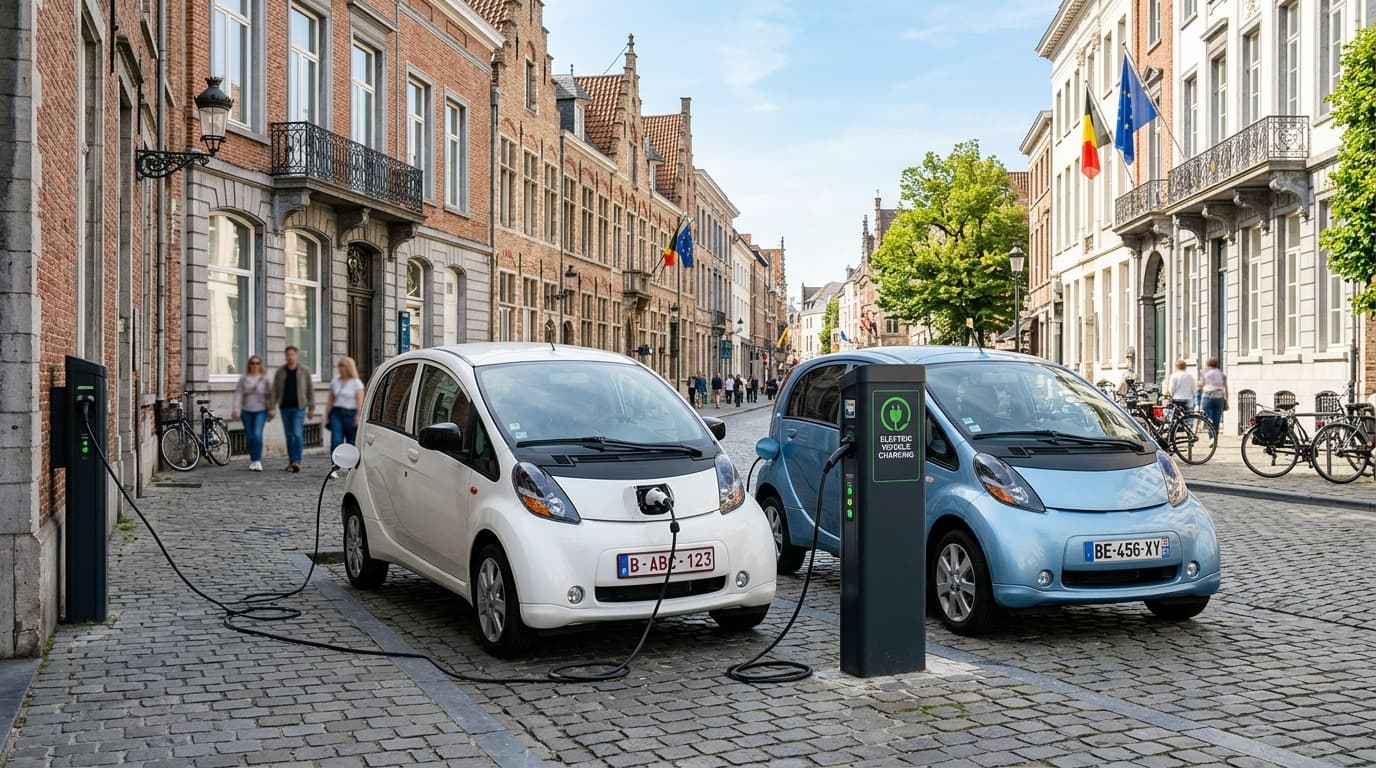
The Citroën ë-C3 and the Renault 5 E-Tech chase the same Belgian buyer: a small electric car under €25,000 you can use every day. The ë-C3 wins on price and comfort, the Renault 5 on long range and driving pleasure. Your daily commute settles this better than any spec sheet.
Renault 5 or Citroën ë-C3: which to choose?
Take the ë-C3 if you drive mostly in town on a tight budget, the Renault 5 E-Tech in 52 kWh form if the motorway comes round every week. Below 60 km a day, the price gap matters more than the range gap.
Both cars answer the same question with two different philosophies. Citroën built the ë-C3 around cost: a single 44 kWh battery, a slightly raised body, and hydraulic-stop suspension that soaks up Brussels cobbles. Renault did the opposite — a dedicated platform, two battery sizes, noticeably more consistent road manners, and a premium to pay up front.
So what does that look like day to day? On urban trips of 20 to 40 km, both do the job effortlessly and you only charge twice a week. Add 60 km of motorway a day and the 52 kWh Renault 5 saves you from recalculating your week every Monday morning. That, and nothing else, is what its extra €4,000 buys.
| Model | Battery | WLTP range | Boot | Rapid charging | Starting price (Belgium, 2026) |
|---|---|---|---|---|---|
| Citroën ë-C3 | 44 kWh | 320 km | 310 L | 100 kW | from ~€23,300 |
| Renault 5 E-Tech (40 kWh) | 40 kWh | 312 km | 326 L | 80 kW | from ~€24,990 |
| Renault 5 E-Tech (52 kWh) | 52 kWh | 410 km | 326 L | 100 kW | from ~€28,000 |
Belgian prices shift with trims and current promotions. Le Moniteur Automobile publishes up-to-date list prices, worth cross-checking against your dealer's offer.
What real range do they deliver in Belgium, summer and winter?
On paper, the ë-C3 (320 km) and the 40 kWh Renault 5 (312 km) are level. In a Belgian winter, both lose 25 to 35 % and drop to around 210-240 real kilometres. Only the 52 kWh Renault 5 stays above 280 km.
The WLTP figure is measured in mild conditions, which Belgium offers about four months a year. Once the thermometer falls below 5 °C, cabin heating and a cold battery eat into range. Add 120 km/h on the E40 or the E411 and a small EV's efficiency drops further: a city car's aerodynamics were never designed for that.
Take a concrete case: a Namur-Brussels return trip is about 130 km. In July, the ë-C3 and the 40 kWh Renault 5 handle it without a thought. In January, heater on, the margin gets thin and forces a near-daily charge. With 52 kWh, the Renault keeps two days in hand. The rule holds for every EV: never pick a range that exactly matches your summer needs.
What do they cost to run in Belgium?
Charged at home at €0.30/kWh, each comes to roughly €5 per 100 km, close to €60 a month for 15,000 km a year. The real cost of a city car is insurance and servicing, not just the list price — and there, the two are level.
Both use around 16 to 17 kWh per 100 km in mixed driving, the ë-C3 slightly more because of its height, the Renault 5 slightly less on the open road. The energy bill gap between them runs to €3-€5 a month: negligible next to the rest. On a public rapid charger at €0.55 or €0.70/kWh, though, the bill almost doubles, which mainly penalises anyone without a socket at home.
On insurance, the Renault 5 costs a little more, given its value and power, especially in 150 hp form. Servicing is gentle on both: no oil changes, brakes that last thanks to regenerative braking, and an annual visit running around €150-€250 in Belgium. Test-Achats and Le Moniteur Automobile regularly publish running-cost figures that help you decide.
One point that changes everything for the self-employed: as a company car, electric remains the best-treated powertrain in Belgium in 2026 for tax purposes, with deductibility set to taper in the following years. If you buy through a company, run the numbers with your accountant before comparing list prices — the €4,000 gap between these two reads very differently.
Which is more practical day to day?
A draw, or close to it. The Renault 5 offers 326 litres of boot against 310 for the ë-C3, but the Citroën makes up for it with a lower loading lip and a raised driving position that makes access easier.
The ë-C3 is the easier one to live with if you load up often: wide tailgate, low sill, rear seats you reach without folding yourself in half. Its height, close to a small SUV, appeals to drivers who no longer enjoy sitting at road level. In exchange, rear visibility is average and sound insulation stays basic.
The Renault 5 plays the opposite card: lower, wider, better planted on the road, with a noticeably more polished interior and an Android Automotive infotainment system that wins everyone over. Its weak point is typical of the body style — rear access is less convenient and the boot sill is higher. To sort them on precise criteria, our city car comparator puts them side by side on price, range and boot space.
Renault 5 or ë-C3 for a motorway commuter?
For a commuter covering more than 80 km a day with a good share of motorway, the 52 kWh Renault 5 E-Tech is the only comfortable option of the two. The ë-C3 remains workable, but with near-daily charging in winter.
Three things explain the gap. Range first: 410 km WLTP against 320. Stability next — the Renault 5 is settled and quiet at 120 km/h, where the ë-C3 gets noisier and more sensitive to crosswinds, a real issue on the exposed plateaus between Liège and Brussels. Charging last: the 100 kW peak is common to both, but a 52 kWh battery holds that power for longer.
That said, everything depends on where you plug in. If your employer provides free chargers in the car park — increasingly common in Belgium — the ë-C3 becomes perfectly viable even on a long commute, since you leave every evening at 100 %. Our guide on the best electric city car for commuting works through that calculation by distance.
How do they hold up on resale and reliability?
The Renault 5 holds its value better at this stage, carried by its novelty status and strong demand on the Belgian nearly-new market. The ë-C3, sold in volume on a price-led positioning, depreciates faster in percentage terms.
On reliability, both are too young for a final verdict — and it's fairer to say so than to invent one. Electric mechanicals are simple and rarely fail heavily; most owner complaints land elsewhere, on software and infotainment. The Renault, running Android Automotive, does better here than the Citroën's more rudimentary system.
One clause to check in the contract, for both: the battery warranty, generally 8 years or 160,000 km with a guaranteed remaining capacity threshold around 70 %. That's the line that counts on resale day, far more than the odometer reading.
Who is each model right for?
The ë-C3 suits the urban buyer who wants the lowest entry ticket and better-than-average ride comfort. It works as a first EV, a household's second car, or for a driver who charges at home and rarely covers more than 200 km at a stretch.
The Renault 5 E-Tech targets someone who drives further, more often, and wants a car that's enjoyable to drive. In 52 kWh form it covers mixed city-motorway use without compromise. In 40 kWh form, honestly, its case is weaker: at that range, the ë-C3 does almost as well for about €1,700 less.
In short: the electric city car that suits you depends on your longest trip, not the spec sheet. Below 50 km a day, take the ë-C3 and keep the difference. Above 80 km with motorway miles, step up to the 52 kWh Renault 5. To compare more widely, our ranking of the best city cars details every model in the segment, and the city car quiz points you in the right direction in a few questions.
Citadines électriques comparator
Compare all citadines électriques side by side.
Compare now →
Frequently asked questions
Léa suit le marché des petites voitures depuis 2014. Basée à Liège, elle roule au quotidien en citadine et passe ses week-ends à comparer autonomies réelles, coffres et coûts d’entretien. Elle teste surtout ce qu’on utilise vraiment en ville : créneaux serrés, recharge en copropriété, trajets courts et budget assurance jeune conducteur.