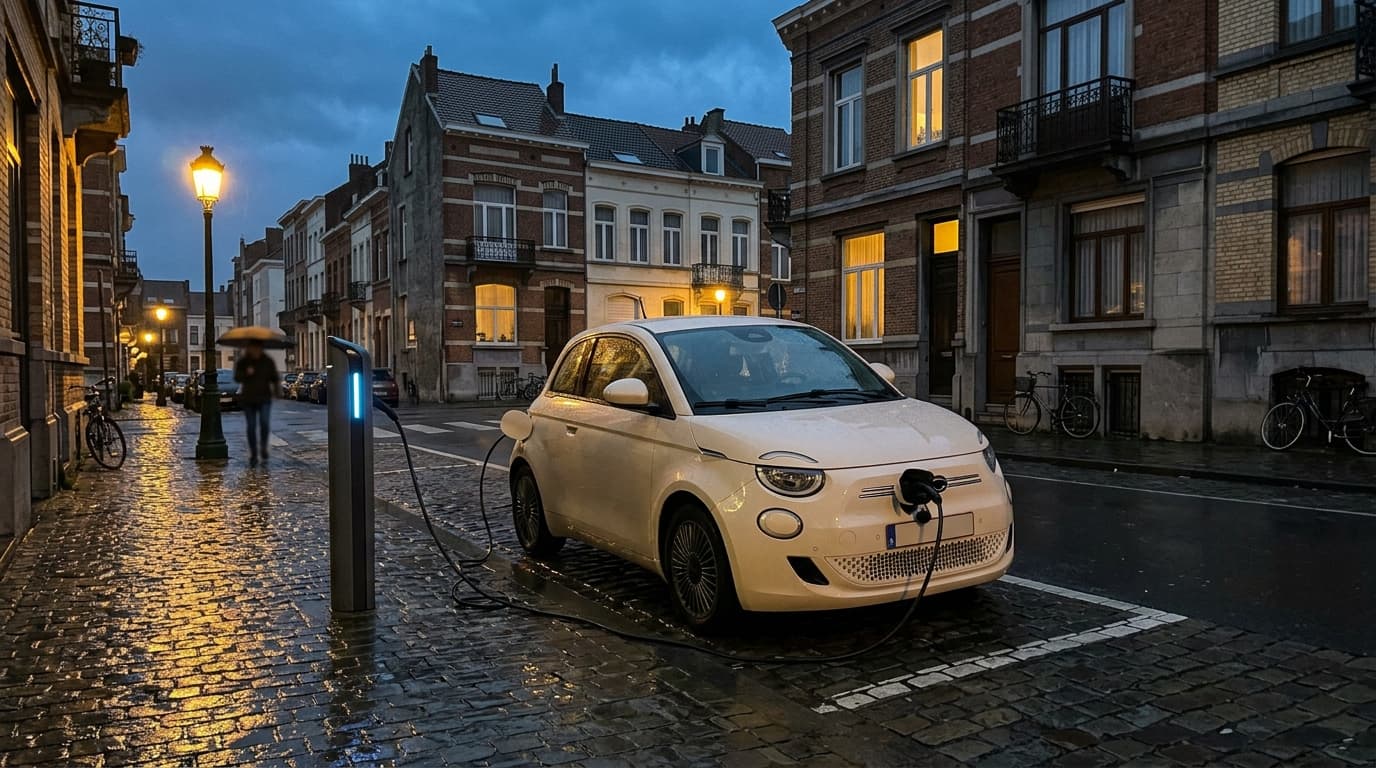
Yes, an electric car without a garage works in the city, and especially in Brussels, where a street charger costs as much as a socket at home, or less. The catch lies elsewhere. You need a charger a few minutes' walk away and a routine that fits into one charge a week, because since 1 October 2026 staying plugged in too long is billed by the minute.
In Brussels, the street charger is cheaper than the living room socket
The received wisdom says that an electric car without a garage is a frustrated owner's luxury: you buy the car, then pay top price for electricity at public chargers. In Brussels, the numbers say the opposite.
EnergyDrive, which runs part of the on-street chargers under a regional concession, displayed on 12 October 2026 a rate of €0.28 or €0.38/kWh including VAT, depending on the charger. On the other side, the rate published by the CREG (Belgium's federal energy regulator) for reimbursing home charging of company cars, which serves as the official benchmark for the price of a kWh at home, stands at 37.19 cents per kWh in Brussels for the third quarter of 2026, 37.83 cents in Wallonia and 32.22 cents in Flanders. A Brussels street kWh is therefore on a par with a living room kWh, and sometimes a quarter cheaper.
It is not a gift. The Region awards its concessions to the most attractive bid, without subsidy, and prices can be reviewed every year in line with household electricity prices, according to explanations from Sibelga, the Brussels grid operator, reported by the business magazine Trends. Nothing guarantees the gap will last. But today, a Brussels resident charging on the pavement across the street pays no premium.
What does a year of charging without a garage cost?
Between €367 and €499 for 8,000 km, if you stick to neighbourhood chargers. We based the calculation on the consumption Citroën states for the ë-C3, 16.4 kWh per 100 km, which gives 1,312 kWh a year, charging losses not included.
| Where you charge | Price per kWh (as recorded) | Cost for 8,000 km |
|---|---|---|
| EnergyDrive street charger, low rate | €0.28 | €367 |
| Home socket, CREG Brussels rate Q3 2026 | €0.3719 | €488 |
| EnergyDrive street charger, high rate | €0.38 | €499 |
| TotalEnergies rapid charging, bank card | up to €0.69 | €905 |
| Petrol city car at 6 l/100 km, Super 95 at €2.065/l | €991 |
Prices recorded on 12 October 2026. Super 95 E10 rises to €2.105/l on 13 October according to the daily L'Avenir, which would take the petrol line to €1,010.
The fourth line is the one that matters. A city car that relies on rapid charging because there is nothing near home costs almost as much as a petrol car to run, and the higher purchase price is never recovered. The real cost is insurance and maintenance, not just the sticker price, and for an electric car without a garage you have to add a third item: where you plug in.
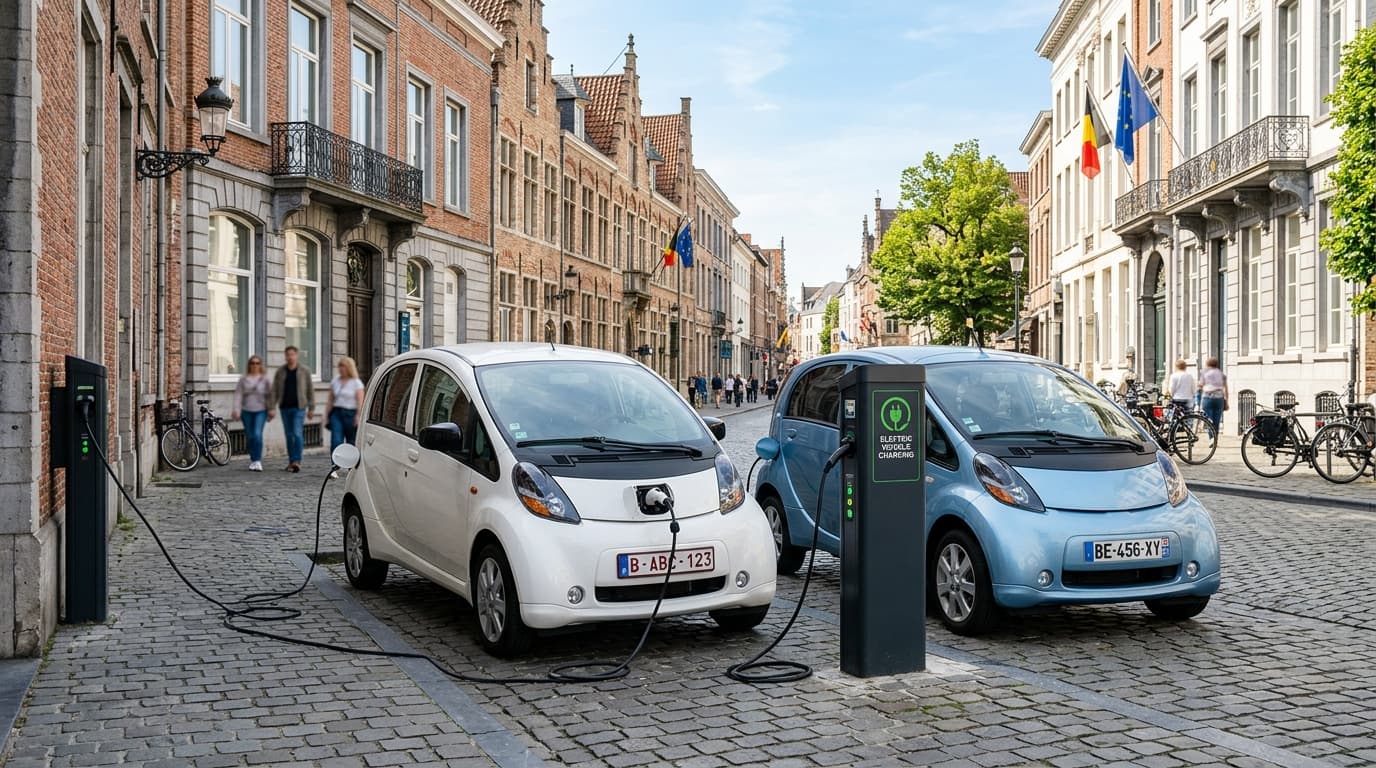
The real price is now paid in minutes
This is the autumn's big change.
Since 1 October 2026, the Brussels Region has applied an idle fee on public chargers (tarif de rotation): €0.06 per minute, or €3.60 an hour, once the car stays plugged in for more than six hours in a row, and only between 9 am and 10 pm. Parking remains free while the car is actually charging. Night time is excluded so as not to penalise local residents.
The reason is well known. Sibelga noted in early 2025 that a car needs about 2 hours 30 minutes to charge fully but stays plugged in for 6 hours 30 minutes on average, and Brussels Environment, the regional environment administration, estimates that one user in three leaves their car connected longer than necessary. The charger was working as a free parking space.
Let us apply the rule as published to three typical days:
- plugged in at 8 pm, gone at 8 am the next day: no extra charge, the 9 am to 10 pm window is never reached after the threshold;
- plugged in at 8 pm, gone at 11 am the next day: 120 minutes billed between 9 and 11 am, or €7.20;
- plugged in on Saturday at 10 am, collected at 8 pm: the threshold falls at 4 pm, four hours billed, or €14.40.
The third case says it all. The €14.40 exceeds the cost of a whole week's energy, since 155 km uses about 25.2 kWh, or €9.58 at EnergyDrive's high rate. For a city dweller without a garage, the question is no longer where electricity is cheapest: it is what time they will be able to move the car, and whether their day allows it.
A charger within 150 metres: promise or reality?
A promise in progress, with real headway. The regional electrify.brussels plan aims for a public charger within 150 m of every household and 22,000 publicly accessible charging points by 2035, as the Brussels Region portal points out. Brussels Environment already counted more than 11,000 on-street points in summer 2026, whereas the Region recorded just over 6,800 of all types in early 2025, according to the public broadcaster RTBF.
The serious objection is about availability, not numbers. In January 2025, Sibelga put charger accessibility at 55%: roughly one time in two, the charger you were aiming for was taken. The idle fee is meant to fix that, and it is too early to say whether it will. In the meantime, a car without a garage depends on a cluster of chargers, not a single one, and the density of the neighbourhood decides. A street with two points outside the door and a street with no charger within 400 m do not offer the same electric life.
My advice takes one week. Before buying, run the test without a car: open the electrify.brussels map or a charging app on Tuesday at 7 pm and on Saturday at 10 am, and count how many points are free within a five-minute walk. Two evenings out of two with a free charger, and it is workable.

And in Wallonia or Flanders, can you do without a garage?
Three regions, three realities. At the end of 2025, EV Belgium counted 82,356 public and semi-public charging points in Flanders, 14,191 in Wallonia and 10,130 in Brussels, according to figures published by L'Avenir on 16 January 2026. Flanders has almost six times as many as Wallonia.
In Wallonia, the municipal network is still being built. In May 2025 the Region announced 1,724 chargers on municipal public land, more than 3,400 points, to be installed within two years of the concession contract being awarded, bringing the total close to 4,700 publicly accessible points. In the centre of Namur or Liège, street charging exists; in a village without a garage, it may be missing. Running a cable over the pavement is, as a rule, still refused by most communes, as we explained in our battery maintainer guide. Courcelles has been the exception since 23 June 2026, with case-by-case permits that are personal, temporary and revocable.
In Flanders, density makes going electric without a garage easier than elsewhere, although a cable across the pavement is, as a rule, not tolerated there either.
Which electric city car when you charge in the street?
One that can go a week between two charges and that charges quickly on alternating current (AC). The power of the on-board charger matters more than battery size: on a street charger, which generally delivers 7 to 22 kW, the car only takes what its charger accepts.
The Citroën ë-C3 is a good example. Its official specification lists a 44 kWh battery, up to 320 km WLTP and a 7.4 kW charger as standard, or 11 kW as an option: 100 km recovered in 2 hours 30 minutes in the first case, in 1 hour 40 minutes in the second. For our 155 km a week, that is about 3 hours 50 minutes against 2 hours 35 minutes. Both stay under the six-hour threshold, but only the second leaves some margin if you plug in on a Saturday morning. The Renault 5 E-Tech takes a maximum of 11 kW on a 22 kW public charger, according to Renault. With the ë-C3 starting at €23,300 before any bonus according to Citroën, the 11 kW option is one of the few extras that pays for itself in time from the very first week.
Before you sign, check these points, in this order:
- the number of free chargers within a five-minute walk, at the times you come home;
- the AC power of the on-board charger, ideally 11 kW;
- a real winter range that covers a week of journeys;
- the fees added by your charging card, which stack on top of the charger's price;
- whether you can charge at work, which changes the whole calculation, as for the electric commuter.
My verdict: yes, provided the charger is close
In Brussels, an electric car without a garage holds up: street kWh at living room prices, nights free for residents. It becomes a bad deal when the nearest charger is a quarter of an hour away, or when you end up on rapid charging.
Look at the map before the brochure, then compare models in our ranking of the best city cars, without forgetting your commune's parking rules.
Citadines électriques comparator
Compare all citadines électriques side by side.
Compare now →
Frequently asked questions
Léa suit le marché des petites voitures depuis 2014. Basée à Liège, elle roule au quotidien en citadine et passe ses week-ends à comparer autonomies réelles, coffres et coûts d’entretien. Elle teste surtout ce qu’on utilise vraiment en ville : créneaux serrés, recharge en copropriété, trajets courts et budget assurance jeune conducteur.