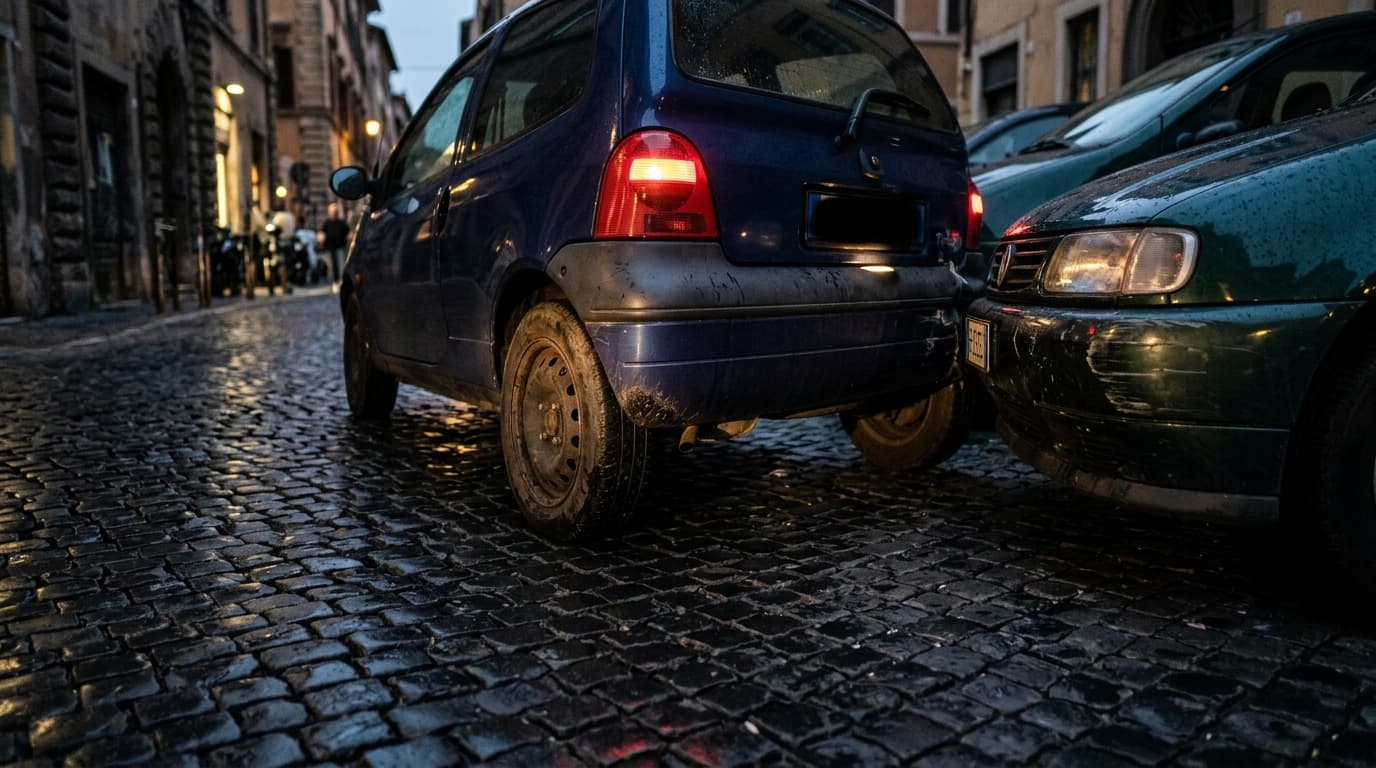
On a used city car with no parking aid, four rear parking sensors are enough in most cases: a kit under €80, half a day's work, and parallel parking gets a lot less stressful. A wireless camera makes sense if you want to see what is low down behind the car. And if your car was registered after July 2024, buy nothing.
Does your city car actually need one?
Start by checking what the car already has. EU Regulation 2019/2144 requires reversing detection on every new car registered since 7 July 2024, after requiring it on newly approved models two years earlier. A city car bought new since that date has a camera or sensors as standard, even in the base trim.
The used market, on the other hand, is full of city cars with nothing. Before the rule, rear sensors were often an option or reserved for higher trims, and small-car buyers looked at the price first: an entry-level version five to ten years old has a good chance of going without. Check the car itself, not the ad.
There is one case where you should buy nothing, even on a bare car. A Kia Picanto is 3.60 m long: if you park on a street with generous spaces, or always in the same garage, your mirrors and a mark on the floor do the job. A parking aid pays off when you change streets often, the neighbouring bumpers are twenty centimetres away and the Brussels bollard never shows up in the rear window.
Reversing camera or parking sensors for city parking?
Sensors, most of the time. They talk to you while you look outside, and in a parallel park that is exactly what you need: eyes on the mirror and the kerb, ears on the beep that speeds up.
A camera shows an image, so it asks you to look down at a screen. Its advantage is real on two points: it sees what is low and thin (a bollard, a parking chain, a bike lying on the ground), which ultrasonic sensors detect poorly, and it sees a child crouching behind the tailgate. On a city car under 4.10 m, those cases are rare on the street. They are less rare in a supermarket car park.
Here are the four criteria to settle before you look at any product, in this order:
- the screen, first of all: a camera without a compatible screen is useless, and it is the most common trap (see the Garmin BC 50 below);
- the power supply: wired to the reversing light, the device only switches on in reverse, while a permanent live feed drains the battery if you forget to switch it off, a real issue on a city car that only does short trips (our battery guide explains why);
- the bumper: drill or not, what thickness, what colour, and painting the sensors if you want them to disappear;
- front or rear, finally: in a parallel park the front matters as much as the rear, and a front kit means routing a cable through the engine bay.
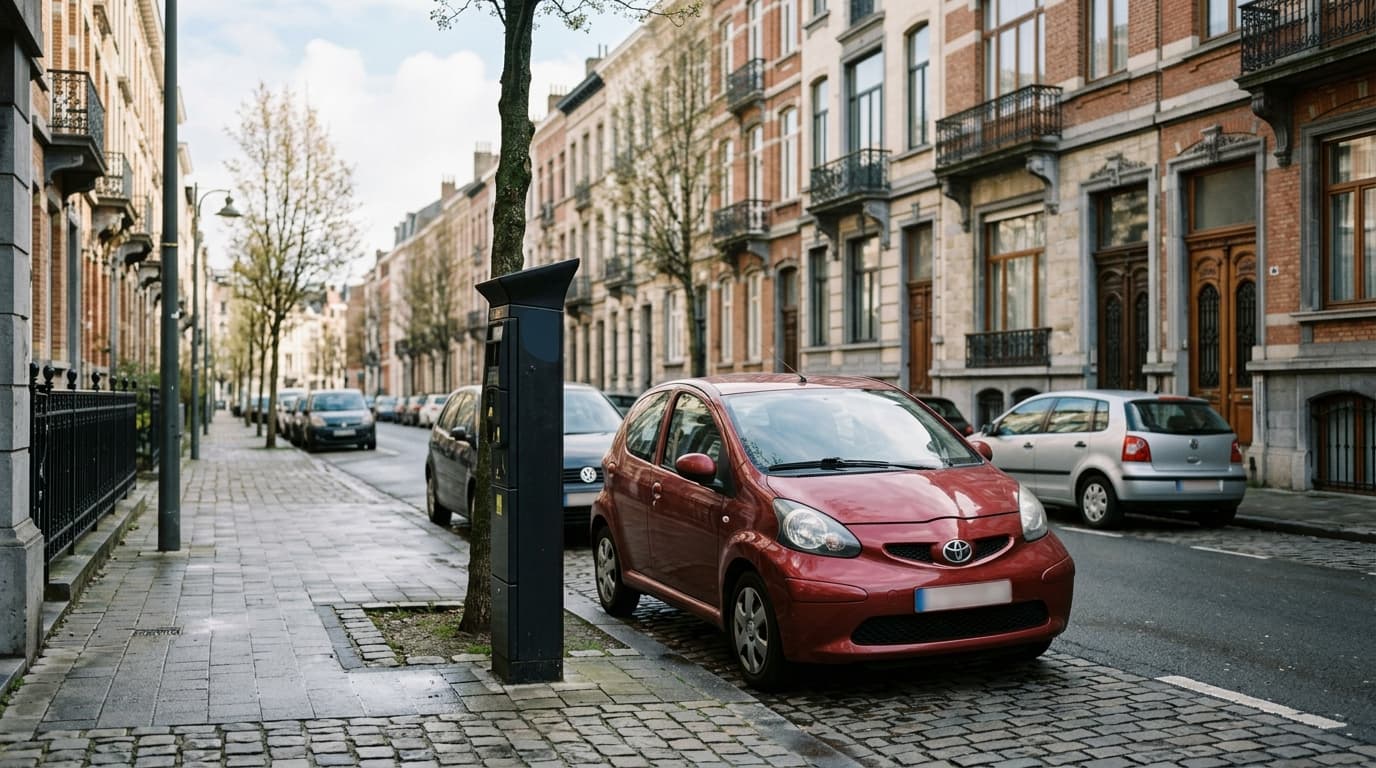
The budget: €0 to €300 depending on the aid
Between €80 and €300 of hardware, depending on whether you go for sensors or a branded camera, plus fitting if you don't do it yourself.
| Solution | Real example | Price found | Fitting time | Note |
|---|---|---|---|---|
| Rear sensors, 4 units | Valeo Beep&Park (ref. 632203) | €79.99 (Amazon, 17/10/2026) | 1 h 30 to 3 h 30 according to Valeo | bumper drilling, paintable sensors |
| Same kit fitted by a garage | €130 to €240 including labour | 1 to 2 h in the workshop | based on €50 to €80 an hour | |
| Branded wireless camera | Garmin BC 50 | €199.99 (Garmin recommended price) | not stated | needs a compatible Garmin satnav |
| Wireless camera, night vision | Garmin BC 50 Night Vision | €299.99 (Garmin recommended price) | not stated | lights up to 15 m behind the car |
| Buy nothing | €0 | new car since 7 July 2024, or always the same space |
Garmin's recommended prices come from the BC 50 launch press release, published in June 2022, and the Valeo kit's specifications from its product sheet; retailers now set their own prices. None of these devices has been fitted or tried by us: times and specifications are the manufacturers'.
A word on the Garmin, because it comes up a lot when people look for a wireless camera. Garmin quotes a 160° field of view, a waterproof housing, a transmitter best wired to the reversing light and a range of about 15 m. But its installation manual is clear: the picture only displays on a compatible Garmin navigator. In a city car without a Garmin satnav, you therefore need to add the screen to the budget, or choose something else.
How do you fit parking sensors yourself?
Allow half a day the first time, in dry weather and under cover. The tools fit in one box: the kit, a drill, a screwdriver, a multimeter or test lamp, masking tape and cable ties.
- Find the reversing light wire. Open the boot, reach the rear light cluster, select reverse with the ignition on and use the multimeter to find the wire that goes to 12 V. Note its colour. That is the wire that will power the control unit.
- Mark the sensor positions. Masking tape on the bumper, four marks evenly spaced, at the height given in the instructions. Valeo supplies 0°, 4° and 10° angle rings: the curved bumper of a city car often needs one.
- Check behind the bumper before drilling. A crossmember, a cable or a fixing behind one of the marks, and the hole has to move. The Valeo kit accepts bumpers 2 to 4 mm thick.
- Drill, then fit the sensors. Drill at the centre of each mark, at the diameter given in the instructions, clip the sensors in and bring the cables inside the boot through an existing grommet if possible.
- Connect the control unit and the speaker. Control unit tucked into a corner of the boot, power from the wire found in step 1, earth on a bare metal point, speaker placed where you can hear it without the radio. Some buyers report that a permanent live feed is also needed: follow the wiring diagram in the instructions, not a generic tutorial.
- Test before closing everything up. Ignition on, reverse gear, bring a cardboard box to one metre, then fifty centimetres. The beep should speed up. Only then refit the trims.
Three mistakes come up often. Drilling without checking behind the bumper, first, and a badly placed hole never fills cleanly. Next, leaving a cable rubbing against a metal edge: it ends up stripped. Finally, fitting unpainted sensors on a light-coloured car, which shows from ten metres and hurts resale.
Is a smartphone allowed as a reversing screen in Belgium?
Yes, if it is mounted. Since 3 March 2022, the Belgian rule covers any mobile electronic device with a screen: you may neither hold it nor handle it while driving, unless it is fixed to the vehicle in a holder designed for the purpose, the federal police points out. At the time, the offence carried an on-the-spot fine of €174.
As for where the holder goes, keep it out of the area swept by the wipers. A screen in the middle of the windscreen can be flagged at the contrôle technique under field of vision.
An €80 kit against a €250 bumper repair
The maths fits on one line.
A smart repair on a bumper costs €100 to €250 at a Belgian body shop, as we found in our guide on removing a car scratch, and claiming it on comprehensive cover (omnium) costs you the excess plus five bonus-malus steps. Sensors you fit yourself come to €79.99; fitted by a garage, €130 to €240. One avoided scrape is therefore enough to pay back the kit, and that is a cautious assumption for anyone who parks on the street in Ixelles or Saint-Gilles several times a week, in spaces whose rules we have explained in our guide to parking in Brussels. For the camera the sums are less clear-cut: at €200 without the screen, it pays for itself in safety more than in bodywork. If you are torn between equipping your current car and replacing it, our ranking of the best city cars puts the models in the segment side by side, with Belgian prices.
My take: rear sensors first, a camera only if you already have the screen.
Guides d’achat comparator
Compare all guides d’achat side by side.
Compare now →
Frequently asked questions
Léa suit le marché des petites voitures depuis 2014. Basée à Liège, elle roule au quotidien en citadine et passe ses week-ends à comparer autonomies réelles, coffres et coûts d’entretien. Elle teste surtout ce qu’on utilise vraiment en ville : créneaux serrés, recharge en copropriété, trajets courts et budget assurance jeune conducteur.