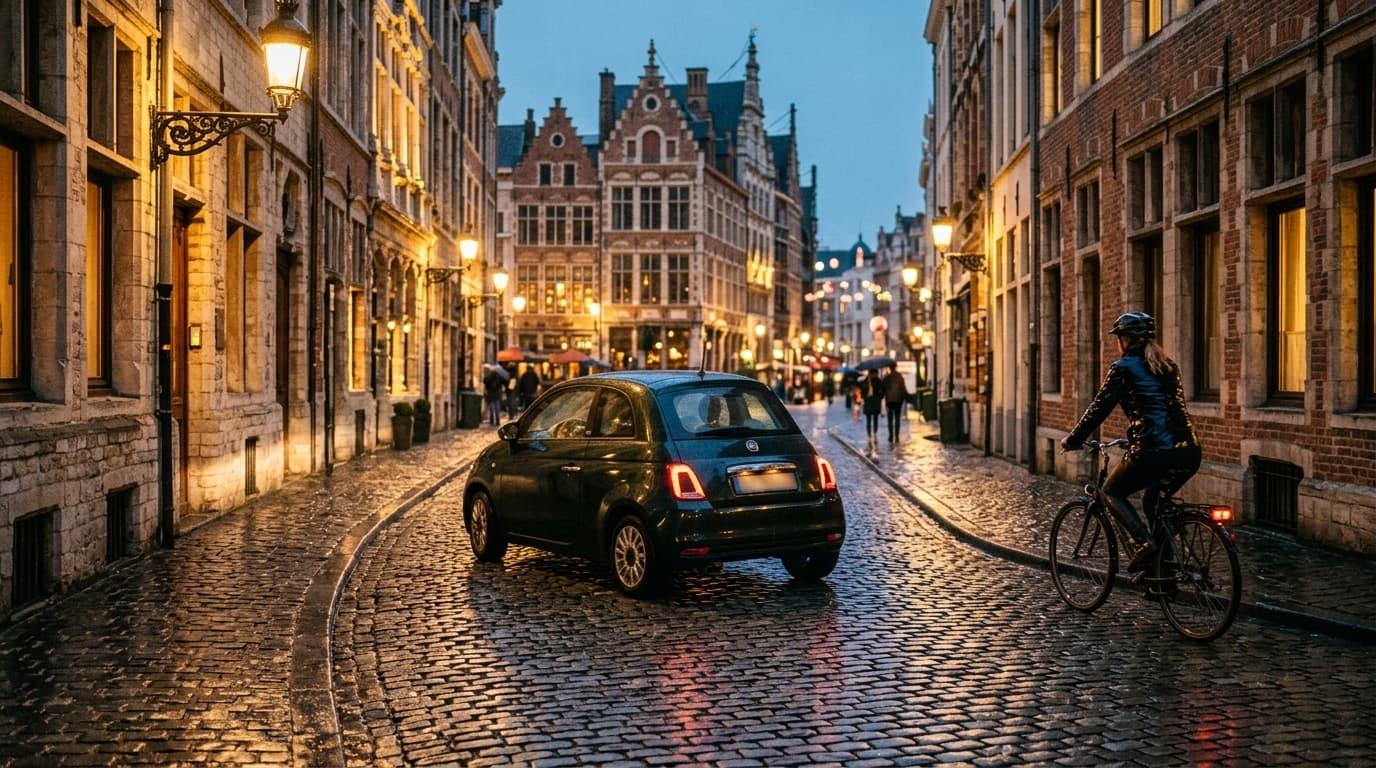
In Brussels, the City 30 rule (Ville 30) has capped speed at 30 km/h on every road in the 19 communes since 1 January 2021, except where a sign shows 50 or 70. Speeding costs €53 for up to 10 km/h over, then €11 for each extra km/h. Beyond 30 km/h over the limit, it goes to court.
Where does City 30 apply in Brussels?
Everywhere in the Brussels-Capital Region, from Uccle to Evere, on municipal streets and regional roads alike. The Region is made up of 19 communes, the Belgian word for municipalities, and the white built-up area sign at its border now means a 30 km/h limit, as the Brussels Region portal points out. Brussels Mobility, the regional transport administration, announced in 2020 that 85% of roads would move to 30, up from about 60%.
The rule covers anything that travels on the carriageway, bikes and e-scooters included. Trams are exempt, as are priority vehicles on an emergency call.
Which streets are still 50 or 70 km/h?
The main roads, and only those. When the measure started, the list published by the public broadcaster RTBF on 9 December 2020 included:
- the tunnels and the inner ring (petite ceinture);
- Boulevard Léopold II;
- Rue de la Loi and Rue Belliard;
- Boulevard Général Jacques;
- Avenue Louise;
- Avenue de Tervuren.
A few entry roads into the city stayed at 70 km/h. At the other end of the scale, shared zones (zones de rencontre) are capped at 20 km/h.
That list is five years old and road works may have changed it. The up-to-date reference is the interactive map from Brussels Mobility, and on the street the sign always has the last word.
How do you know the limit when there is no sign?
No sign means 30.
Every exception is announced by the white disc with a red border. If you have not passed one since entering the Region, you are at 30, even on a wide two-lane avenue that looks very much like a 50 road. It is the classic commuter trap and I know it well: coming from Liège, where built-up areas are driven at 50, my right foot does not adjust on its own.
New cars help. Intelligent speed assistance, compulsory on every new vehicle registered in the EU since July 2024, reads the signs and warns you when you go over. In an older used city car, the useful habit is to set the speed limiter to 30 at the built-up area sign, if the car has one.
How much is a speeding fine in a 30 km/h zone?
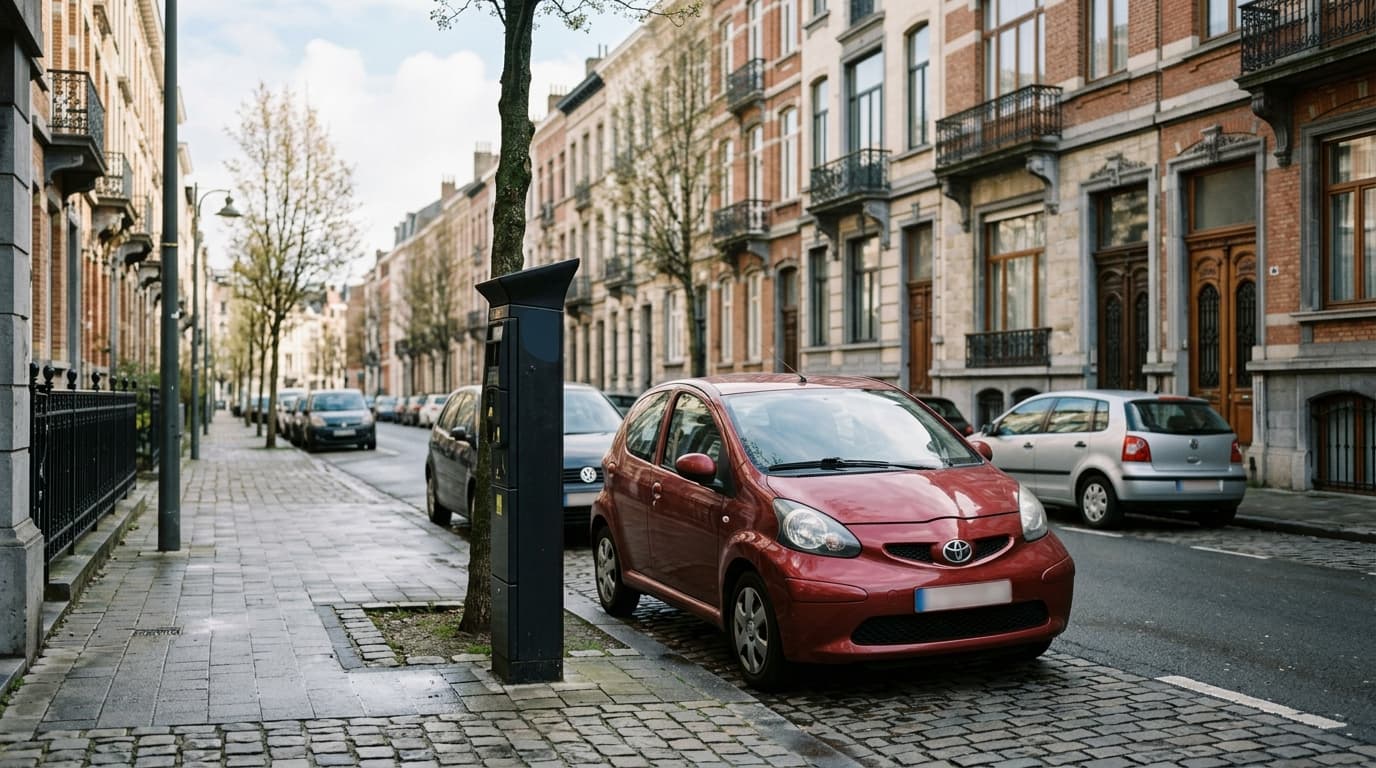
The scale is federal and the police publish it: €53 for 1 to 10 km/h over, then €11 for each extra km/h in built-up areas and 30 zones. These are minimum amounts for the on-the-spot fine (perception immédiate, the payment proposal you receive by post), calculated on the corrected speed. We ran the numbers for the speeds people reach in town without thinking, deducting the 6 km/h technical margin.
| Speed measured by the camera | Recorded speed | Over the limit | Outcome |
|---|---|---|---|
| up to 36 km/h | 30 km/h or less | none | nothing |
| 37 to 46 km/h | 31 to 40 km/h | 1 to 10 km/h | €53 |
| 47 km/h | 41 km/h | 11 km/h | €64 |
| 50 km/h | 44 km/h | 14 km/h | €97 |
| 56 km/h | 50 km/h | 20 km/h | €163, licence withdrawal possible |
| 66 km/h | 60 km/h | 30 km/h | €273 |
| 67 km/h and above | 61 km/h and above | more than 30 km/h | public prosecutor, police court |
So driving at 50 in a street that was a 50 street six years ago costs €97. The 20 km/h threshold matters more than the money: the Region states that a licence withdrawal or driving ban becomes possible from that point.
At what speed does the camera trigger?
At a measured 37 km/h. Below 100 km/h, the device deducts 6 km/h to cover its own inaccuracy, and the offence starts at a recorded 31 km/h. That margin belongs to the machine, not to the driver.
322,000 speeding reports in six months
The figure was given by the Brussels channel BX1 on 28 May 2026: more than 322,000 speeding reports (procès-verbaux, or PV) issued on Brussels roads in the first half of 2025 alone. According to the road safety institute Vias, quoted in the same report, 42% of speeding offences recorded in Brussels exceed the limit by more than 10 km/h, which takes them above the base rate.
Enforcement relies on three tools. Fixed cameras, nine more of which were announced on regional roads in 2025 according to the cycling association Pro Velo, sometimes catch red light offences too. Average speed cameras calculate a mean between two points, which makes braking in front of the box pointless. Mobile Lidar units, finally, stay one to two weeks in the same spot and then move, and those are the ones that catch people out in neighbourhood streets.
The safety record is less clear-cut than it is sometimes presented. Brussels roads saw 11 deaths in 2020 and 5 in 2021, the first year of the measure, according to Brussels Mobility. Pro Velo then reports 6 deaths in 2023 and 10 in 2024. With numbers this small, one year proves nothing either way, and the motoring organisation Touring is in fact calling for an audit of speed limits and automatic cameras in all three Belgian regions. My view as a driver: the rule is simple, the checks are frequent, and arguing about whether the measure is justified does not lower the bill.
Do you really lose time at 30 km/h?
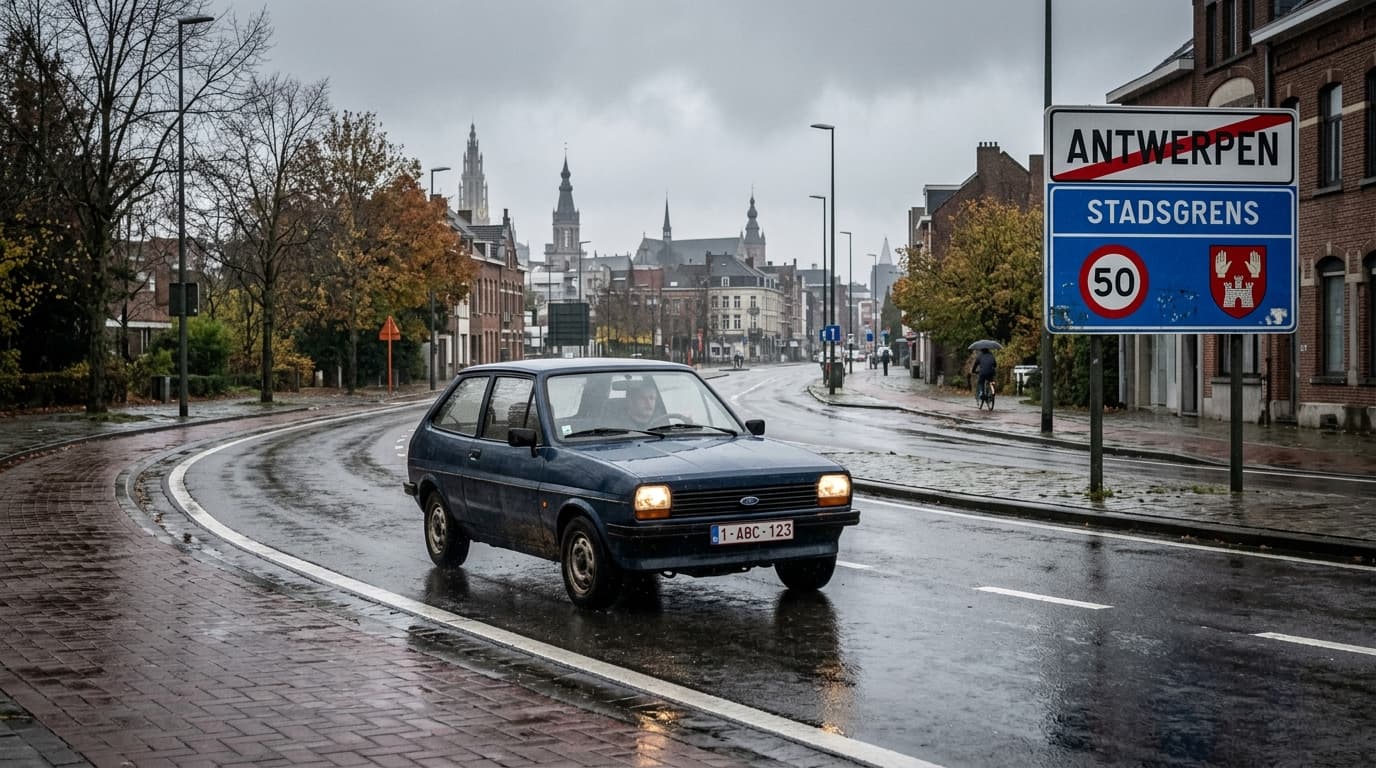
Very little. Touring, never the measure's keenest supporter, estimated the drive from Botanique to Poelaert at about forty seconds longer, on a route that takes 6 to 12 minutes depending on the traffic lights. Brussels Mobility tracked twelve routes in 2019, 2020 and 2021 and found journey times stable.
In town, traffic lights and queues set the schedule.
What about Wallonia and Flanders?
The logic is reversed. In built-up areas, the default limit there is still 50 km/h and 30 only exists where a sign imposes it, around schools or in a traffic-calmed centre. The scale of fines is identical, though, since it is federal.
If you mostly drive in Brussels, you deal with three rules specific to the Region: speed, the low emission zone (LEZ, which bans older engines) and parking, which changes from one commune to the next. If you are looking for the car to match, our ranking of the best city cars starts from that kind of use.
Guides d’achat comparator
Compare all guides d’achat side by side.
Compare now →
Frequently asked questions
Léa suit le marché des petites voitures depuis 2014. Basée à Liège, elle roule au quotidien en citadine et passe ses week-ends à comparer autonomies réelles, coffres et coûts d’entretien. Elle teste surtout ce qu’on utilise vraiment en ville : créneaux serrés, recharge en copropriété, trajets courts et budget assurance jeune conducteur.