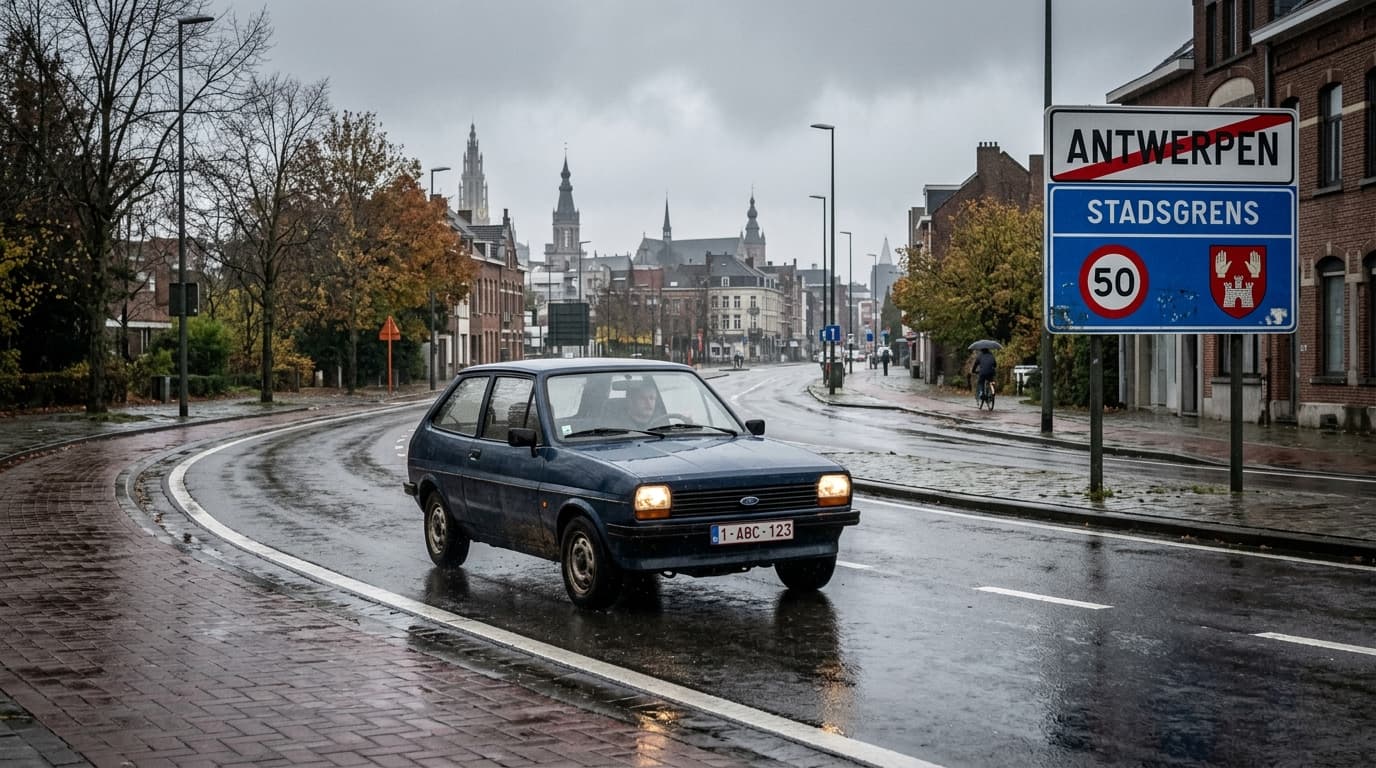
Since 1 January 2026, a Euro 5 diesel city car may no longer enter Brussels, while it drives freely in Antwerp, Ghent and anywhere in Wallonia. Same car, same standard, three legal statuses. Here is what that changes in practice, and what it costs to ignore it.
One city car, three legal statuses
I started this article wanting to check one simple thing: at what point does a small used car become unusable in Belgium. I expected one answer. There are three.
Take a 2013 diesel Volkswagen Polo, the most ordinary car in the Belgian fleet. In Brussels it has been illegal since 1 January 2026. In Antwerp and Ghent it goes through without paying or declaring anything, and will do so until at least 1 September 2027. In Namur or Charleroi the question does not even arise: Wallonia has no low emission zone at all.
This is not an administrative subtlety. It is the difference between a car you keep and a car you sell. And because the three timetables move at different speeds, that same Polo changes status three times in eighteen months depending on which city it parks in.
Which city cars are banned, and since when?
In Brussels, two categories fell on 1 January 2026: Euro 5 diesels and Euro 2 petrols. Brussels Environment puts it bluntly — cars, vans, buses, lorries and motorbikes included.
Translated into registration years, that means:
- Euro 5 diesel: first registered between January 2011 and August 2015. This is the heart of the affordable used market — Clio III and IV dCi, Polo V TDI, first-generation 208 BlueHDi, Corsa D CDTi, Fiesta TDCi.
- Euro 2 petrol: first registered between roughly 1997 and 2000. Far fewer cars, but these are precisely the €1,500 runabouts that serve as a student's first car.
In Flanders nothing moved this year. The Flemish government postponed the planned tightening: Euro 5 diesels and Euro 2 petrols remain allowed in Antwerp and Ghent in 2026, free of charge and with no paperwork. The squeeze is pushed back to 1 September 2027.
What is already banned in Flanders, though, is Euro 4 diesel and below, and Euro 1 petrol and below. For those, monthly and annual permits disappeared in 2026: the day ticket is now the only way in.
The Euro standard is in box V.9, not in the seller's ad
Open the registration certificate. Box V.9 gives the European environmental type-approval class, and it is the only figure an ANPR camera cares about.
On older documents the box is sometimes empty: fall back on the date of first registration, box B. And be wary of an ad promising "Euro 6" with no document behind it, especially on a 2015 engine: the pivot year, when the switch happened production batch by production batch rather than on 1 January.
Check before you buy, not after.
The three timetables, line by line
Here are the three timetables side by side, as published in August 2026. They diverge today, they converge in 2027, and they meet completely in 2035.
| Deadline | Brussels | Antwerp and Ghent | Wallonia |
|---|---|---|---|
| Since 1 January 2026 | Euro 5 diesel and Euro 2 petrol banned | Euro 5 diesel and Euro 2 petrol still allowed | No restriction |
| 1 September 2027 | — | Euro 5 diesel and Euro 2 petrol banned | No restriction |
| From 2031 | Announced phase-out of diesel | All diesels banned, Euro 6 included | No restriction |
| From 2035 | Combustion engines targeted for the end | End of combustion engines (petrol, CNG, LPG, hybrids) | No restriction |
One detail few people pick up: in Antwerp the LEZ covers everything inside the R1 ring road, but not the R1 itself, nor the port, nor the access roads leading to the park-and-ride car parks. In Ghent it follows the 30 km/h zone inside the R40 ring, with two bypass routes left open to reach certain car parks. In other words, you can often skirt the city without ever legally entering it — and plenty of people do exactly that without realising.
How much is a day pass, and how many can you buy?
This is where the three cities become genuinely incomparable, and it is the point most articles miss: the price matters less than the cap.
| City | Day pass (car) | Cap per year and per plate | Fine | Plate registration |
|---|---|---|---|---|
| Brussels | €35 | 24 passes | €350 | Own system, separate from Flanders |
| Antwerp | €45 | 12 passes | €150, then €250, then €350 | Free, valid 5 years, also covers Ghent |
| Ghent | €35 | 8 passes | €150, then €250, then €350 | Free, valid 5 years, also covers Antwerp |
Prices recorded in August 2026 on lez.brussels, stad.gent and the Flemish portal. The Ghent cap of eight passes is the one published by the City of Ghent; it rises to twelve for fleet owners, and several secondary sources wrongly quote that twelve for everyone.
Let us do the sum nobody does. Someone driving into Brussels twice a week in a non-compliant city car needs about a hundred passes a year. They are entitled to twenty-four. The quota runs out in mid-March, leaving nine and a half months of illegal driving, on top of €840 already spent. In Ghent, with eight passes, the job is done in six weeks.
What the day pass does not do:
- it does not roll over from one year to the next, and it is neither exchangeable nor refundable;
- it is valid only in the city where it was bought: a Ghent pass opens neither Antwerp nor Brussels;
- it expires at 6 a.m. the following morning, not after a full twenty-four hours;
- it does not replace the prior registration required for foreign plates;
- it is never a substitute for an exemption, which has to be applied for and justified.
That leaves exemptions, which are the real way out when they apply. All three cities provide for holders of a disabled parking card, and for recognised informal carers visiting a resident of the zone. Flanders has also harmonised its classic-car rules: over thirty years old, an "O" plate, free and unlimited exemption in Antwerp and Ghent — but only once the vehicle is registered, otherwise the camera cannot tell it apart from a non-compliant car. None of these exemptions is automatic, all of them require a file, and all of them have to be requested before you drive.
Put plainly: the pass is there for a house move, a medical appointment or a weekend. Nobody commutes on it.
Why does Wallonia have no low emission zone?
Because it gave up on one. The 2019 decree on air pollution provided for a low emission zone across the whole Walloon territory, first for 2023, then postponed to 1 January 2025. The Walloon Parliament repealed that region-wide plan in April 2024, and the majority formed after the following elections wrote into its regional policy statement that it would improve air quality "through tools other than low emission zones".
One nuance matters for what comes next: the region handed the power to municipalities. Nothing stops Liège or Charleroi from setting up their own zone. None has so far, but the legal instrument exists, and a city car bought in Liège today carries no contractual guarantee for 2032.
That asymmetry has a very concrete effect on the used market, which I come back to below: Euro 5 diesels leave Brussels and get resold in Wallonia, where they bother nobody.
The €350 fine does not land on the first offence
In Brussels you have to separate two populations, and this is the least understood part of the scheme.
If your vehicle became affected on 1 January 2026 — a Euro 5 diesel or a Euro 2 petrol — the first recorded offence only triggers a warning letter. The €350 fine can only follow three months after that first offence, and Brussels Fiscality only started sending them on 1 July 2026. Once a fine has been issued, no new penalty can be applied to the same plate for the following twelve months. It can be paid in four instalments, or ten on request.
If your vehicle was already banned before 1 January 2025, none of that applies: €350 from the very first offence, with no warning, renewable every three months.
In Flanders the logic runs the other way and is more conventional: €150 the first time, €250 for a repeat within twelve months, €350 thereafter. A Ghent offence and an Antwerp offence stack up, since the two cities fine separately.
What the low emission zones do to a small used car's value
This is the quietest and costliest effect of the whole scheme. A 2012 diesel city car in good condition is still worth something on paper; it is worth much less to a Brussels buyer, and Brussels buyers make up a large share of demand in this segment. The seller discovers the gap on the day of resale, never before.
Three practical consequences, if you are buying right now:
First point: a recent Euro 6 petrol, even with 30,000 km more on the clock, will be easier to sell in 2030 than a better-maintained Euro 5 diesel. On short urban mileages diesel already made no mechanical sense — the particulate filter clogs on short, cold journeys. The LEZ timetable simply adds one more reason to an already long list.
Second point, more counter-intuitive: a Euro 4 or Euro 5 petrol from 2006-2014 is covered by no ban at all, neither in Brussels nor in Flanders, before 2035. A ten-year-old small petrol is currently the least exposed used car on the Belgian market, which is the exact opposite of what people assume when they look at a car's age rather than its engine.
Third point, and this one is my opinion rather than a fact: I would not change car purely because of the low emission zones. Twenty-four Brussels passes cost €840 a year; a compliant used city car costs €9,000 to €13,000. Replacement only wins if you enter the zone more than twice a week — otherwise, keep the car, take the train into Brussels, and push the decision back to resale day.
If you are weighing things up right now, our ranking of the best city cars lists the compliant engines in the segment, the city car comparator puts them side by side, and the article on what a city car costs per year prices the real bill once the car is in the garage.
Guides d’achat comparator
Compare all guides d’achat side by side.
Compare now →
Frequently asked questions
Léa suit le marché des petites voitures depuis 2014. Basée à Liège, elle roule au quotidien en citadine et passe ses week-ends à comparer autonomies réelles, coffres et coûts d’entretien. Elle teste surtout ce qu’on utilise vraiment en ville : créneaux serrés, recharge en copropriété, trajets courts et budget assurance jeune conducteur.