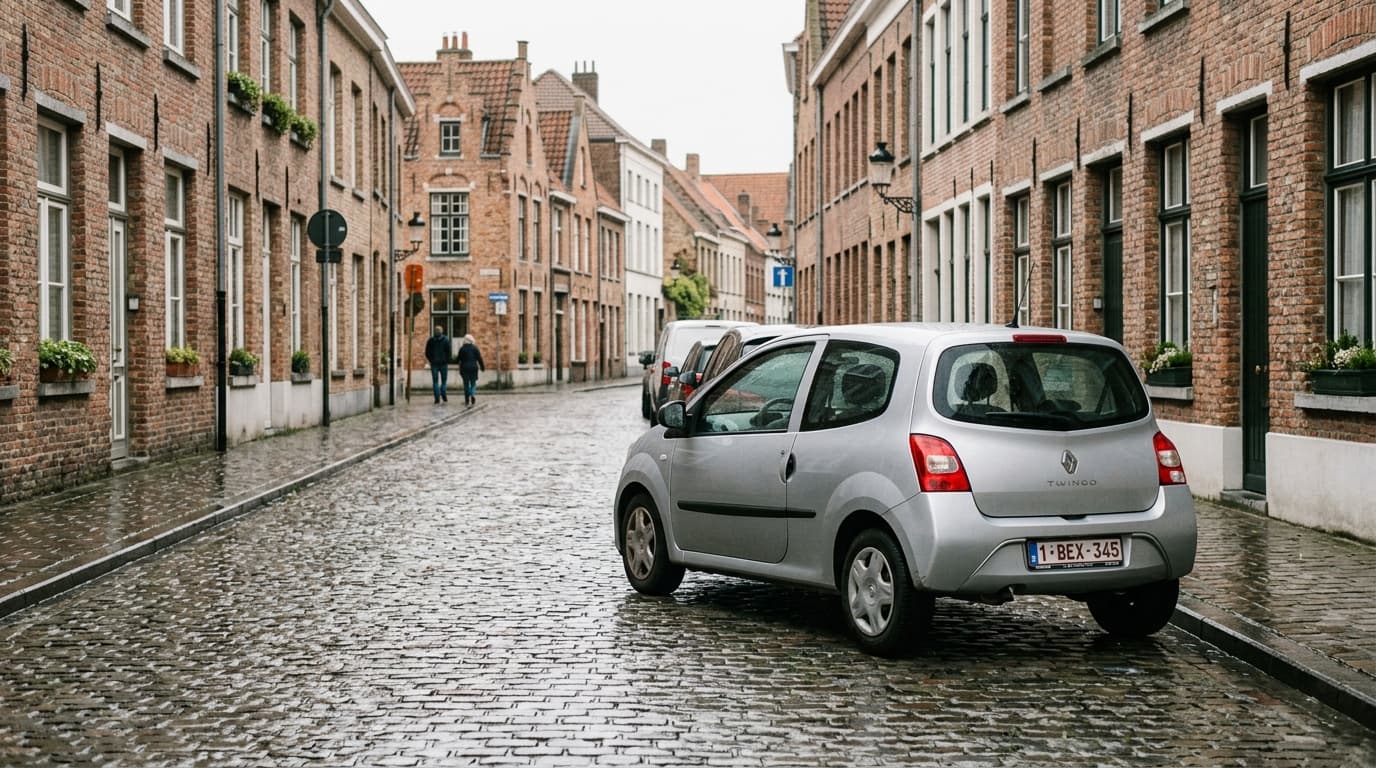
Budget €2,000 to €3,200 a year for a petrol city car covering 10,000 km, around €2,700 in the most common case, excluding loan repayments and loss of value. Fuel alone accounts for half the bill, insurance comes next, and road tax depends as much on your region as on your engine.
What does a city car really cost per year in Belgium?
Between €2,000 and €3,200 a year for a petrol city car of 6 fiscal horsepower covering 10,000 km, excluding finance and depreciation. The bottom of the range matches a hybrid on third-party cover only; the top matches a petrol car on full comprehensive serviced at a franchised dealer.
The figure often surprises people, because buyers think in list prices. A €15,000 Dacia Sandero and a €22,000 Renault Clio look worlds apart; in use, the annual gap between them is around €50. What really widens the difference is not the badge on the grille — it is your mileage, your bonus-malus level and the insurance policy you sign.
Wikifin, the financial education service run by the Belgian regulator FSMA, puts it in one line that I think is right: the purchase price is only the entry ticket. I would add one item the simulators forget, and it matters in town: parking. A Brussels resident's permit costs little, but a private parking subscription in Ixelles or Antwerp runs €80 to €150 a month, and it blows up every calculation below.
Which items make up the bill, and in what order?
Six items, four of them recurring. Fuel dominates, insurance follows, servicing and road tax bring up the rear. Tyres and the roadworthiness test spread over several years and weigh little.
| Item | Annual range | What moves it |
|---|---|---|
| Fuel (10,000 km) | €850 to €1,300 | real urban consumption, pump price |
| Insurance | €450 to €900 | age, bonus-malus, third-party or comprehensive |
| Servicing and wear parts | €350 to €550 | franchised dealer or independent garage |
| Road tax | €103 to €301 | engine capacity, region of residence |
| Tyres (amortised) | €100 to €150 | four tyres every three to four years |
| Roadworthiness test | €0 to €50 | no inspection before year four |
Add up the middle of each range and you land on €2,700, or €225 a month. That is the number to hold on to if you are drawing up a first budget. It includes neither a loan instalment, nor depreciation, nor parking — which is exactly why so many first-time buyers discover their real budget six months after the purchase.
Which city car is cheapest to run?
The hybrid, by a clear margin — despite carrying the highest road tax in the table. Over 10,000 urban kilometres, a Toyota Yaris Hybrid comes to roughly €1,149 in tax and fuel, against €1,468 for a Dacia Sandero 1.0 TCe. That is €320 a year, on the only two items that can be calculated in full.
| Model | Capacity · fiscal hp | Road tax (Wallonia / Brussels) | Realistic urban consumption | Fuel over 10,000 km | Tax + fuel |
|---|---|---|---|---|---|
| Toyota Yaris Hybrid 1.5 | 1,490 cc · 8 hp | €300.96 | ~4.3 l/100 km | €848 | €1,149 |
| Hyundai i10 1.0 | 998 cc · 6 hp | €186.25 | ~6.0 l/100 km | €1,183 | €1,369 |
| Kia Picanto 1.0 | 998 cc · 6 hp | €186.25 | ~6.0 l/100 km | €1,183 | €1,369 |
| Škoda Fabia 1.0 TSI | 999 cc · 6 hp | €186.25 | ~6.3 l/100 km | €1,242 | €1,428 |
| Dacia Sandero 1.0 TCe | 999 cc · 6 hp | €186.25 | ~6.5 l/100 km | €1,282 | €1,468 |
| Renault Clio 1.0 TCe | 999 cc · 6 hp | €186.25 | ~6.5 l/100 km | €1,282 | €1,468 |
| Citroën C3 1.2 PureTech | 1,199 cc · 7 hp | €243.41 | ~6.5 l/100 km | €1,282 | €1,525 |
How the table is built: road tax uses the regional scale in force from 1 July 2025 to 30 June 2026, including the 10 % municipal surcharge, as published by SPW Finances and applied identically in Brussels. Fuel is calculated at the official capped price for Super 95 E10 set by the Belgian federal economy department, €1.972 per litre on 14 August 2026. Consumption figures are real-world urban orders of magnitude, well above the quoted WLTP values — in this segment the gap commonly reaches 1 to 1.5 l/100 km.
Two honest caveats. First, the Yaris Hybrid costs €4,000 to €6,000 more to buy than a Sandero: at €320 saved a year, breaking even takes about twelve years, which only makes sense if you keep the car a very long time. Second, the hybrid advantage melts away as soon as you leave town — on the motorway those 4.3 l/100 km become 5.5 and the maths changes. If you mostly drive the E19, this is not the right trade-off.
Why does a hybrid pay more tax than a petrol car?
Because in Wallonia and Brussels, road tax is calculated on the capacity of the combustion engine, not on emissions. The Yaris's 1.5-litre block puts it at 8 fiscal horsepower, so €300.96 a year; the Sandero's 1.0-litre stays at 6 hp, so €186.25. The car that pollutes less pays €115 more.
This is one of those Belgian quirks that no French comparison can explain to you, because it exists only here. Flanders switched to a calculation based on CO₂, kW output and Euro standard back in 2016: the same vehicle is taxed there on what it emits, and the hybrid becomes clearly advantageous. Wallonia and Brussels stayed on fiscal horsepower, a notion inherited from engine capacity that no longer says much about how much a modern turbocharged engine actually drinks.
What does that mean in practice? A household moving from Liège to Ghent with the same car has its tax recalculated under the Flemish scale at the next due date, and the gap commonly reaches €100 to €300 a year in one direction or the other. For electric cars the map is redrawn again: minimum tax of about €103 in Wallonia and Brussels, and the end of full exemption in Flanders since 1 January 2026, with a flat charge of roughly €61 to €100 a year. Three regions, three logics, one car.
How much does insurance cost on a city car in Belgium?
€280 to €550 a year for third-party liability, €410 to €950 for mini-comprehensive and €800 to €1,800 for full comprehensive. A city car usually sits at the bottom of each range: low power, low insured value, cheap repairs.
Three variables account for most of the spread, and only one of them is about the car. Your age first — a 22-year-old pays two to three times the premium of a 40-year-old on the same model. Your bonus-malus level next, which takes years to climb down and jumps five steps after a single at-fault claim. Your region last, since Brussels claim rates cost more than a rural postcode. Engine capacity and vehicle value come after that. Belgian premiums also rose 4 to 5 % on average in 2026, regardless of profile.
One simple benchmark for comprehensive cover, which I apply every time: once the annual premium passes 10 % of the vehicle's value, it no longer pays. A six-year-old city car valued at €6,000 and insured for €700 comprehensive costs €700 to protect capital that is shrinking by €800 a year. Switch to mini-comprehensive, keep legal protection, and put the difference aside. If you are a young driver the trade-off is different, and I set out the reasoning in the guide to the best city car for a young driver.
Servicing, tyres and the roadworthiness test: what should you budget?
€350 to €550 in routine servicing, €100 to €150 in amortised tyres, and nothing at all for the roadworthiness test before year four. On a well-kept city car, this block is the most predictable part of the budget.
The rhythm is simple: a minor service every 15,000 km or once a year, oil, filters and checks included, at €180 to €300 depending on the workshop; a heavier service every 60,000 km, with spark plugs, fuel filter and sometimes brake fluid, which doubles the bill. The gap between a franchised dealer and an independent garage runs 30 to 40 % on labour, with no consequence for the statutory warranty as long as the manufacturer's schedule is followed and invoiced.
Tyres are best handled by planning ahead. A set of four city-car tyres lasts three to four years in urban use and costs €300 to €450 fitted — so €100 to €150 a year to set aside. As for the roadworthiness test, a new car is only inspected at four years, then annually; budget around €50 per visit, and zero for the first four years.
Does depreciation weigh more than fuel?
On a new car, yes, by a wide margin. A new city car loses 15 to 25 % of its value in the first year: on a €20,000 model, that is €3,000 to €5,000 gone in twelve months, more than every running cost combined.
That is why a "real" new city car budget almost always exceeds €500 a month, while running costs top out at €270. Depreciation never shows up on a bank statement; you meet it on the day you sell — which is precisely what makes it so easy to forget when you sign.
A four- to six-year-old used car breaks that curve: the first owner absorbed the drop, the annual loss falls back towards €800 to €1,200, and the service history is still readable. One Belgian-specific warning, though: the Brussels low-emission zone tightens its criteria every year, and a Euro 5 diesel bought today will lose value far faster than an equivalent petrol car. Check the Euro standard in box V.9 of the registration certificate before committing.
How do you cut the bill without changing car?
Three levers, in order of return: renegotiate the insurance, leave the franchised dealer for an independent garage, and ease off the throttle. Together they save €400 to €700 a year without touching the vehicle.
Insurance is the fastest win, because nobody ever revisits it. A premium signed five years ago, on a car that has lost half its value, with a bonus-malus that has come down three steps in the meantime, can almost always be renegotiated downwards — €100 to €250 a year, for an hour of comparison. Servicing comes next, with 30 to 40 % between dealer network and independent on labour. Driving style closes the trio: in town, anticipation and correct tyre pressure are worth 0.5 to 0.8 l/100 km, or €100 to €160 a year at current prices.
Then there is the most radical lever, which I rarely raise on a site devoted to city cars: below 5,000 km a year, Belgian car-sharing — Cambio, Poppy — often works out cheaper than ownership, tax and insurance included. That only holds for a very urban profile with flexible timing, but when it holds, it holds. If you are still weighing things up, our ranking of the best city cars gives full running costs across the segment, the city car comparator puts them side by side model by model, and the quiz points you somewhere in four questions.
Citadines pas chères comparator
Compare all citadines pas chères side by side.
Compare now →
Frequently asked questions
Léa suit le marché des petites voitures depuis 2014. Basée à Liège, elle roule au quotidien en citadine et passe ses week-ends à comparer autonomies réelles, coffres et coûts d’entretien. Elle teste surtout ce qu’on utilise vraiment en ville : créneaux serrés, recharge en copropriété, trajets courts et budget assurance jeune conducteur.