
Yes, pay-per-km insurance lowers the premium on a city car you rarely drive, by anything from a few dozen to a few hundred euros a year. But in town it never makes up for the price of your address: in Brussels, the postcode weighs more than the odometer. The formula only really pays off on a second car that mostly sits still.
How does pay-per-km insurance work in Belgium?
Two mechanisms go by the same name, and they have little in common.
The first one bills the actual kilometre. You give an estimate when you sign, the premium is calculated on that basis, then at the end of the year you report the reading on your odometer and the insurer settles up: it refunds the kilometres you did not drive, or charges a supplement if you drove more, without ever suspending your cover. Beyond 25,000 km a year, extra kilometres are no longer billed. This is the model of Belfius Direct, formerly Corona Direct, which presents itself as the only Belgian insurer that refunds kilometres not driven. Around 111,000 customers had chosen this formula by September 2023, according to the press release issued by Belfius when Corona Direct changed its name.
The second mechanism is a discount by band. You declare that you will drive less than 5,000, 10,000 or 15,000 km a year, the premium drops by a percentage set in advance, and that is it. Nothing is refunded if you drive even less; leaving the band normally means losing the discount. AXA, Ethias, Yuzzu and Allianz work this way, with thresholds and percentages that are rarely published and have to be obtained on a quote. The rate cards compiled by Selectra put the advertised discounts at up to 15 % below 15,000 km and up to 30 % below 10,000 km.
The Test-Achats file on the subject (Test-Achats is Belgium's main consumer association) adds two details that matter. Mileage caps range from 2,500 to 25,000 km depending on the company. And the discount applies at best to third-party liability (RC, the compulsory cover) and to omnium (the Belgian term for comprehensive cover), never to breakdown assistance, driver cover or legal protection.
| Criterion | Actual mileage (Belfius Direct) | Band discount (AXA, Ethias, Yuzzu, Allianz) |
|---|---|---|
| Basis of calculation | odometer reading at the end of the year | band declared when you sign |
| You drive less than planned | kilometres not driven are refunded | nothing comes back |
| You drive more than planned | supplement at settlement, cover maintained | discount lost; €250 to €500 excess if you claim |
| Beyond 25,000 km a year | extra kilometres free | outside the band |
| Assistance and legal protection | outside the per-km calculation | outside the discount |
| Winning profile | car driven very little, or irregularly | steady mileage, close to the top of the band |
Actual mileage wins as soon as your mileage is low or hard to predict: it tracks real use and does not punish a wrong estimate. The band only comes out ahead if you know your mileage to within 1,000 km and the insurer offering it is already the cheapest for your address.
In Brussels, the postcode weighs more than the odometer
Here is the argument, and the table that carries it.
The Belgian comparison site CallMePower published in 2023, then updated in February 2025, a study of car insurance premiums by provincial capital: same experienced driver with no claims, same 2022 Citroën C3 1.2 petrol, same full comprehensive cover, premiums taken from insurers' online quote tools. I took those premiums and applied the two steepest mileage discounts found on the Belgian market.
| City | Annual premium (full omnium, C3) | With a 15 % km discount | With a 30 % km discount |
|---|---|---|---|
| Brussels | €1,321 | €1,123 | €925 |
| Liège | €1,272 | €1,081 | €890 |
| Namur | €1,169 | €993 | €818 |
| Antwerp | €1,136 | €965 | €795 |
| Ghent | €996 | €846 | €697 |
| Hasselt | €833 | €708 | €583 |
Average monthly premiums from the study multiplied by twelve. Discounts applied to the whole premium, which overstates the real saving: assistance and legal protection do not benefit.
Read the first and last rows together. A Brussels driver who lands a 30 % mileage discount still pays €925 a year. A Hasselt driver who asked nobody for anything pays €833. The address gap, €488 a year between those two cities, exceeds the biggest mileage discount the capital can get on this car, which is €396.
The reason lies in how the premium is built. A city car is priced first on how often claims happen where it sleeps: traffic density, theft, parking scrapes, doors opened against the bodywork. A small car parked on the street in Saint-Gilles carries the risk of the street even when it does not move, and no odometer reading measures that. The kilometre only measures the risk of the road.
In the study, the three regions line up neatly. Brussels comes first, Liège right behind, Mons and Namur above the national average of €91 a month; Antwerp sits in the middle; Ghent, Bruges, Leuven and Hasselt bring up the rear.
A second car that sits still gives actual mileage the edge
This is the serious objection to the argument, and it partly holds.
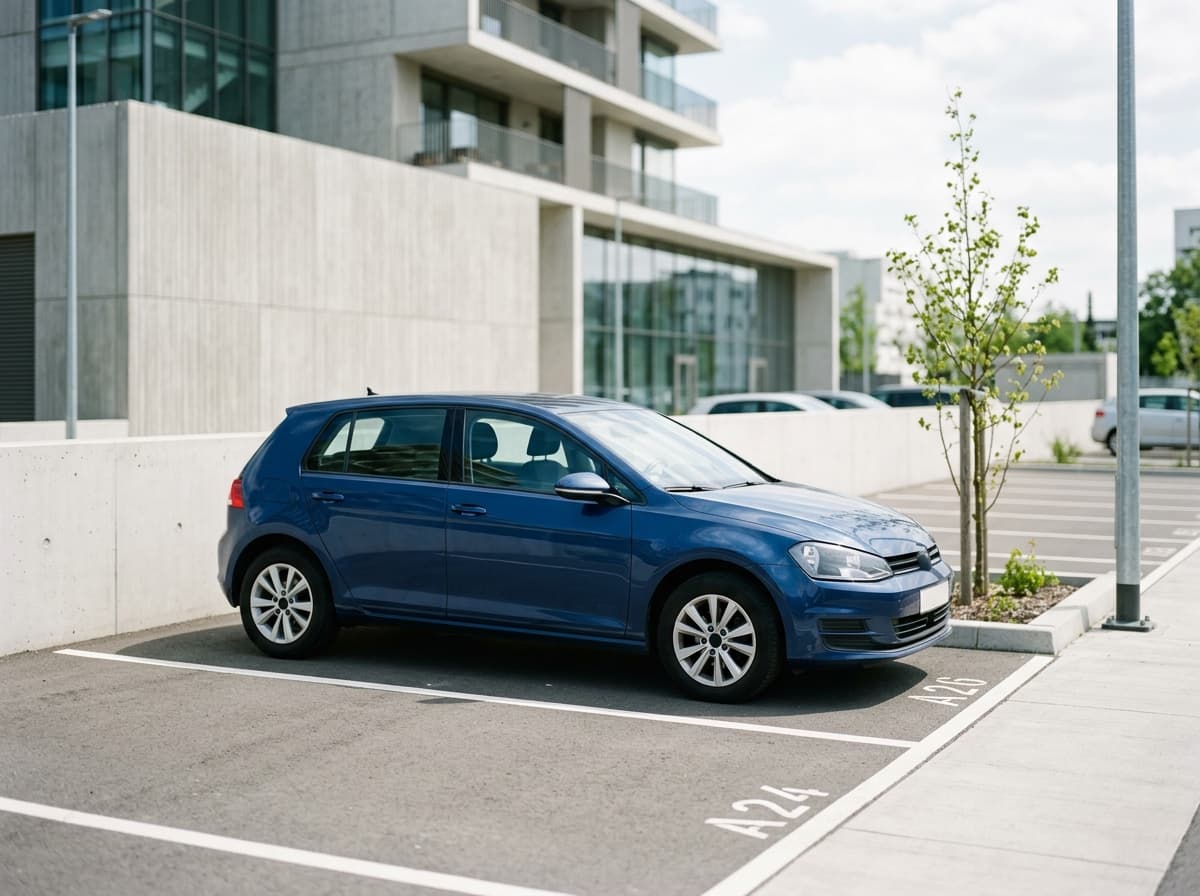
Take a Brussels household's second car, a twelve-year-old Polo that comes out for the Saturday shop and two visits a month to the parents: 3,000 km a year, maybe less. With a band discount, it is filed under "less than 5,000 km" or "less than 10,000 km", exactly like a car that does 9,900. On actual mileage, it pays for 3,000. The more the car sits still, the wider the gap between the two mechanisms, and this is the only case where the odometer takes back the upper hand over the address.
The profile is nothing unusual. The 2025 annual report of Car-Pass, the body that records the mileage of every Belgian car, puts the average Belgian car at 14,172 km a year, but that figure shrinks with age: 20,225 km in the first year, 12,074 km at ten years, 7,903 km at twenty. A second urban car, often an old one, naturally sits at the bottom of the curve.
That leaves measuring what the refund actually brings in. Belfius gave a figure that makes it possible, in the same 2023 release: more than 140,000 refunds paid in 2020 and 2021, totalling €4.7 million. That is about €34 per refund, during the two years when lockdowns emptied the roads as never before. It is not the total saving against a standard contract (the starting premium already rested on a low estimate), but it is the order of magnitude of what a year of driving less than planned puts back in your account.
Thirty-four euros.
Useful, no more. The money is made when you sign, on the starting estimate and on the choice of insurer, not at the end of the year.
How much does pay-per-km insurance cost?
For a city car and a driver over 30 with no claims who covers less than 10,000 km a year, CallMePower published indicative simulations in July 2026: at Belfius Direct, €292 for third-party liability alone, €434 with mini omnium (theft, fire, glass and weather damage), €753 for full omnium; at AXA, €320, €457 and €655; at Yuzzu, €329, €477 and €540. So the true per-kilometre formula is the cheapest for third-party liability and the most expensive for full omnium: the mechanism does not guarantee the premium. These amounts are not quotes and change with the commune, the car and the bonus-malus step.
Who really comes out ahead?
Three profiles, mainly. The household's second car first, for the reasons above. The city dweller who has switched to remote work or public transport and keeps a car for weekends and holidays. And the urban retiree who now only makes short trips.
Young drivers rarely gain. Some companies reserve the formula for drivers aged at least 26 with a few years free of at-fault claims, and for a first contract the starting step and the postcode outweigh everything else: we put figures on it in our article on young driver car insurance in Belgium.
Before signing, four questions to put to the insurer, in writing if possible:
- which covers does the per-kilometre calculation or discount apply to: third-party liability only, omnium as well, or assistance too?
- how is the mileage recorded: a simple declaration, a photo of the odometer, a connected box, and who pays for the box if there is one?
- what happens if you exceed it: a supplement at the end of the year, loss of the discount, or an excess applied only when you make a claim?
- can the formula be combined with bonus-malus protection or a welcome offer?
What happens if you exceed the declared mileage?
It depends on the mechanism. On actual mileage, you pay a supplement at settlement and stay covered, whatever the total.
With a band discount, the risk is concentrated on the day of the claim. According to Test-Achats, an overrun hidden on purpose can lead the insurer to refuse cover and claim back what it paid to victims; an unintentional overrun usually ends in an excess of €250, sometimes €500. A house move or the end of remote work are good reasons to tell your insurer before it finds out.
Compare the premium first, negotiate the kilometres second
The order matters.
Ask for three or four quotes with identical cover for your postcode, without mentioning kilometres, and keep the two cheapest. Only then raise the mileage question with those two. In Brussels, the gap between two insurers for the same profile can exceed the most generous mileage discount, and comparing then pays more than the formula itself. The real cost is insurance and servicing, not just the sticker price, and the full budget of a small car is broken down item by item in how much a city car costs per year.
For a second car doing under 4,000 km a year, widen the question before choosing an insurer: in Brussels, the resident parking permit (carte riverain) for a second vehicle costs at least €127 a year, and the car remains a fixed cost of some €2,000 before the first kilometre. The point where car sharing takes over is worked out in our article on car sharing versus a second car, and if the main car needs replacing, the ranking of the best city cars sets the segment's models side by side, with Belgian prices.
Citadines pas chères comparator
Compare all citadines pas chères side by side.
Compare now →
Frequently asked questions
Léa suit le marché des petites voitures depuis 2014. Basée à Liège, elle roule au quotidien en citadine et passe ses week-ends à comparer autonomies réelles, coffres et coûts d’entretien. Elle teste surtout ce qu’on utilise vraiment en ville : créneaux serrés, recharge en copropriété, trajets courts et budget assurance jeune conducteur.