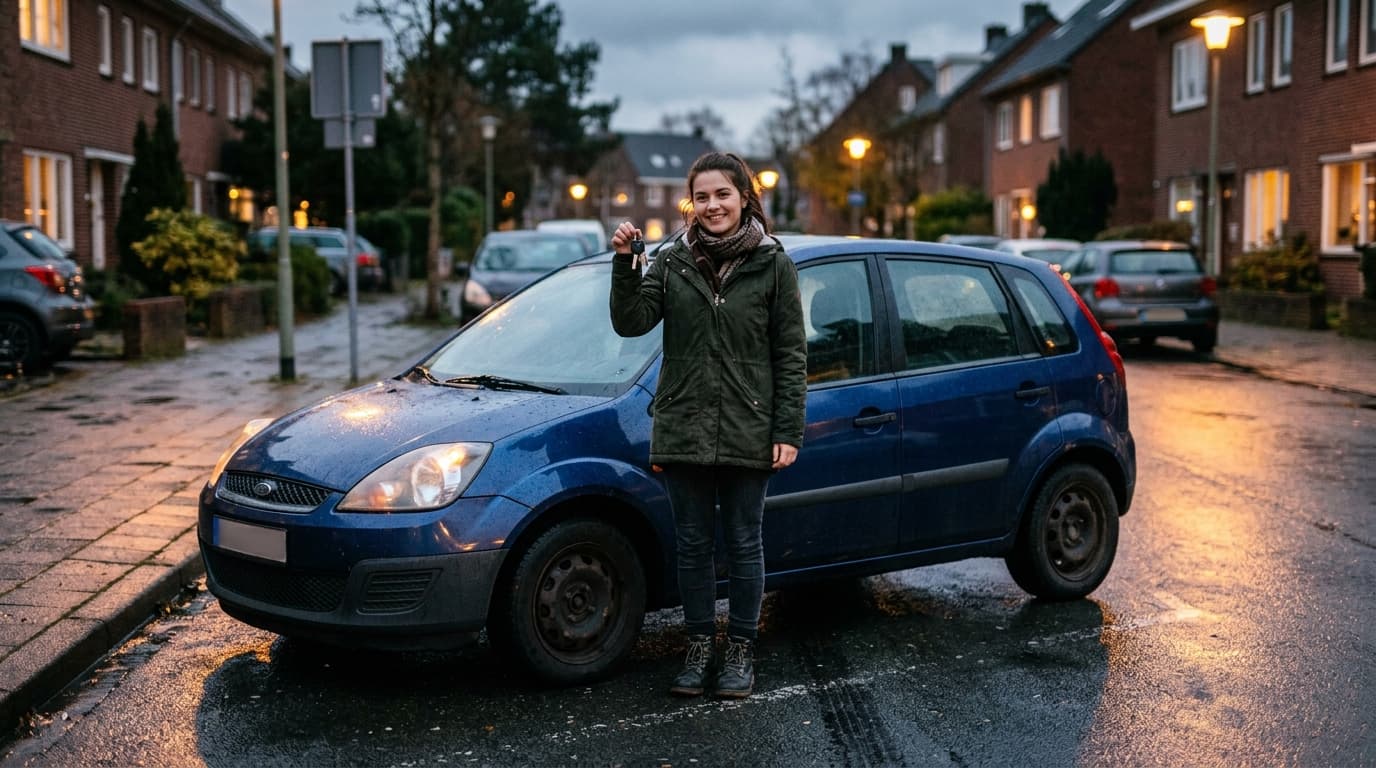
A young Belgian driver pays between €800 and €1,800 a year for third-party liability, and up to €3,500 for full omnium cover. The amount depends less on the car than on three things: your age, your postcode, and the bonus-malus level your insurer starts you at. Here is how those three dials are set.
How much does young driver insurance cost in Belgium?
Budget €800 to €1,800 a year for third-party liability alone (RC, the compulsory cover) for a driver aged 18 to 25. Mini omnium adds €300 to €500; full omnium pushes the bill past €1,800.
| Cover | Annual range (18-25) | Suits which car |
|---|---|---|
| RC only | €800 to €1,800 | used car over 7 years, worth under €8,000 |
| RC + mini omnium | €1,200 to €2,200 | used car 4 to 7 years old |
| RC + full omnium | €1,800 to €3,500 and up | recent car, or bought on finance |
Those ranges are wide, and that is exactly the useful part. For an identical profile — same age, same municipality, same car, same cover — the gap between the dearest and the cheapest insurer on the Belgian market commonly reaches €400 to €800 a year. An hour spent collecting four quotes pays better than six months of careful driving on fuel.
Put plainly: a young driver's premium is negotiated on the market, not on the car's spec sheet.
Why does your postcode weigh as much as your age?
Because Belgian insurers segment premiums on claim rates in your municipality of residence, and Brussels is the most expensive zone in the country. The same file — 20 years old, six-year-old Dacia Sandero, RC only — routinely moves from €950 in Marche-en-Famenne to €1,500 in Saint-Josse.
This is the variable French comparison sites cannot explain to you, because they work on another market. Here, traffic density, theft rates and parking-damage frequency read off the postcode, and the tariff grid follows. A student legally resident with their parents in the provinces but parking in Ixelles all week sits in a grey area: the legal address sets the premium, but claims consistently filed in the city eventually draw the insurer's attention at renewal.
So what does that mean day to day? Three things. If you move to a large city, tell your insurer — omitting it is a misstatement and can hollow out your cover at the worst possible moment. If you are choosing between two municipalities, the premium difference is worth asking about before signing a lease. And if you drive little, pay-per-kilometre cover becomes attractive precisely in the zones where the standard premium explodes.
What bonus-malus level do you start at?
Level 11 for a first private policy, around 85 % of the reference premium. Professional use starts at level 14, at 100 %. Each claim-free year takes you down one level; one at-fault claim takes you up five.
| Level | % of reference premium | Typical situation |
|---|---|---|
| 6 | 66 % | five years of driving without a claim |
| 8 | 73 % | three claim-free years |
| 11 | 85 % | first policy, private use |
| 14 | 100 % | professional use, or return after a claim |
| 16 | 111 % | one at-fault claim from level 11 |
| 22 | 200 % | ceiling of the classic scale |
One clarification changes how you read that table: since 1 January 2004, bonus-malus is no longer imposed by Belgian law. The European Commission saw it as an obstacle to free pricing, and the official system was replaced by the claims history certificate (attestation de sinistralité), which you can download yourself at carattest.be. Insurers kept the 23-level scale anyway, each with its own percentages: level 22 is worth 219 % of the reference premium at Ethias and 154 % at Partners. Published grids are therefore benchmarks, not a standard.
Some companies also sell protection mechanisms — lifetime bonus-malus, a joker on the first claim, accelerated descent of two levels a year. They genuinely exist at AG Insurance, Baloise, Belfius and Federale Assurance, under different commercial names and conditions worth reading line by line. In principle none of them is open to a driver who has just passed their test: they reward seniority.
What a parking bump really costs
The maths is brutal.
Take a Brussels-based young driver whose reference premium is €1,600. They sit at level 11. One at-fault scrape against a car park pillar, one mirror torn off while manoeuvring: five levels of malus. They do not restart at 85 %, they restart at 111 %, and above all they lose the five years of descent they would have made otherwise.
| Year after the claim | Level without claim | Level with claim | Extra premium |
|---|---|---|---|
| 1 | 10 (81 %) | 16 (111 %) | +€480 |
| 2 | 9 (77 %) | 15 (105 %) | +€448 |
| 3 | 8 (73 %) | 14 (100 %) | +€432 |
| 4 | 7 (69 %) | 13 (95 %) | +€416 |
| 5 | 6 (66 %) | 12 (90 %) | +€384 |
| Five-year total | +€2,160 |
Two thousand one hundred and sixty euros for a bumper a body shop repairs for €600. The calculation uses a classic 23-level scale and a €1,600 reference premium — substitute your own, the proportion holds: five levels of difference weigh roughly 135 % of one annual premium, spread over five years. It is the single figure I consider indispensable for a first policy, and I have never seen an insurer put it forward.
That does not mean you should hide a claim. It means that below a certain amount, declaring costs more than repairing — and I come back to that at the end.
Mini omnium or full omnium: what covers what?
Mini omnium adds four guarantees on your own car to compulsory third-party cover: theft, fire, glass breakage, acts of nature. Full omnium adds damage you are responsible for. The whole difference sits in that last line.
What mini omnium does not take on, and what many young drivers find out afterwards:
- the scrape or dent you cause yourself while manoeuvring;
- vandalism, excluded from most Belgian mini omnium policies;
- damage from an unidentified third party — the door swung into yours at the supermarket, nobody around;
- the bodywork scratches that pile up with street parking, the number-one small urban claim;
- any value beyond the car's actual market value on the day of the claim, never what you paid.
The benchmark I apply is simple: once the omnium premium exceeds 10 % of the vehicle's value, it no longer pays. A used city car valued at €7,000, insured for €1,900 on full omnium because the driver is 19, costs more over three years than the car is worth. Mini omnium, an excess you accept, and the difference into a savings account: on a first car that is nearly always the better trade-off. The exception is a car bought on finance, where the lender often requires full omnium until the final repayment.
Do you need a small engine to get cover?
No Belgian law sets a maximum power output for young drivers. The filter is commercial, and it is real: beyond 90 to 100 kW, many insurers refuse drivers under 24.
A city car clears that threshold easily: 46 kW for a Hyundai i10 1.0 and a Kia Picanto 1.0, 53 kW for a Toyota Aygo X, 67 kW for a Dacia Sandero 1.0 TCe, 74 kW for a Citroën C3 1.2 PureTech. That is the real reason the segment dominates first purchases. Power outputs and running costs side by side in our ranking of the best city cars and the city car comparator.
Five steps to pay less in your first year
- Get four quotes, on strictly identical cover. Same formula, same excess, same insured value. It is the only comparison that means anything, and it is worth €400 to €800 a year.
- Have yourself listed as a declared secondary driver on a parent's policy, not as an occasional driver. The distinction is decisive: a secondary driver appears on the contract and builds up bonus, an occasional one does not. Allow twelve to twenty-four months before switching to a policy in your own name.
- Pick the highest excess you can absorb. On a city car, moving from €500 to €1,000 of excess cuts the omnium premium by 10 to 15 %, and you would not have declared a €900 claim anyway.
- Ask explicitly for the provisional licence discount. Belgian learners drive on a provisional licence: model 36 — from age 17, with a guide, valid three years — or model 18. There is no automatic reduction equivalent to French accompanied driving, but a few companies grant one on request. Driver training rules are regionalised: check the ones that apply to you on mobilit.belgium.be.
- Pay the premium annually. Monthly instalments add 3 to 8 % in charges at most Belgian insurers, so €50 to €120 a year on a young driver policy.
A sixth lever, less obvious: if you drive under 7,500 km a year, ask for pay-per-kilometre cover. In town, with public transport and a bike, that ceiling arrives sooner than people expect — and the full annual budget is broken down in how much a city car costs per year.
When is it better not to declare a claim?
Below roughly €2,000 of at-fault damage, when you are at the start of the scale. The threshold comes from the table above: five levels of malus cost around €2,160 over five years to someone paying a €1,600 reference premium, and an excess doubled to €1,000 for a young driver already halves the payout.
Three caveats, because the rule is not absolute. A claim involving a third party must be declared, whatever happens: you have no choice, and driving off without reporting it exposes you to far more than a malus. Glass damage or theft falls under mini omnium and does not affect bonus-malus on most policies — declare it without waiting. And the trade-off changes entirely once you reach level 0 or 2, where there is no room left to descend.
If you disagree with your insurer, free recourse exists and it works: the Insurance Ombudsman handles complaints from Belgian policyholders, and Wikifin, the financial education service run by the regulator FSMA, publishes independent guidance on motor cover. The industry body Assuralia publishes the claim statistics behind the pricing. Three addresses worth knowing before you need them.
That leaves the car itself, which drives part of the premium. The guide to the best city car for a young driver compares models from that angle, and the quiz points you somewhere in four questions if you are still undecided.
Citadines pas chères comparator
Compare all citadines pas chères side by side.
Compare now →
Frequently asked questions
Léa suit le marché des petites voitures depuis 2014. Basée à Liège, elle roule au quotidien en citadine et passe ses week-ends à comparer autonomies réelles, coffres et coûts d’entretien. Elle teste surtout ce qu’on utilise vraiment en ville : créneaux serrés, recharge en copropriété, trajets courts et budget assurance jeune conducteur.