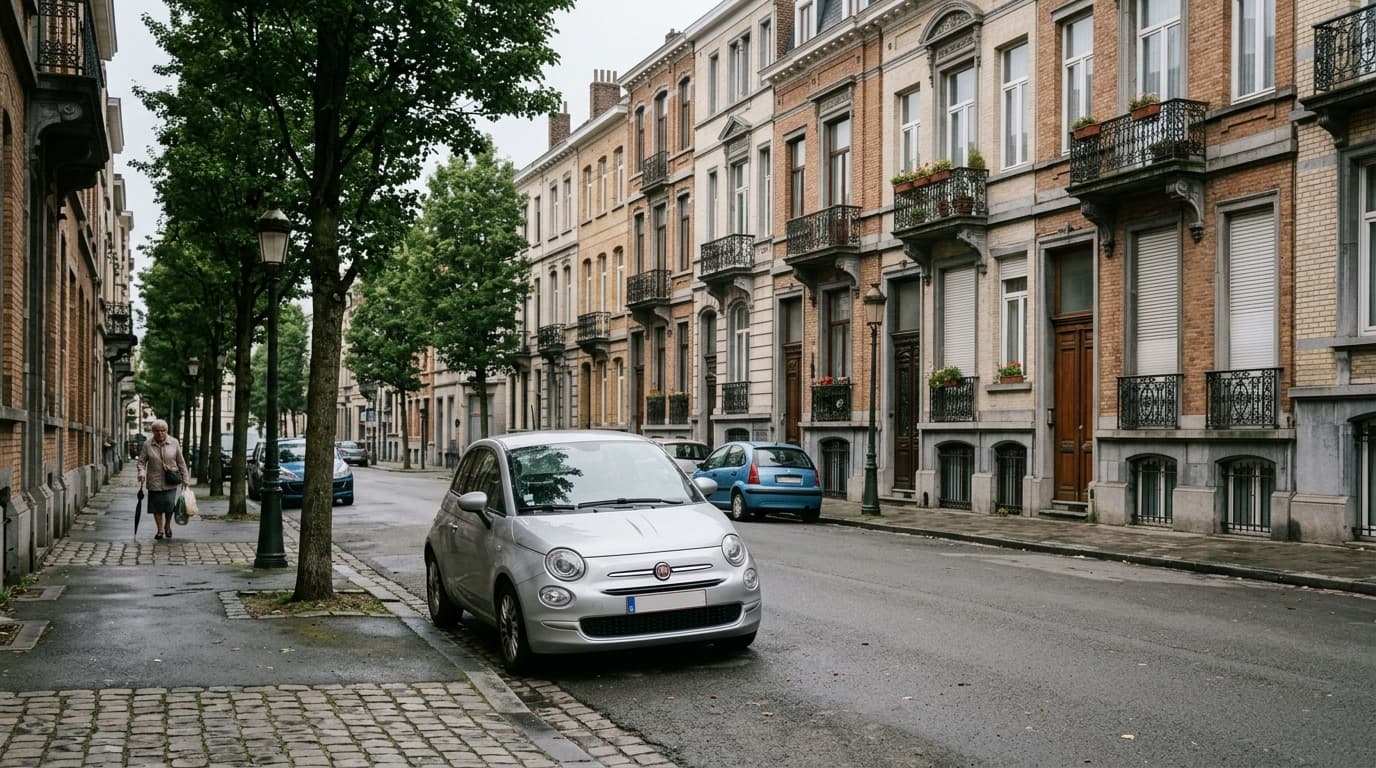
For a Brussels household, the tipping point sits around 4,300 km a year. Below that, Cambio or Poppy cost less than keeping the second car. Above it, ownership takes the lead again. The threshold moves mainly with how long your trips last, not with how far they go.
Car sharing or a second car: above how many kilometres?
There is no single threshold. It depends on how long the car sits idle while you have it booked, because that is where car sharing bills you without you covering any ground.
The calculation below pits a class S Cambio city car on the Bonus plan against a second second-hand city car owned in Brussels, across four trip profiles.
| Trip profile | Cost of the trip | Cost per kilometre | Tipping point |
|---|---|---|---|
| Local errands, 10 km over 2 h | €7.40 | €0.74 | ≈ 3,100 km/year |
| Ordinary outing, 25 km over 3 h | €14.30 | €0.57 | ≈ 4,300 km/year |
| Weekend, 300 km over two days | €142 | €0.47 | ≈ 5,600 km/year |
| Out-of-town run, 60 km over 3 h | €25.50 | €0.43 | ≈ 6,400 km/year |
Read the last column as a break-even point: below that annual mileage, car sharing costs less than ownership; above it, the reverse.
The result is counter-intuitive. Someone who drives to the shop four times a week tips towards ownership far earlier than someone who drives 60 km once a month, even though the second person covers more ground. Hourly billing punishes slow trips, not long ones.
A second car costs €2,032 a year before the first kilometre
This figure is half the calculation, and the half nobody works out.
Take a second-hand petrol city car, a Toyota Aygo X, Hyundai i10 or Dacia Sandero, bought at €7,000 and sold at €3,000 five years later, parked on the street in a Brussels commune.
| Item | Per year | Basis |
|---|---|---|
| Depreciation | €800 | €7,000 at purchase, €3,000 at resale five years later |
| Third-party insurance and roadside assistance | €520 | order of magnitude, second vehicle, experienced driver |
| Servicing, tyres, small repairs | €400 | vehicle aged 8 to 12 years, urban use |
| Road tax (taxe de circulation) | €130 | petrol city car, 5 fiscal horsepower, Brussels scale |
| Roadworthiness test (contrôle technique) | €55 | annual inspection from the fourth year |
| Resident parking permit, second vehicle | €127 | Brussels regional minimum since 5 May 2025 |
| Total | €2,032 | before a single litre of fuel |
Fuel comes on top, at roughly €0.12 per kilometre for a small petrol car burning 6 L/100 km, at the official maximum price for Super 95 E10 set by the FPS Economy at €2.058/l since 3 September 2026.
The surprising line is the resident permit, the carte riverain that entitles a household to park in its own zone. At the indexation of 5 May 2025, the Region left the first vehicle's permit at €15 a year and raised the second to €127, as the RTBF set out commune by commune. That amount is only a floor, and each commune then sets its own rate. Saint-Josse went down to €5 for the first permit, Woluwe-Saint-Lambert brings the second to €50 thanks to a local grant, the City of Brussels charged €110. Ixelles holds the regional record at €331 for a second vehicle longer than 4.90 m. Permits remain capped at two per household.
Put plainly, the household's second car pays eight times more than the first to occupy the same metre of kerb. And it is that car, not the other one, this trade-off is about.
How much does Cambio cost for a city car?
Three plans, one rate card per vehicle class. Class S covers city cars and is available at almost every station.
| Plan, class S | Subscription | Hour (6 am to midnight) | Kilometre under 100 km | 24-hour day |
|---|---|---|---|---|
| Start | €4/month | €2.35 | €0.41 | €28 |
| Bonus | €8/month | €2.10 | €0.32 | €25 |
| Comfort | €22/month | €1.85 | €0.29 | €22 |
Rates recorded on 18 September 2026 from Cambio's public rate card. Add a one-off €35 activation fee and a financial contribution of €150 to €500, refunded at the end of the contract. Fuel, comprehensive insurance, servicing, breakdown assistance and city parking are all included in those prices.
The night rate changes the picture on long bookings: between midnight and 6 am, the hour drops to €0.50 in classes S and M. Keeping the car overnight costs three euros, not twenty.
Poppy bills by the minute, Cambio by the hour
The two services do not replace the same car.
Poppy is free-floating: you take the vehicle wherever it is parked, leave it anywhere in the zone, with no subscription, fuel and parking included. Ideal for the unplanned, one-way trip. Cambio runs in a loop: dedicated bay, advance booking, return to the same spot.
To replace a second car, the loop wins. You know on Friday you will need a boot on Saturday morning.
Miles left Belgium in March 2025
The Belgian car-sharing market has narrowed, and plenty of comparisons have yet to register it.
Miles Mobility, which charged purely by the kilometre driven and ran around 1,400 vehicles for some 180,000 registered users, announced its withdrawal from Belgium in March 2025, citing vandalism and attempted thefts. The Moniteur Automobile covered both its arrival and its departure, and the consumer association écoconso documented the shrinking Brussels offer that followed.
None of this undoes the reasoning, but it adds a variable the arithmetic cannot see: selling your car means handing your mobility to two private operators in a market that has already lost one player in eighteen months. The Brussels-Capital Region keeps an up-to-date list of the services still running.
What happens the day the car has to be there right now?
The financial calculation says nothing about these situations, and they often decide in its place.
- the 6 am emergency, when the nearest station is empty and the app offers nothing before 9 am;
- the child seat, to be fitted and removed on every trip unless you leave it in the hallway;
- the daily commute, which blows up every car-sharing plan without exception;
- the pet, the furniture move, the building materials, rarely compatible with the terms of use;
- the unplanned late return, billed at double the hourly rate if you flag it, ten times if you do not;
- the holiday period, when vehicle availability degrades precisely when everyone wants one.
None of these is a deal-breaker on its own. Taken together, they explain why households below the threshold keep their car anyway, and why that choice is anything but irrational.
Sell the second car or keep it?
Three cases settle cleanly.
Under 3,000 km a year, sell. At that rate the car spends 97 % of its life stationary, you pay €2,032 in fixed costs for €360 of fuel, and any combination of Cambio, public transport and the occasional taxi costs less. This is the classic case of the household that kept an old Volkswagen Polo "just in case" after moving into the city, uses it only for Saturday shopping and a monthly visit to family, and yet keeps putting it through the annual roadworthiness test.
Between 3,000 and 6,000 km a year, the answer depends on how long your trips last. Go back to the first table, find the profile closest to yours, and compare it with the mileage recorded in your service book. Not with your estimate.
Above 6,000 km a year, keep the car. At that level no car-sharing plan competes, and the real question becomes whether the vehicle you have is the right one. Our ranking of the best city cars and the city car comparison tool are there for that.
Run the numbers with your own figures
Three inputs are enough: your real annual mileage, read off the last roadworthiness test certificate, the average length of your outings, and the price of the resident permit in your commune. Everything else follows.
Watch out for one well-documented bias: most urban drivers overestimate their mileage by 30 to 40 %. That gap alone is enough to flip the decision. We broke down the full annual cost of a small car model by model in our article on how much a city car costs per year, and the low-emission zones (LEZ) add a deadline worth watching if the car you are hesitating over is a diesel, as set out in our guide to the LEZ of Brussels, Antwerp and Ghent.
One last point, often forgotten: Cambio's financial contribution is refunded when the contract ends. Trying it for six months before selling costs only the subscription and the trips.
Guides d’achat comparator
Compare all guides d’achat side by side.
Compare now →
Frequently asked questions
Léa suit le marché des petites voitures depuis 2014. Basée à Liège, elle roule au quotidien en citadine et passe ses week-ends à comparer autonomies réelles, coffres et coûts d’entretien. Elle teste surtout ce qu’on utilise vraiment en ville : créneaux serrés, recharge en copropriété, trajets courts et budget assurance jeune conducteur.