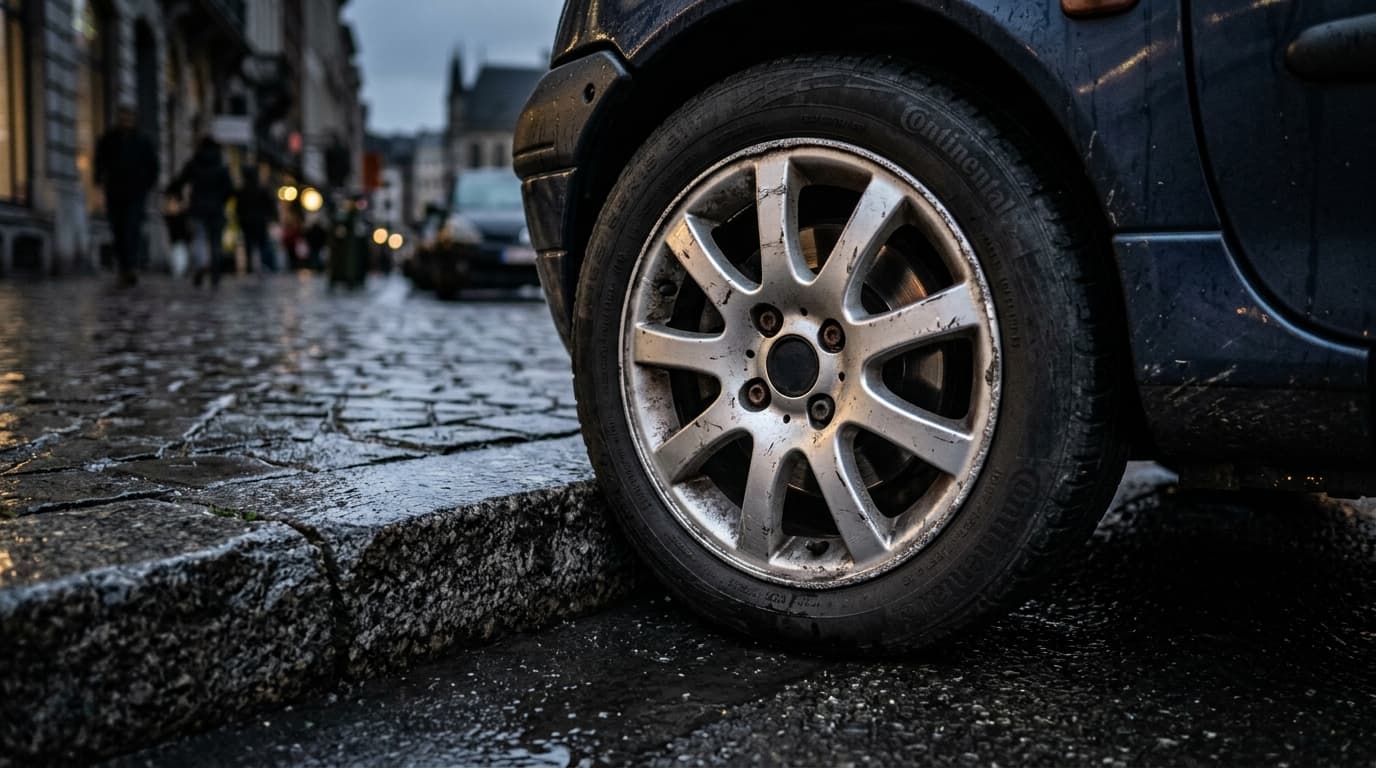
A wheel scraped on a kerb can be touched up at home in one case only: a shallow scuff on a wheel painted silver, with no impact and no air loss. The kit costs about twenty euros. As soon as the wheel is cracked, bent or diamond-cut, it is a workshop job, and prices checked in Belgium run from €100 to €450 apiece.
Scuffed, gouged or buckled: three kinds of damage with nothing in common
A tight parallel park always makes the same noise. That noise tells you nothing about how bad it is.
A wheel rubbed at 3 km/h while reversing along a kerb loses paint and a little aluminium on its rim edge, nothing more. A wheel that hits the same kerb at 30 km/h, because you clipped the pavement while turning, can bend or crack without a single scratch showing from the outside.
| Damage | How to recognise it | DIY repair? | Next step |
|---|---|---|---|
| Shallow scuff | paint scraped off the rim edge, aluminium barely marked | yes, if the wheel is painted | touch-up kit |
| Gouge | missing metal you can feel with a fingernail | no, not cleanly | wheel refurbishment workshop |
| Buckle or deformation | vibration in the steering wheel, falling pressure | no | specialist, or replacement |
| Crack | fine line, often on the inside of the wheel | never | replacement |
How do you know the wheel is only scratched?
Two minutes, crouched next to the wheel, with your phone torch. I always run the same checks, in this order:
- the tyre sidewall next to the scuff: a bulge, even a small one, means a damaged carcass and a tyre that must be replaced;
- the rim edge seen side-on: it should stay perfectly round, with no flat spot and no fold;
- the inner face of the wheel, the one you never see, with the steering on full lock;
- the pressure, measured the same day and again three days later;
- the steering wheel on a fast road, between 90 and 120 km/h, looking for a new vibration.
Five reassuring answers and you have a paint problem. One worrying answer and a home touch-up is no longer the question.
Which wheels can you touch up yourself?
Alloy wheels painted in a single colour, and in practice mostly silver ones. Retail kits come with a filler and a silver paint: on an anthracite or black wheel, the repair will show from ten metres away.
Diamond-cut wheels are out. You recognise them by a bright, polished-looking face that contrasts with dark painted recesses: that face is machined on a lathe and then lacquered, and no filler reproduces that shine. They need re-machining in a workshop.
As for steel wheels under a wheel trim, common on entry-level city cars, it is the plastic trim that took the hit. It can be replaced without tools.
How do you repair a scratched alloy wheel in six steps?
The Quixx kit for silver wheels was listed at €19.99 on bol.com on 4 October 2026. It contains an aluminium-based filler, a silver paint, sandpaper and gloves, and its maker intends it for light to medium scratches. We have not tried it: the method below follows the steps described on the product page (sand, fill, reshape, paint), plus the usual bodywork precautions.
- Wash the wheel with car shampoo and dry it. Brake dust, black and greasy, stops anything from sticking.
- Mask the tyre with painter's tape along the whole length of the area you are treating.
- Sand the scuff with sandpaper, from the coarsest grit to the finest, until your finger no longer feels an edge.
- Fill with the putty in a thin layer, slightly overfilling, then let it harden for the time stated in the instructions.
- Sand again with fine grit to restore the profile of the rim edge.
- Apply the silver paint in thin passes rather than one thick coat.
Allow half a day somewhere dry and out of the cold, most of it spent waiting for things to dry. The realistic result is a wheel that looks clean from two metres, not a new wheel.
Three mistakes keep coming back: sanding a diamond-cut wheel, painting without degreasing, and touching up a wheel that vibrates in the hope the fault was cosmetic.
How much does a wheel repair cost in Belgium?
More than the €80 to €150 quoted on many French pages. Here are the prices Belgian workshops were advertising themselves on 4 October 2026 (TVAC means VAT included).
| Solution | Price checked | Time | For which damage |
|---|---|---|---|
| Quixx touch-up kit (bol.com) | €19.99 | half a day, drying included | light scuff, silver wheel |
| Polishing, Wheelservice Maertens (Jabbeke) | €50 to €100 per wheel | a few hours | fine scratches, oxidation |
| Repair, Wheelservice Maertens (Jabbeke) | €100 to €200 per wheel | depends on the damage | gouge, kerb damage |
| Repair, La Carrosserie Namuroise (Namur) | €235 to €450 incl. VAT per wheel | a few hours to a day | scratch, buckle, deformation |
| Repair, Car Alliance (Eupen, Liège, Verviers) | from €290 | on quotation | scuff, chip, dent |
The ranges stretch from €100 to €450 for the same wheel, and the services do not fully overlap. Do the sum for a city car whose two kerb-side wheels have been hit: €200 to €400 in West Flanders, €470 to €900 in Namur. Always ask whether the price includes removing the tyre and rebalancing the wheel.
A word on welding. Some workshops offer to weld a cracked wheel; the Jabbeke specialist itself writes that it is not always advisable from a safety point of view. On a city car, where a second-hand replacement wheel is easy to find, I would not have one welded.
For insurance, the reasoning is the one we set out for a bodywork scratch: below your excess, you do not claim.
Does a damaged wheel pass the roadworthiness test?
Scratched, yes. Cracked or badly bent, no.
The Belgian roadworthiness test (contrôle technique, the periodic inspection every car over four years old must pass) does not judge looks. EU Directive 2014/45, which Wallonia, Brussels and Flanders each apply through their own test centres, includes an inspection item dedicated to wheels, where cracks and serious deformation appear. A major defect leads to a red certificate (carte rouge) and a retest, within fifteen days according to Touring, a deadline Flanders has extended to two months according to Le Moniteur Automobile. The retest costs €16.50 in Wallonia, a rate reported by the same magazine.
The tyre is penalised far more often than the wheel. In the 2023 figures from the three regions compiled by the site controle-technique.be, tyres damaged down to the cord top the causes of red certificates. A kerb strike that leaves a bulge on the sidewall takes you straight there.
Protecting your wheels from the kerb: three options, one of them free
The free one first: tilt the right-hand mirror down when reversing. Some city cars do it automatically, provided you have switched the option on in the settings: the manual covers it in one line. Seeing the kerb solves most of the problem.
Second option, tyres with a rim protector. This rubber rib sits slightly proud of the wheel and rubs in its place; you spot it on the sidewall by the markings MFS or FSL, depending on the brand. It mostly exists on low-profile tyres, so rarely in the sizes fitted to small city cars: check before counting on it.
Third option, an add-on protector. The AlloyGator set is advertised at €134.90 for four by its French distributor, for wheels of 12 to 24 inches: a composite nylon profile seated between the wheel and the tyre, with the tyre deflated. The distributor does not advertise a fitting network in Belgium, so you will have to convince your tyre fitter. The purchase makes sense for someone who parks on the street every day on diamond-cut wheels. On silver wheels that a €20 kit can rescue, I would keep my money.
If your wheels suffer because the car is too long for your parking spaces, the wheel is no longer the issue: our ranking of the best city cars gives the dimensions, and the guide to parking in Brussels explains the rules commune by commune.
Guides d’achat comparator
Compare all guides d’achat side by side.
Compare now →
Frequently asked questions
Léa suit le marché des petites voitures depuis 2014. Basée à Liège, elle roule au quotidien en citadine et passe ses week-ends à comparer autonomies réelles, coffres et coûts d’entretien. Elle teste surtout ce qu’on utilise vraiment en ville : créneaux serrés, recharge en copropriété, trajets courts et budget assurance jeune conducteur.