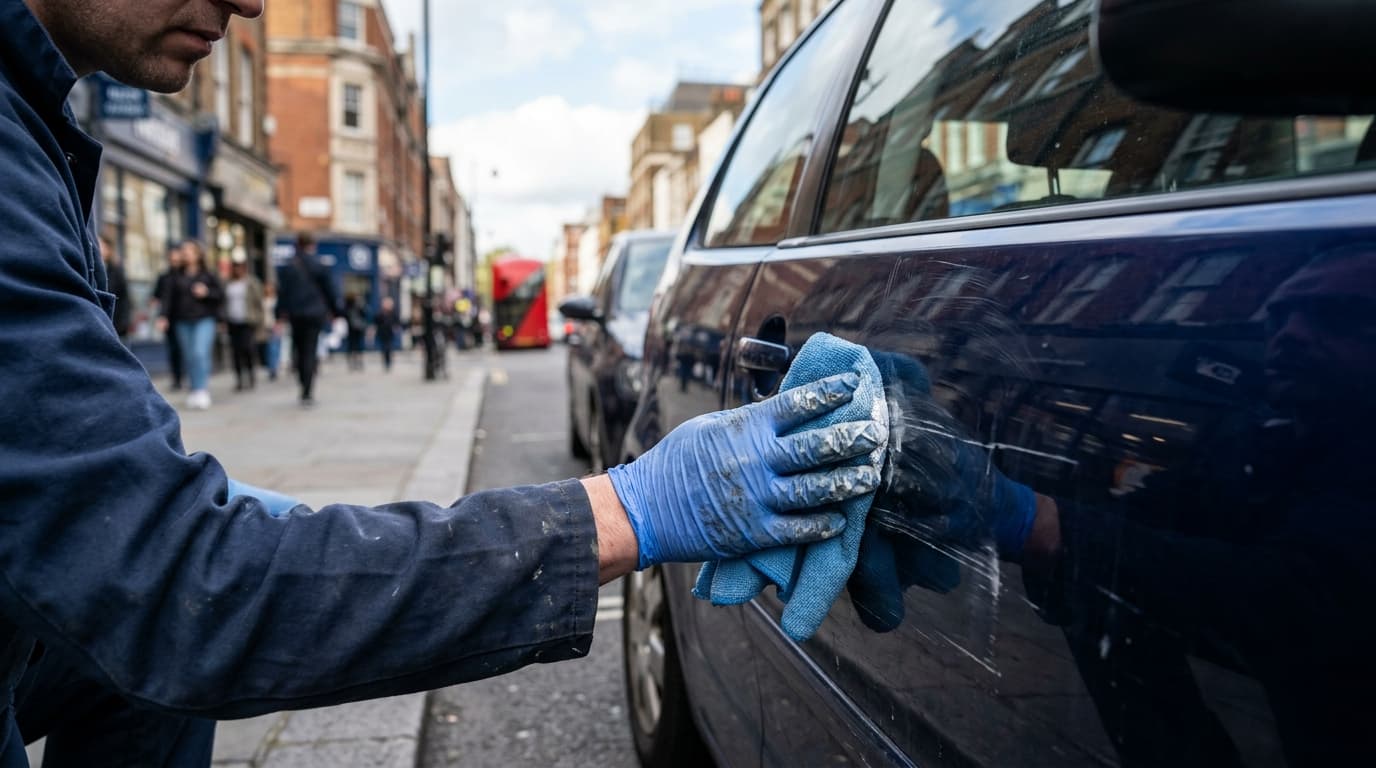
A scratch on a city car is part of urban parking life: a badly placed bollard, a bike leaning over, a supermarket trolley. Eight times out of ten it only touches the clear coat and comes out with polish, in half an hour and for under €20. The fingernail test tells you straight away which case you're in.
How do you know whether a scratch will polish out?
Run your fingernail across the scratch on dry paint. If it glides without catching, you're in the clear coat and a correcting polish will remove it. If it catches, the colour coat is broken and no off-the-shelf product will make it disappear completely.
Modern automotive paint is four layers stacked within a few tenths of a millimetre: steel, primer, colour coat, then the clear coat that protects everything else. The clear coat alone is 40 to 50 microns, about the thickness of a fine hair. It takes 90 % of car-park scratches, and it's the only level you can correct yourself.
The colour at the bottom of the scratch gives you the diagnosis without any tools. A whitish line that vanishes when you wet the area: clear coat, easy case. A grey or matte white line still visible when wet: the primer is exposed. A bright metallic line: bare steel. Only that last case is urgent — in Belgian rain, bare metal starts browning within three to six weeks, and a rust bubble under intact paint costs ten times the price of a touch-up pen.
What do you need, and what does it cost?
Two clean microfibre cloths, car shampoo and a correcting polish. Budget €15 to €30 for a kit that will last several years across the whole car, not just today's scratch.
| Product | Common brands | What it fixes | Typical price |
|---|---|---|---|
| Correcting polish (fine abrasive) | Meguiar's ScratchX, 3M Perfect-it | Micro-scratches, swirls, marks in the clear coat | €12 to €25 |
| Consumer scratch remover | Turtle Wax, Sonax | Scuff marks, very light scratches | €8 to €15 |
| Touch-up pen in the factory colour | Depends on the car brand | Scratches down to primer or metal | €15 to €30 |
| Microfibres + pH-neutral shampoo | Meguiar's, Sonax | Preparation, without which nothing holds | €10 to €20 |
A word on orbital polishers, the standard forum recommendation: at €120 for an entry-level machine, they only make sense if you plan to do the whole car. On an isolated 10 cm scratch, hand work is just as good and won't burn the clear coat on a door edge.
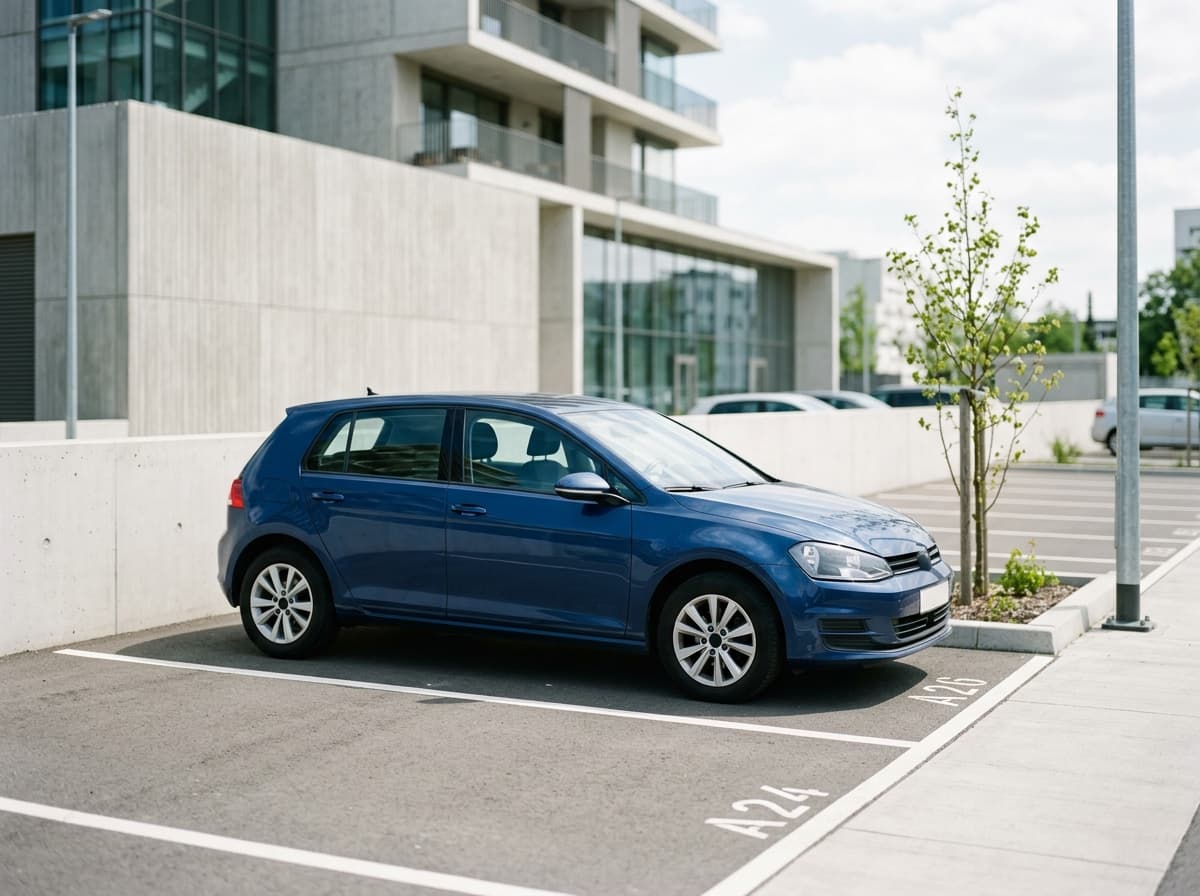
How do you remove a surface scratch in five steps?
Wash, dry, apply polish in small circles, let it work for a few seconds, buff off with a clean microfibre. Thirty to forty-five minutes on a door panel, of which five minutes is actual polishing.
- Wash the area with car shampoo and rinse. A single grain of sand trapped under the cloth turns one scratch into ten. Everyone rushes this step, and it's the reason three-quarters of attempts fail.
- Dry completely, in the shade, between 10 and 25 °C. In direct sun the polish dries before it has worked and leaves a white haze that's a nuisance to fix.
- Put a pea-sized amount of polish on the cloth, never straight onto the paint. Work in tight small circles over a 20 × 20 cm area with moderate pressure — the weight of your hand is enough.
- Buff off with a second clean, dry microfibre, then inspect under raking light. A phone torch held flat against the panel shows what daylight hides.
- Repeat twice at most. If the scratch is still there after three passes, it isn't in the clear coat: stop and move to the next section. Pushing on only thins the clear coat until you go through it.
Once the scratch is gone, put wax or sealant back on the area. Polishing stripped the existing protection, and polished bare paint gets dirty twice as fast.
What if the scratch reaches the colour coat or the metal?
A touch-up pen in the exact factory colour. The paint code sits on a sticker on the driver's door pillar, under the bonnet, or in the boot under the carpet. Without that code, the repair will show more than the scratch did.
The method is nothing like polishing: you're not erasing, you're filling and protecting. Degrease with isopropyl alcohol, apply the paint in very thin coats with a fine brush or a toothpick, allow 20 minutes between passes, then finish with clear coat. The result isn't invisible; it's tidy from a metre away, and it stops the rust. That's the realistic ceiling of a home repair.
Three situations call for a body shop instead of a pen: the scratch crosses two panels, it runs more than 20 cm on a flat visible surface, or a rust bubble has already appeared. In all three, a rough touch-up will cost you more in resale value than the scratch itself.
What does a body shop charge in Belgium?
Belgian body shops charge €50 to €80 an hour. A localised repair, known as smart repair, comes to €100 to €250 per panel; a full door refinish, including sanding, primer, paint and clear coat, climbs towards €300 to €600.
The gap comes down to method. Smart repair treats a hand-sized area without removing the panel: two hours in the workshop, a localised paint blend, and the price follows. A full refinish repaints the entire panel to guarantee the colour match, which means stripping handles and seals, a spray booth and drying time. On a city car worth €8,000 to €12,000, that second option deserves a hard think.
So what does that look like in practice? Get quotes before deciding. Belgian online quote platforms such as Fixico or Wondercar send back three or four offers from body shops in your area within 24 to 48 hours, which spares you the first price accepted out of fatigue. On the same wing scratch, I've seen €180 between two workshops six kilometres apart in Liège.
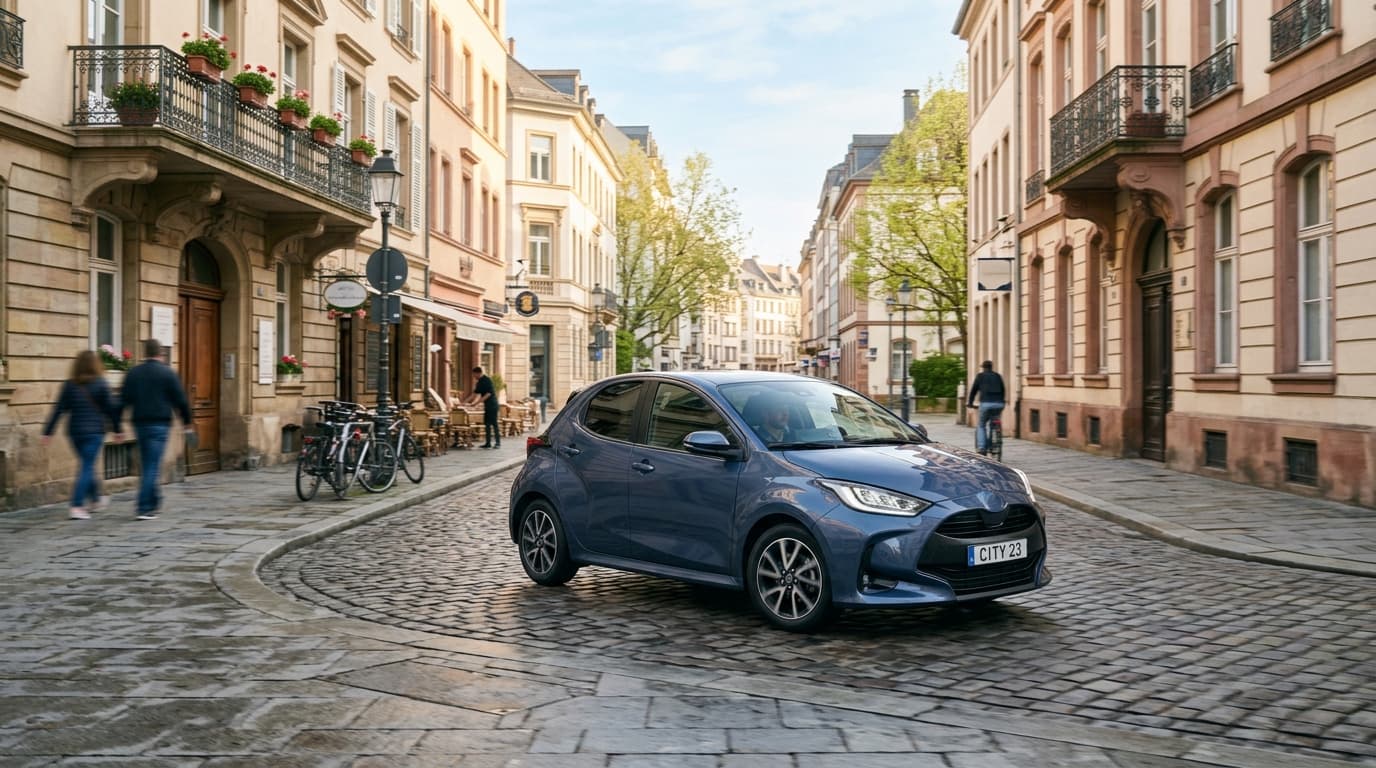
Should you claim a scratch on your comprehensive policy?
Rarely. Two numbers settle it: your excess, often 2 to 3 % of the insured value, and the 5 bonus-malus points an at-fault claim adds to your contract. Below €500 of damage, claiming almost always costs more than the bill.
The maths is easy to lay out. Take a city car insured for €12,000 with a 2.5 % excess, so €300. A scratch quoted at €350 leaves you €50 reimbursed — and a higher premium for three to five years, the time it takes to climb back down the bonus-malus scale. The claims record also follows the driver from one insurer to the next: switching companies doesn't erase it. The insurers' federation Assuralia documents how these mechanisms work, to be cross-checked against your own policy terms, which are the only binding text.
The logic flips in two cases. Malicious damage with a police report: many contracts treat it as vandalism, outside the bonus-malus, and there you should claim. Damage caused by an identified third party: their liability cover pays and your bonus stays put, so never skip the accident statement. In short: the amount doesn't decide, knowing who is at fault does.
The mistakes that make a scratch worse
Five habits come up again and again, and they turn a 10 cm mark into a €300 repair.
Toothpaste and baking soda first. They do abrade, true, but with uneven, uncalibrated grains: you swap a crisp line for a dull halo the size of a saucer, far more visible in daylight. Polishing dirty paint next — the grit acts as sandpaper. Third mistake: holding a machine polisher too long in one spot, which heats up and burns through the clear coat on an edge, irreversible damage that forces a respray.
The two most expensive come last. Leaving bare metal "until spring": in our climate, corrosion starts within weeks and creeps under intact paint, invisible until the bubble appears. And hiding a scratch with an approximate-colour pen before selling: an attentive buyer spots it in thirty seconds, and will assume, fairly or not, that the rest of the maintenance was handled the same way.
Does a scratch hurt resale value?
Yes, but moderately, and predictably: a private buyer typically knocks off two to three times the real repair cost. A scratch worth €200 in smart repair costs you €400 to €600 on the negotiated price. Fixing it before selling pays off as soon as the quote is reasonable.
There's nothing mysterious about the mechanism. Faced with marked bodywork, a buyer doesn't count the repair, they count the risk: what they can see, plus what they can't. On the Belgian used market, where three- to five-year-old city cars sell within days, a clean car goes for the asking price and a scratched one opens the bargaining. Dealers apply a more mechanical discount, usually the workshop cost plus their margin.
One reassuring point to finish on: the Belgian roadworthiness test doesn't judge cosmetics. What it cares about is a sharp metal edge at pedestrian height or a part about to fall off. A mark in the paint, however long, passes without comment. If you're weighing repair against selling, our ranking of the best city cars gives current segment values, the city car comparator puts them side by side on price and running costs, and the quiz points you somewhere in four questions if you're moving on to another model.
Guides d’achat comparator
Compare all guides d’achat side by side.
Compare now →
Frequently asked questions
Léa suit le marché des petites voitures depuis 2014. Basée à Liège, elle roule au quotidien en citadine et passe ses week-ends à comparer autonomies réelles, coffres et coûts d’entretien. Elle teste surtout ce qu’on utilise vraiment en ville : créneaux serrés, recharge en copropriété, trajets courts et budget assurance jeune conducteur.