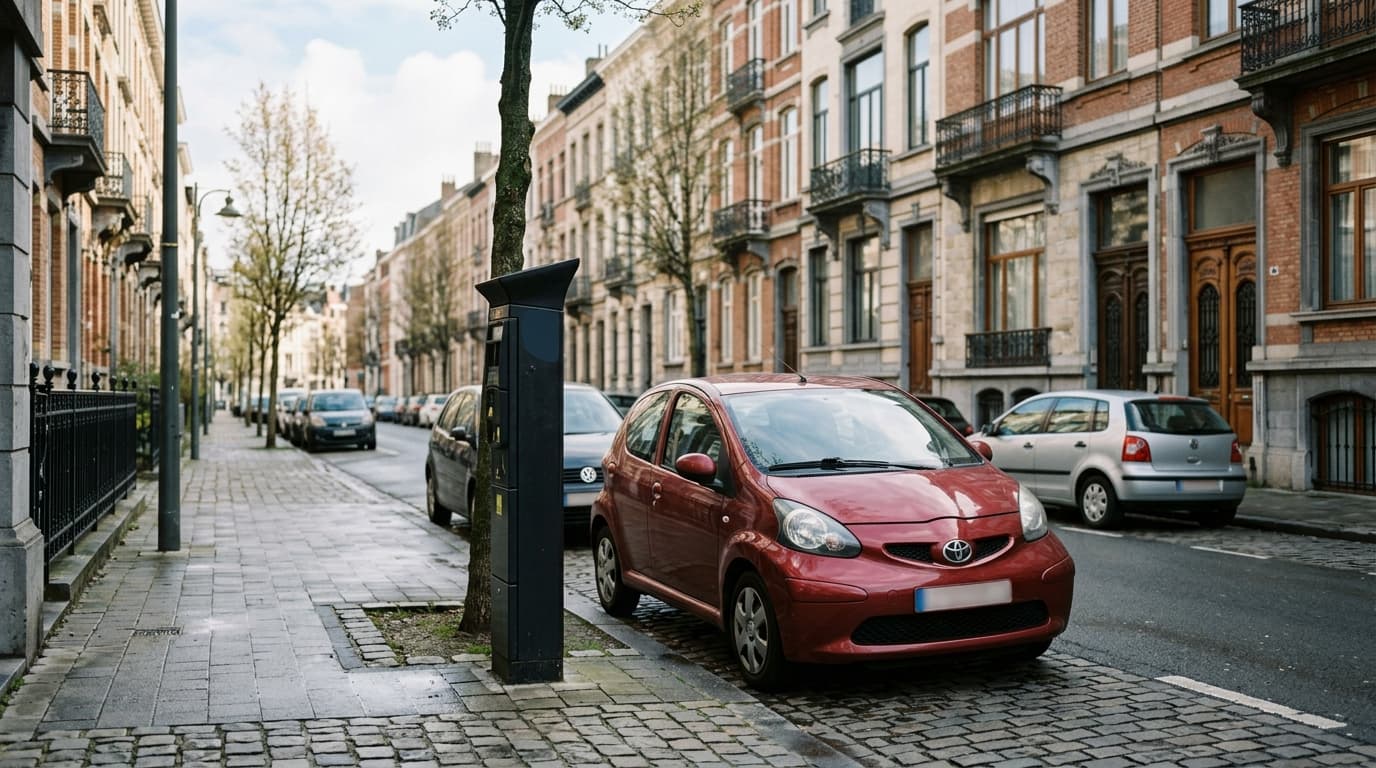
In Brussels, the zone colour decides the price and the maximum stay, and the commune decides the hours. Two hours cost €5.50 in a green zone, €9.20 in a grey or red zone, and nothing in a blue zone with a disc. Forgetting costs €37 to €47. Residents avoid all of it with a resident permit, the carte riverain, from €15 a year.
How does parking work in Brussels?
The Region sets the framework and the rates. Each of the nineteen communes (the local municipalities) then draws its zones, picks its hours, issues or delegates its permits, and enforces.
The result baffles every newcomer: a street running from Ixelles into the City of Brussels can change hours halfway along a pavement. There is no single Brussels rule, only a shared grammar (four colours, one disc, one text number) and nineteen dialects.
Enforcement increasingly relies on scan cars, vehicles fitted with cameras that read number plates. Payment is therefore tied to your registration, not to a ticket.
Who manages parking in your commune?
This is the first thing to settle, because it tells you where to apply for your permit and where to dispute a charge.
Twelve communes have handed management to the regional agency parking.brussels: Anderlecht, Berchem-Sainte-Agathe, Evere, Forest, Ganshoren, Ixelles, Jette, Koekelberg, Molenbeek-Saint-Jean, Saint-Gilles, Schaerbeek and Watermael-Boitsfort. The others, including the City of Brussels, Etterbeek, Uccle and Saint-Josse, still run it themselves, according to the list kept by the Brussels support centre for debt mediation services. The commune keeps control of policy; the agency handles permits, enforcement and collection.
Green, grey, red or blue zone: how much and for how long?
The amounts below are those of the regional scale, which the City of Brussels aligned with in summer 2025. They appear in the City's official FAQ, checked on 27 September 2026.
| Zone | Maximum stay | 1 h | 2 h | Maximum payable | Charge if unpaid |
|---|---|---|---|---|---|
| Green | unlimited | €1.80 | €5.50 | €27.10 (until 7 pm) or €32.50 (until 9 pm) | €37 |
| Grey | 4 h 30 | €3.60 | €9.20 | €23.10 for 4 h 30 | €47 |
| Red | 2 h | €3.60 | €9.20 | €9.20 | €42 |
| Blue | 2 h | free (disc) | free (disc) | free | €37 |
In the City's green, grey and red zones, a free quarter of an hour can be activated at the meter or in the app, once per parking period. The resident permit is worthless in a red zone.
The painful calculation is the one for forgetting. Four hours in a green zone cost €10.90.
Forgetting costs €37.
And since the flat-rate charge only covers 4 h 30, a city car left all day without a ticket can collect more than one. Conversely, the first vehicle's resident permit, at €15 a year, costs less than a single charge.
Until what time do you have to pay?
It depends on the street, and this is where general-interest sites most often get it wrong. The same colour does not mean the same hours from one commune to the next, nor from one neighbourhood to another within the same commune.
| Commune | Rule in force | Source |
|---|---|---|
| City of Brussels, Pentagon and Avenue Louise | paid from 9 am to 9 pm, Monday to Saturday | City parking plan |
| City of Brussels, Laeken, North, Leopold quarter | green zones paid from 9 am to 7 pm, Monday to Saturday | City parking plan |
| City of Brussels, Heysel-Verregat | grey zone from 9 am to 9 pm, seven days a week, public holidays included | City parking plan |
| Ixelles | red until 7 pm, grey until 9 pm, green and blue until 6 pm | commune page, updated 31 August 2026 |
| Etterbeek | green zone capped at 4 h 30 for non-residents, first quarter of an hour free | commune page checked on 27 September 2026 |
| Molenbeek | almost entirely grey zone since 2 February 2026, so 4 h 30 maximum without a permit | BX1, 3 February 2026 |
| Berchem-Sainte-Agathe, Ganshoren, Koekelberg | blue zones scrapped, paid green zone since 2 February 2026 | BX1, 3 February 2026 |
The north-west switch, reported by BX1, shows how fast these rules move: five communes changed regime on the same Monday, and drivers who used to park for free with a disc in Ganshoren have been paying at the meter ever since. The Ixelles commune page shows the other trap, hours that change with the colour inside a single commune, and it reminds drivers that the signs in the street always prevail.
A simple habit: look at the nearest meter before you lock the car. It shows the zone, the rate and the hours.
How do you get a resident parking permit in Brussels?
Allow half an hour of paperwork, plus your commune's processing time.
- Check your address and your plate. The permit requires registration in the commune's population register and a car registered in your name, or one you have exclusive use of.
- Find the right counter. Commune managed by parking.brussels: apply online with your electronic identity card and its PIN code. City of Brussels: by email to the traffic department, through Irisbox or at the counter on Boulevard Anspach.
- Attach the documents. Registration certificate, plus a leasing or rental contract, or an employer's certificate of exclusive use for a company car.
- Choose the duration. One or two years. In the City, €15 for one year or €30 for two for the first permit, €127 or €254 for the second.
- Remember your sector. The permit is electronic and only valid in the sector you are assigned, never in a red zone. The City has agreements with six neighbouring communes for streets that straddle a municipal boundary.
Car size can matter. Ixelles charges €331 for the second permit of a vehicle longer than 4.90 m, a threshold no city car comes close to: a Kia Picanto measures 3.60 m, a Renault Clio VI 4.12 m.
Meter, text to 4411 or app: how do you pay?
Three routes, one outcome: your plate is logged as paid up.
| Method | Set-up time | Requirements | Worth knowing |
|---|---|---|---|
| Parking meter | 1 minute | bank card and plate number | shows the street's zone and hours |
| Text to 4411 | 2 minutes the first time | a phone | also used to activate visitor codes |
| App | 5 minutes to sign up | EasyPark, 4411, Yellowbrick, Autlo or Seety | detects the zone and lets you stop paying remotely |
If the nearest meter is out of order, the City of Brussels asks you to display the blue disc, which then gives you two hours. Use the European model and set the arrow to the half hour following your arrival: arriving at 11:05, you show 11:30.
A €37 charge is not a fine
Legally, not paying amounts to choosing the flat rate. It is a charge, a price, not a Highway Code penalty.
Left on the windscreen, it must be paid within twelve days. Sent by post, within fifteen days, and always to the keeper registered with the DIV (the Belgian vehicle registration service), even if your partner was driving that day. A first reminder is free, a second adds €15 plus postage, and a formal notice can add another €15 before the file goes to a bailiff, which turns a €37 charge forgotten in a drawer into a debt that has almost doubled without anyone ever writing you a ticket.
You can dispute it in writing, ask for the scan-car photos, and turn to the Brussels Ombudsman if the answer does not satisfy you. Ixelles, Schaerbeek and Woluwe-Saint-Lambert have their own municipal ombudsman.
Six mistakes that cost you a charge
- parking in a red zone thinking the resident permit covers it;
- using your permit in the neighbouring sector, even two streets from home;
- leaving the car more than 4 h 30 in a grey zone after paying the maximum;
- missing that the local blue zone has turned green, as in Ganshoren or Koekelberg;
- setting the disc to your exact arrival time, or changing it during your stay;
- ignoring the first letter: it is the only free reminder.
To find out whether your car can still enter the region, read our guide to the low-emission zones (LEZ) of Brussels, Antwerp and Ghent. If you are unsure about keeping a second car, whose resident permit costs eight times more than the first, the full calculation is in our article on car sharing versus a second car. And to pick a car that slips in anywhere, start with our ranking of the best city cars.
Guides d’achat comparator
Compare all guides d’achat side by side.
Compare now →
Frequently asked questions
Léa suit le marché des petites voitures depuis 2014. Basée à Liège, elle roule au quotidien en citadine et passe ses week-ends à comparer autonomies réelles, coffres et coûts d’entretien. Elle teste surtout ce qu’on utilise vraiment en ville : créneaux serrés, recharge en copropriété, trajets courts et budget assurance jeune conducteur.