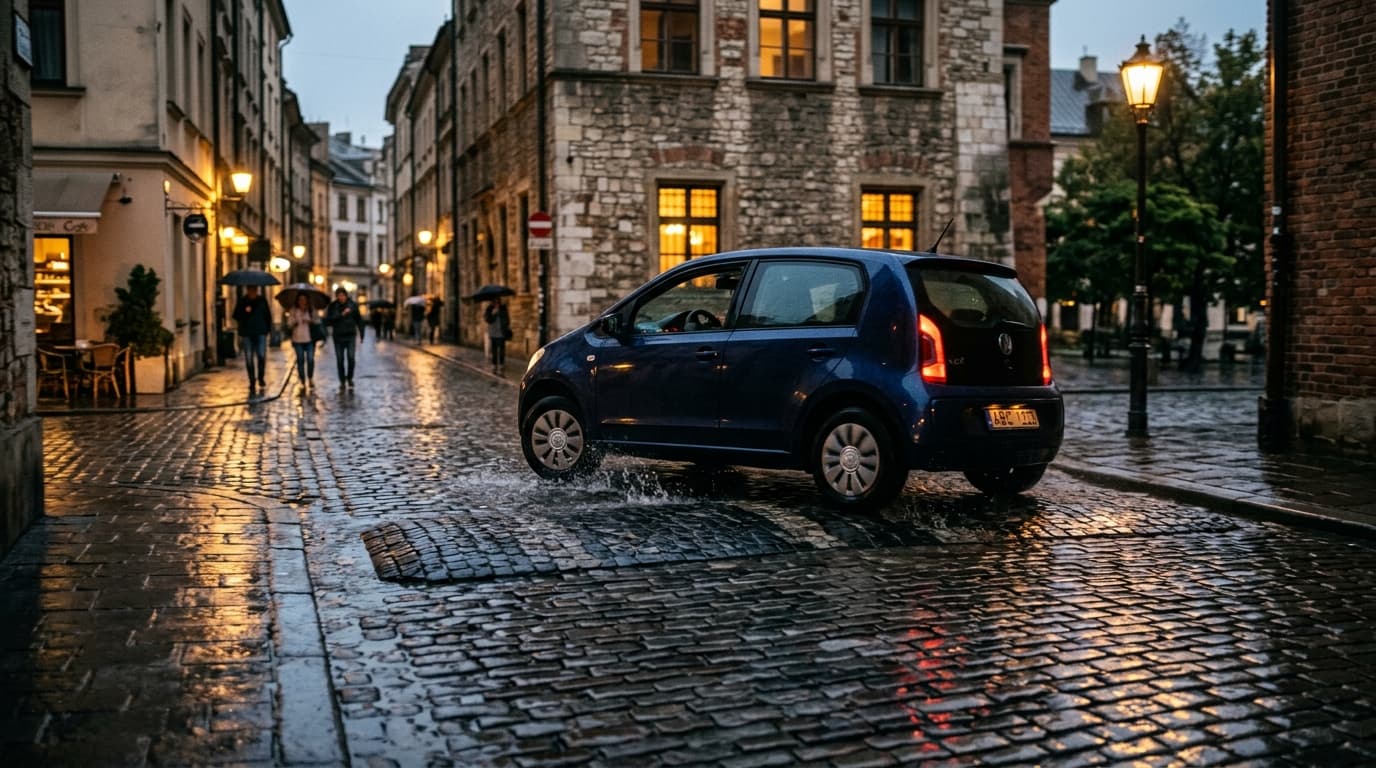
The Citroën C3 is the most comfortable city car among those with a recent, verifiable suspension score. The gap with its rivals is slim, though, and another choice weighs almost as much as the badge: the wheel size ticked on the order form. On Belgian cobbles and speed bumps, that is often where it is decided.
Five city cars, one scoring grid
A feeling of comfort cannot be compared. A score can.
The ADAC, Germany's motoring club, publishes a detailed report for every car it tests, in which suspension, seats and interior noise each get a score, with precise comments on manhole covers, cobbles and speed bumps. The scale follows German school grades: from 0.6 (very good) to 5.5 (poor), and the lowest score wins. As far as I know, no Belgian source publishes this level of detail model by model.
I went through the reports available for current-generation city cars sold in Belgium. Five have a complete one, with every sub-score. The table gives the scores as published, with the date of the report and, above all, the tyres fitted to the test car.
| Model tested by the ADAC | Report | Test car tyres | Tyre sidewall | Suspension | Seats | Noise at 130 km/h |
|---|---|---|---|---|---|---|
| Citroën ë-C3 You (4th-generation C3) | October 2025 | 205/55 R16 | 113 mm | 2.7 | 4.0 | 3.0 (68.6 dB) |
| Škoda Fabia 1.0 TSI Style | May 2023 | 215/45 R17 | 97 mm | 2.8 | 2.8 | 3.5 (70.6 dB) |
| Peugeot 208 PureTech 130 Allure | October 2020 | 205/45 R17 | 92 mm | 2.8 | 2.9 | 3.2 (69.1 dB) |
| Toyota Yaris Hybrid 130 Style Plus | August 2025 | 205/45 R17 | 92 mm | 3.0 | 3.3 | 4.0 (71.3 dB) |
| Renault Clio VI E-Tech 160 Esprit Alpine | July 2026 | 205/45 R18 | 92 mm | 3.1 | 3.2 | 3.2 (68.8 dB) |
Two words of caution. The Clio VI was assessed under the protocol the ADAC has used since 1 February 2026, which is not directly comparable with earlier ones. The 208 report dates from 2020: it is the generation on sale today, but before its late-2023 facelift.
The sidewall column appears in no report. I worked it out from the tyre size, multiplying the width by the aspect ratio: a 205/45 gives 205 × 0.45, so 92 mm of rubber between the rim and the road.
Why does the C3 come out on top?
Because of a part its rivals do not have. Since the fourth generation, Citroën has fitted every version of the C3, petrol, hybrid and electric, with its suspension with progressive hydraulic bump stops. At each wheel, two hydraulic stops replace the mechanical ones that halt the damper at the end of its travel, one in compression, the other in rebound.
The result shows in the ADAC report on the ë-C3: in town, the suspension responds with a finesse you would not expect from a small car, and speed bumps are soaked up well thanks to longer than average suspension travel. The high-sidewall 205/55 R16 tyres explicitly help, according to the testers.
There is a trade-off, and it mainly concerns people who take the motorway every day: over short, sharp undulations at speed, the body moves around more. On poor roads, it moves more than a Fabia.
Two limits before you rush to the dealer. The ADAC only measured the electric version, whose battery changes the weight and its distribution, and I do not carry its score over to the other powertrains, even if the suspension is the same on paper. And the entry-level You version scores 4.0 for its seats, with no height adjustment and no lumbar support: the ride comfort is there, seating comfort requires the next trim up.
Twelve centimetres: the height of a Belgian speed bump
The bumps in our streets are not left to chance. The Royal Decree of 9 October 1998, still in force and updated in the Vias institute database on 28 August 2026, sets their geometry to the centimetre, and it states its intention openly: the bump's profile must cause discomfort that increases with speed, and vertical acceleration must rise most sharply at around 30 km/h.
| Device | Legal reference | Height | Length or width | Target speed |
|---|---|---|---|---|
| Sinusoidal speed bump (sleeping policeman) | Royal Decree of 9 October 1998, annex 1 | 12 cm maximum | 4.80 m long | discomfort peaks at around 30 km/h |
| Older 4 m speed bump | same annex | 10 cm | 4.00 m long | same |
| Speed table (plateau) | Royal Decree of 9 October 1998, annex 2 | 10 or 12 cm recommended, 8 to 15 cm | flat section over 5 m | 30 km/h |
| Speed cushion ("Berlin cushion") | ministerial circular of 3 May 2002 | 6 to 7 cm | 1.75 to 1.90 m wide | no speed imposed |
Now put that column next to the tyre column. A Škoda Fabia on its base 185/65 R15 tyres rides on 120 mm of sidewall: twelve centimetres, exactly the maximum height of a regulation speed bump. The same Fabia on 215/45 R17, like the ADAC car, has only 97 mm left. A Clio VI Esprit Alpine on 205/45 R18 goes down to 92 mm, less than the height of a 10 cm speed table.
The tyre obviously does not swallow the bump on its own, that is the suspension's job. But the sidewall is the car's first spring, the one that filters sharp edges, the joints between cobbles and the bevelled sides of speed cushions before the damper even moves, and it is precisely what you shave off when you pick the trim with the big wheels.
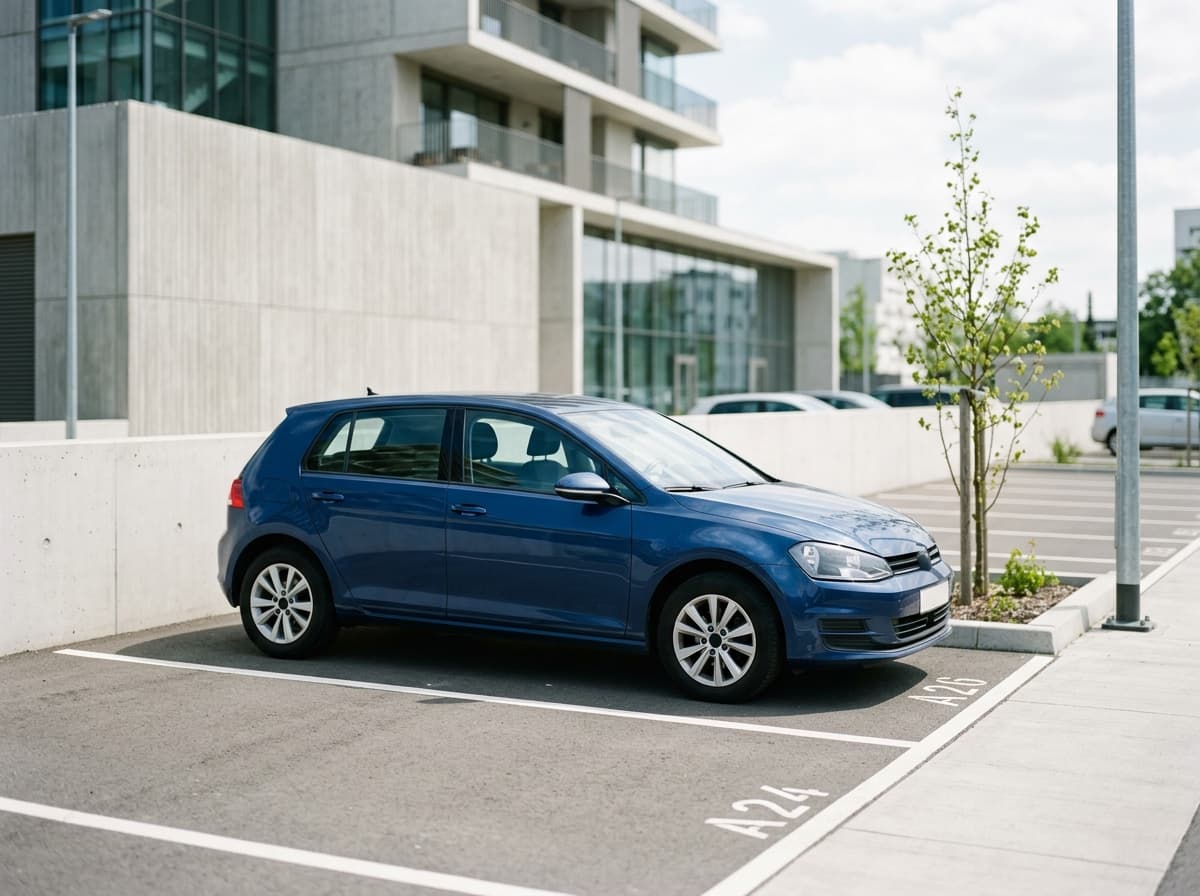
The Clio and the Yaris, held back by their big wheels
The bottom two in the table have something in common that has nothing to do with their chassis.
The Clio VI tested by the ADAC is an Esprit Alpine, and the name is misleading: it keeps the range's standard suspension, with no sporty tuning. The testers find it decent overall and note that it copes well with cobbles, but that at low speed it responds rather stiffly to imperfections, and they put that down to the standard 18-inch wheels and their low sidewall. It is all in the July 2026 report. A lower-trim Clio on smaller wheels has not been measured; I will not invent its score, but the testers' argument stands on its own.
The Yaris is firmer by nature. Its August 2025 report describes a rather sporty set-up, a rear axle that copes poorly with transverse joints, a harsh response at low speed and cobbles that are frankly jarring. The tested trim rides on 205/45 R17 as standard. For someone who spends 30 to 60 minutes a day driving through a cobbled municipality, it is the car in the table I would be most wary of, even though it is also the one that uses the least fuel in town, as we found when comparing city car fuel consumption in town.
So the choice is between two virtues that do not go together.
A practical note that applies to all five. Wheel size appears in the technical sheet of every trim, and it often changes from one equipment level to the next without the displayed price pointing it out. When a salesperson offers to upgrade you "for free" to the bigger wheel, as part of a promotion or a trim pack, they are giving you style and taking away sidewall. Ask for the exact size in writing on the order form, and keep the smallest one if you drive mostly in town.
Quiet in town is not measured at 130 km/h
The interior noise the ADAC publishes is recorded at 130 km/h, a speed a Brussels city car mostly sees on the ring road. It tells you something about wind and tyre noise, nothing about the atmosphere in a traffic jam on Avenue Louise.
In town, the two hybrids change things. The Clio E-Tech and the Yaris often run on electric power at low speed, and the petrol engine then goes completely silent; for the Clio, the ADAC records an external pass-by noise of only 64 dB(A), lower than a fully electric Renault 5. The trade-off is well known: as soon as you accelerate, the Yaris three-cylinder makes itself clearly heard, hence its 4.0, the worst score in the table.
The electric C3 is the quietest at 130 km/h, at 68.6 dB(A). The Fabia, which the ADAC nonetheless rates as comfortable on the motorway, is one of the noisiest at that speed.
For a quiet and comfortable small car used purely in town, a hybrid on small wheels or an electric car ticks both boxes. On the motorway, the ranking changes.
Where are the Volkswagen Polo and the Hyundai i20?
Nowhere, for lack of comparable data. For the current Polo, no recent detailed ADAC report with its suspension score is published; for the i20, the latest full report dates from October 2018 and covers the previous generation. Sharing a platform is not enough: the Polo is a technical cousin of the Fabia, but I do not lend it the Fabia's score.
Brussels, Wallonia, Flanders: three networks, the same bumps
The geometry of raised traffic-calming devices is still that of the 1998 Royal Decree, and the region-specific public road codes that codedelaroute.be announces for 2027 will not remove the speed bumps already in place.
Road-design policy, on the other hand, varies. In Brussels, the default speed limit dropped to 30 km/h almost everywhere on 1 January 2021 (the "Ville 30" or "City 30" scheme), and Brussels Mobility, the regional mobility administration, lists more road layouts that encourage slowing down among the three pillars of its road safety policy. In 2020 the Region had the Belgian Road Research Centre draw up a guide dedicated to speed tables, speed bumps and speed cushions. Its technical sheet on the speed cushion gives a figure that explains the state of some neighbourhoods: a rubber cushion costs €1,500 to €2,000 installed, but deteriorates noticeably after two to three years, so much so that it is treated as a temporary fixture. A damaged bevel hits harder than a new one. In Wallonia, the regional Sécurothèque documents the same families of devices for road managers, and Flanders applies the same federal decree.
Three regions, then, and the same 12 cm.

How do you test a city car on cobbles before signing?
By refusing the test drive on the smooth boulevard around the dealership. Urban comfort is judged where it matters, and half an hour is enough.
- Ask for the exact trim you plan to buy, with its wheels, and read the size printed on the tyre sidewall: 205/55 R16 and 205/45 R17 do not make the same car.
- Find a cobbled street and drive along it at 20 and then 30 km/h, windows closed, radio off.
- Go over a speed bump at 30 km/h and then at 20: the difference in jolt tells you how hard the suspension is working, since the device is designed to punish 30 km/h.
- Drive straight over a speed cushion, then listen to the rear: the ADAC criticises the Yaris for a rear axle that copes poorly with joints, and the 208 for manhole covers clearly felt through the rear axle.
- Sit in the back for five minutes if you regularly carry a passenger: that is where knocks from the rear axle are felt most.
- Adjust the driver's seat height and, if there is one, the lumbar support before judging anything.
One more common-sense precaution: check the tyre pressure shown on the label on the door pillar. An over-inflated tyre stiffens any city car, and it is the cheapest adjustment there is.
If your budget or your use points you towards a used car, our guide to the low-mileage used city car details a full test drive in urban conditions. To weigh comfort against the other criteria, the ranking of the best city cars and the city car comparator line the models up side by side, and the quiz points you in the right direction in four questions.
Essence & hybride comparator
Compare all essence & hybride side by side.
Compare now →
Frequently asked questions
Léa suit le marché des petites voitures depuis 2014. Basée à Liège, elle roule au quotidien en citadine et passe ses week-ends à comparer autonomies réelles, coffres et coûts d’entretien. Elle teste surtout ce qu’on utilise vraiment en ville : créneaux serrés, recharge en copropriété, trajets courts et budget assurance jeune conducteur.