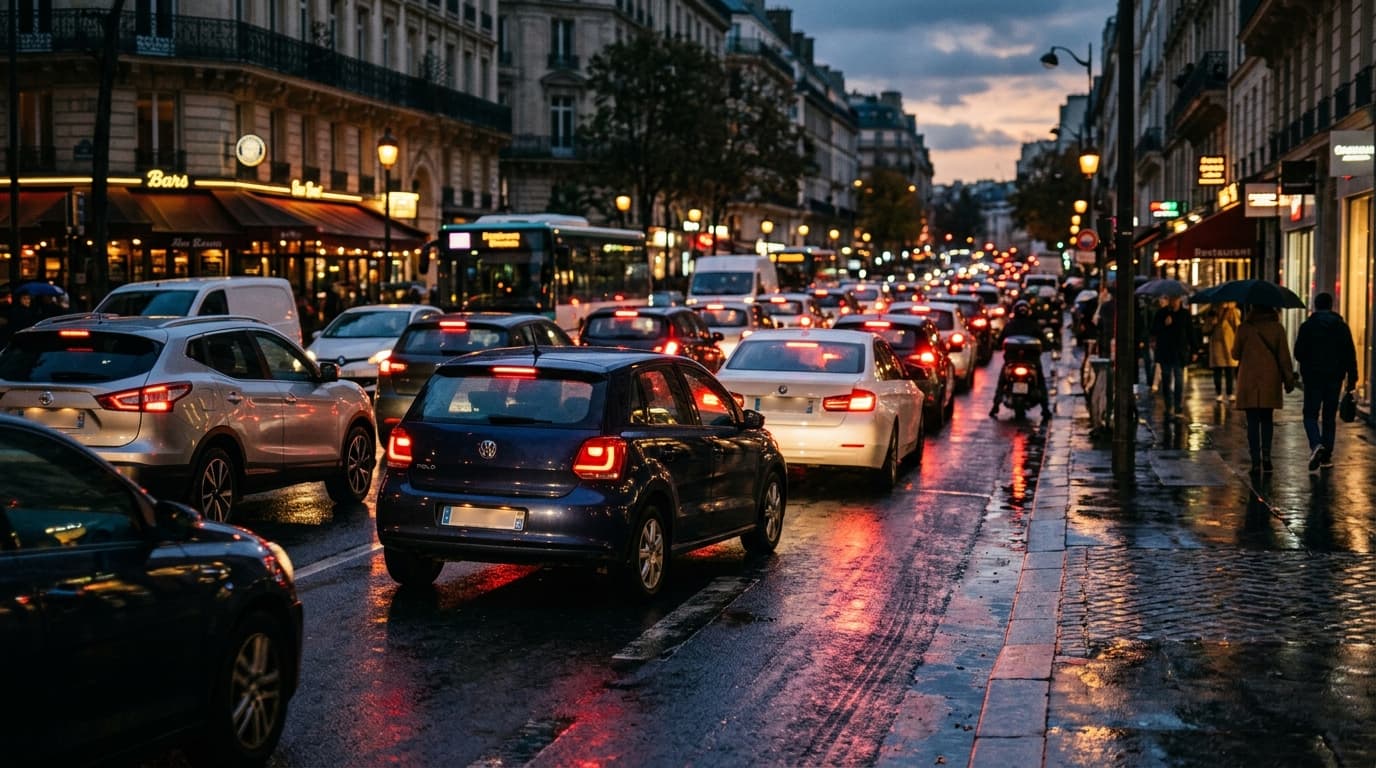
In town, the city car that uses the least fuel is a full hybrid: between 3.9 and 4.5 L/100 km in real urban driving, against 5.5 to 7 L for a three cylinder petrol. The gap widens on short trips, where a cold engine costs the most. Here is how to read those numbers before you sign.
Which city car uses the least fuel for your kind of driving?
The answer depends on how long your trips are, not on the badge. An engine that never gets time to warm up cancels much of the technical progress of the last ten years, and that is precisely the situation of an urban driver.
| Your urban use | The most frugal powertrain | Representative models | Order of magnitude in town |
|---|---|---|---|
| Trips under 5 km, several times a day | Full hybrid | Toyota Yaris Hybrid, Renault Clio E-Tech, Honda Jazz e:HEV | 3.9 to 4.5 L/100 km |
| 10 to 20 km per trip, heavy traffic | Full hybrid, or a light small petrol | Toyota Yaris Hybrid, Toyota Aygo X, Suzuki Swift Hybrid | 4 to 5.5 L/100 km |
| A few trips a week, under 6,000 km a year | Three cylinder petrol, cheaper to buy | Kia Picanto, Hyundai i10, Dacia Sandero | 5.5 to 7 L/100 km |
| Town and motorway in alternation | Turbo petrol or hybrid, the gap narrows | Renault Clio TCe, Volkswagen Polo TSI | 5 to 6.5 L/100 km |
| Socket or charge point at home | Electric, fuel question no longer applies | Renault 5 E-Tech, Citroën ë-C3 | not applicable |
These brackets are orders of magnitude observed in urban driving, not homologation values. They move with the season, the gradient, the traffic and your right foot.
The first kilometre costs 45 % more than the ones after it
Here is the figure missing from every ranking of economical city cars. Work published by ADEME, the French environment agency, on fuel efficient driving puts the extra consumption at roughly 45 % over the first kilometre driven from cold, and still 25 % over the second. After that it fades.
Let us run the sum on a small petrol car rated at 6.0 L/100 km once warm.
| Length of the urban trip | Consumption expressed per 100 km | Gap against the same engine warm |
|---|---|---|
| 2 km | 8.1 L | +35 % |
| 4 km | 7.1 L | +17 % |
| 6 km | 6.7 L | +12 % |
| 10 km | 6.4 L | +7 % |
| 20 km | 6.2 L | +3 % |
Same car, same engine, same driver. Only the trip length changes, and consumption swings by two litres per 100 km. A household doing the school run then the supermarket twice a day, three kilometres each time, will never see the figure printed on its spec sheet, whatever model it picked, because the car spends most of its life warming up and only reaches operating temperature at the moment the ignition goes off.
What does that actually cost at the pump in Belgium?
The FPS Economy (SPF Économie, the Belgian federal economy department) sets an official maximum price per product. Super 95 E10 rose to 2.058 €/l on 3 September 2026, its highest level since July 2022. At that rate, every litre saved per 100 km is worth 16 € a year over 8,000 km.
| Urban consumption | Cost per 100 km | 8,000 km a year | 12,000 km a year |
|---|---|---|---|
| 3.9 L | 8.03 € | 642 € | 963 € |
| 4.5 L | 9.26 € | 741 € | 1,111 € |
| 5.5 L | 11.32 € | 906 € | 1,358 € |
| 6.5 L | 13.38 € | 1,070 € | 1,605 € |
| 7.5 L | 15.44 € | 1,235 € | 1,852 € |
Between a hybrid at 3.9 L and a petrol car at 6.5 L, the annual gap reaches 428 € over 8,000 km and 642 € over 12,000 km. That is real money, and it is nowhere near enough on its own to cover the purchase premium of a hybrid, which runs into thousands of euros. The full calculation, insurance and road tax included, sits in our article on how much a city car costs per year.
Can a petrol city car drop below 5 L in town?
Rarely, and never in winter. The small naturally aspirated A segment cars, Toyota Aygo X, Kia Picanto, Hyundai i10, manage it on a free flowing run, driven gently, engine warm, with neither heating nor air conditioning. In other words, never a January morning in Brussels. In ordinary use, count on 5.5 to 7 L/100 km, turbocharged B segment blocks included: a turbo helps on acceleration, not in a traffic queue.
Do hybrids deliver on a two kilometre run?
Less than advertised, and that deserves saying. The commercial case for an urban hybrid rests on frequent stops and low speeds, which is accurate. On a very short trip, the demonstration still frays.
A full hybrid has to warm its petrol engine and its catalytic converter like any other petrol car. Until that temperature is reached the engine runs even at a standstill, and the battery, which holds barely more than a kilowatt hour, empties within a few hundred metres of electric running. The advantage over a conventional petrol car stays clear, it simply sits closer to 20 % than to the 40 % promised in the brochures. If an urban hybrid appeals to you, we compared the three reference models in our guide to the best hybrid city car for urban driving.
Why does diesel remain a bad urban bet?
Because its consumption is not the point. A modern diesel does burn around a litre less per 100 km than a comparable petrol car, and on the motorway that advantage holds. In town, two mechanisms wipe it out.
The particulate filter needs a high exhaust temperature, sustained for several minutes, to burn off the soot it has collected. Three kilometre trips never give it that. The filter clogs, forced regenerations multiply, the exhaust gas recirculation valve fouls up, and a single workshop bill outweighs years of saved fuel. The warning light comes on one November morning, the garage offers a cleaning, sometimes a full replacement. None of that shows up in the consumption column of a comparison table.
The second mechanism is regulatory. Belgian Low Emission Zones (LEZ) target diesel first, on a tightening timetable already published by Brussels Environment, which feeds straight through to resale value. We covered the three cities concerned and the Walloon exception in our guide to the Low Emission Zones of Brussels, Antwerp and Ghent.
How do you lower a city car's fuel use in town?
Six habits, ranked from most to least profitable:
- combine your trips: two errands run back to back with a warm engine cost far less than two separate departures from the garage;
- check tyre pressure once a month, since running 0.5 bar low is paid for in fuel and in wear;
- read the lights ahead and lift off rather than brake, which counts double on a hybrid thanks to regenerative braking;
- empty the boot, because 50 kg of dead weight tells on dozens of daily starts;
- switch off the air conditioning in town when the temperature allows, and give up idling to warm the car, which is both banned and pointless;
- shift up early on a manual gearbox, without ever labouring the engine.
None of these replaces the choice of powertrain. Together they are still worth 10 to 15 % of an urban fuel bill, roughly one free tank a year.
The cheapest city car to run is not the one that uses the least fuel
Fuel rarely accounts for more than a third of a small car's budget. Insurance, road tax, servicing and depreciation carry the rest, and none of those care how many litres you burn. A frugal hybrid that is expensive to buy, dearer to insure and taxed on its fiscal horsepower (chevaux fiscaux, the Belgian tax rating based on engine size) in Wallonia or Brussels can easily cost more over five years than a simple petrol car drinking two litres more.
Consumption is a criterion, not the criterion.
To settle the question across every cost line, our ranking of the best city cars sorts models on measured criteria, and the city car comparator puts them side by side. And before you order, read your real annual mileage off the service book rather than estimating it: most urban drivers overstate theirs by 30 to 40 %, and that number is what decides whether a hybrid ever pays for itself.
Essence & hybride comparator
Compare all essence & hybride side by side.
Compare now →
Frequently asked questions
Léa suit le marché des petites voitures depuis 2014. Basée à Liège, elle roule au quotidien en citadine et passe ses week-ends à comparer autonomies réelles, coffres et coûts d’entretien. Elle teste surtout ce qu’on utilise vraiment en ville : créneaux serrés, recharge en copropriété, trajets courts et budget assurance jeune conducteur.