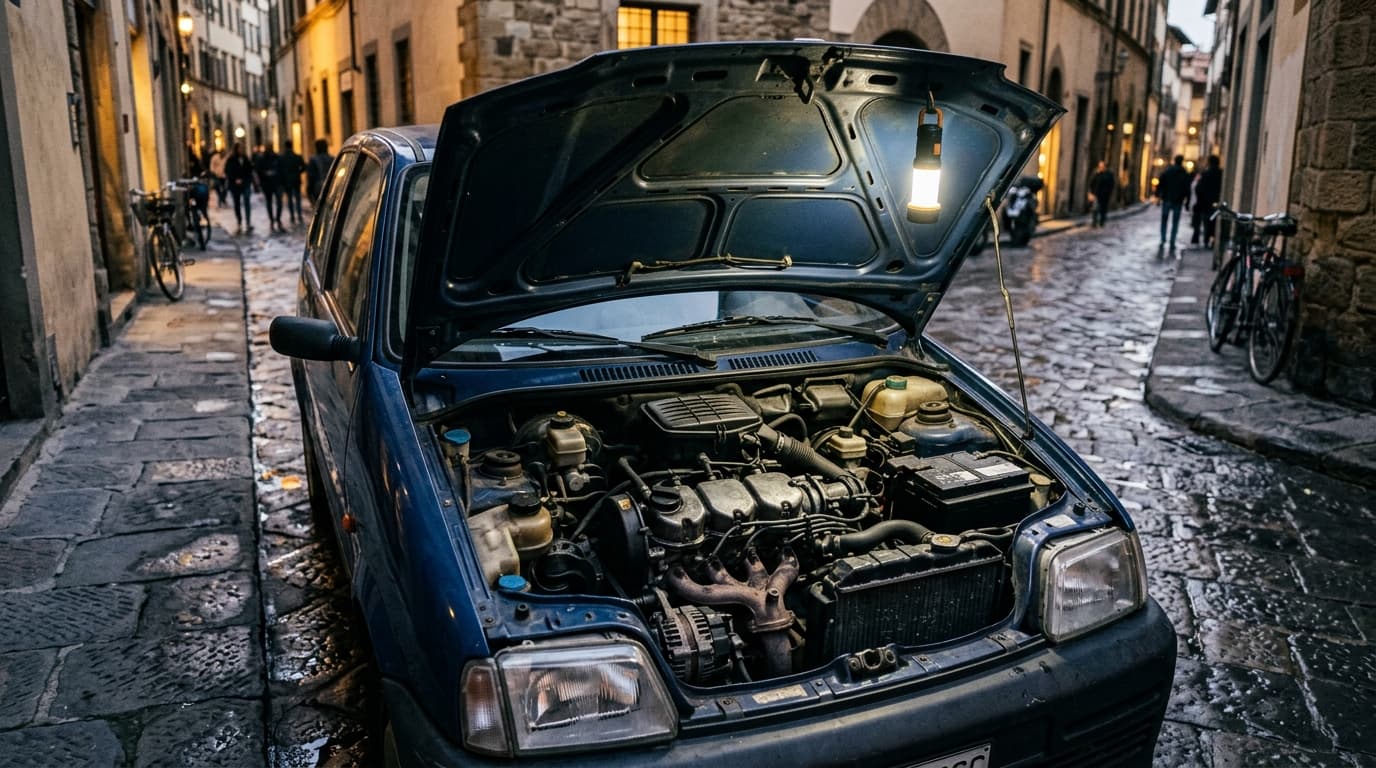
Yes, a three-cylinder engine is a good choice for a city car, and below 1.2 litres it is the most logical layout. The vibration and breakdowns it is blamed for belong to specific engines, not to the number of cylinders. In Belgium, the taxman does not look at cylinders anyway: he looks at engine size.
Why do nearly all city cars have a three-cylinder engine?
Open the bonnet of a petrol city car sold new in Belgium and you will almost always find three cylinders. Kia Picanto, Hyundai i10, Volkswagen Polo, Dacia Sandero, Renault Clio TCe, Peugeot 208, Toyota Aygo X and Yaris: all of them. The four-cylinder has not left the segment, it has retreated into the more powerful hybrid versions, such as the Clio E-Tech 160 and its 1.8.
The first reason is regulatory. EU Regulation 2019/631 required manufacturers to average 95 g of CO₂ per kilometre on new cars sold from 2020, and every gram saved on a small car sold in hundreds of thousands counts heavily in a brand's average. Removing one cylinder from a one-litre engine means removing a piston, four valves, an injector and a good share of internal friction, which weighs heavily in the losses at low revs, where a city car spends its life.
The second reason is geometry. One litre spread over four cylinders gives 250 cm³ chambers, small, with a lot of cold wall around little mixture to burn. Over three cylinders, each chamber is 333 cm³, a size better suited to efficiency. A one-litre three-cylinder is therefore not a four-cylinder cut down to save money: it is the most efficient way to build a one-litre engine.
A city car weighs a little over a tonne. It needs no more.
Three or four cylinders: the difference lies in one turn of the crankshaft
A four-stroke engine needs two crankshaft turns, 720 degrees, for every cylinder to fire once. With four cylinders, a combustion stroke comes every 180 degrees; with three, every 240 degrees. Between two pulses the crankshaft slows down a little more, and that gap, which engineers call cyclic irregularity, reaches the body as a shake.
You feel it at idle and below 1,500 rpm. In other words in a jam on the Brussels inner ring, stopped at the lights on Place Flagey, in first gear on a 30 km/h street. Speed does not make it worse, quite the opposite: beyond 2,500 rpm, a well-designed three-cylinder is hard to tell from a four.
Manufacturers have three remedies, and most recent city cars combine two of them. A heavier or dual-mass flywheel smooths out the jolts. Hydraulic engine mounts filter them before they reach the body. Some units add a balance shaft spinning the other way. And Stop & Start, standard across most of the segment, settles the matter when the car is fully stopped by switching the engine off.
That leaves the sound, rougher, which some people like and others do not. That one cannot be compensated. Try it.

Is a three-cylinder engine reliable?
The objection deserves to be taken seriously, because it rests on a real case. Stellantis's 1.2 PureTech, fitted to the Peugeot 208, Citroën C3 and Opel Corsa among others, used a timing belt running in oil up to its second generation. As it ages, the belt breaks up, its debris clogs the lubrication circuit, oil pressure drops, and the engine can burn too much oil or fail. Test-Achats, the Belgian consumer association, filed a complaint with the Economic Inspection in December 2023 and confirmed in September 2024 that Stellantis was applying in Belgium a warranty extension of 10 years or 175,000 km, provided diagnosis and repair are done in the brand's network.
The reputation of three-cylinder engines in general was built on that engine, and on early versions of Ford's 1.0 EcoBoost. The generalisation does not hold. The 1.0 units from Toyota, Kia and Hyundai, Renault and Dacia or Volkswagen have no comparable documented series defect, and the PureTech itself moved to a timing chain with its third generation, introduced from 2023: codes EB2LTED and EB2LTEDH2, found on the 208 Hybrid 100 and 136 and on the new C3.
So here is my reading: the number of cylinders tells you nothing about an engine's reliability, its design tells you everything. Cyclic irregularity does put more load on the damper pulley, the mounts and the timing drive, but those parts are sized accordingly on a well-designed engine. Judge engine by engine. For city cars as a whole, we have gathered breakdown and inspection statistics in our article on the most reliable city car.
Before buying a used three-cylinder city car, five checks are worth more than any reputation:
- the exact engine code, read on the certificate of conformity or confirmed by the dealer from the chassis number;
- for a belt-driven 1.2 PureTech (codes EB2FA and EB2ADTD), the network service invoices, without which the warranty extension may be refused;
- the oil used and how often it was changed, shown on the invoices, because a one-litre turbo engine copes badly with stretched intervals;
- an abnormal shake at idle with the engine warm, which may point to a tired mount rather than to the layout itself;
- the oil level on the dipstick during the test drive, a visible drop between two oil changes being the first sign of a suffering PureTech.
In Belgium, road tax looks at engine size, not cylinders
Here is the figure that sites written for France cannot give you. In Wallonia, a car's annual road tax (taxe de circulation) is calculated on its fiscal horsepower, and fiscal horsepower is derived from engine size in bands of 200 cm³. The number of cylinders appears nowhere in the calculation. I took the rates published by SPW Finances, the Walloon tax administration, in force from 1 July 2026 to 30 June 2027, additional surcharges included, and applied them to the petrol and hybrid engines of the segment.
| Model and engine | Cylinders | Engine size | Fiscal hp | Annual road tax (Wallonia) |
|---|---|---|---|---|
| Kia Picanto 1.0 | 3 | 998 cm³ | 6 | €193.91 |
| Hyundai i10 1.0 | 3 | 998 cm³ | 6 | €193.91 |
| Volkswagen Polo 1.0 TSI | 3 | 999 cm³ | 6 | €193.91 |
| Dacia Sandero TCe 100 | 3 | 999 cm³ | 6 | €193.91 |
| Renault Clio VI TCe 115 | 3 | 1,199 cm³ | 7 | €253.31 |
| Peugeot 208 Hybrid 100 | 3 | 1,199 cm³ | 7 | €253.31 |
| Toyota Aygo X Hybrid | 3 | 1,490 cm³ | 8 | €313.24 |
| Toyota Yaris Hybrid | 3 | 1,490 cm³ | 8 | €313.24 |
| Renault Clio VI E-Tech 160 | 4 | 1,789 cm³ | 10 | €432.30 |
Amounts exclude the additional LPG tax: an LPG version, such as the Dacia Eco-G models, adds €89.16 a year up to 7 fiscal hp.
Two rows sum up the argument. Both Toyotas have three cylinders, like the Picanto, and still pay €119.33 more every year, because their cylinders are large. Over eight years of ownership, the gap exceeds €950 before indexation. And between the two Clio VI versions, the three-cylinder TCe 115 and the four-cylinder E-Tech 160, the difference reaches €178.99 a year. A one-litre three-cylinder is tax-efficient in Wallonia because it is one litre, not because it has three cylinders.
In Brussels, annual road tax uses the same fiscal horsepower scale, with indexed amounts published by the Region on MyTax; we could only check the Walloon rates, which give the right order of magnitude. Flanders works differently: tax on recent cars is calculated on CO₂ emissions and the Euro standard, which favours precisely the hybrids that Wallonia taxes on engine size. The full budget, tax, insurance and fuel included, is worked out model by model in our article on how much a city car costs per year.
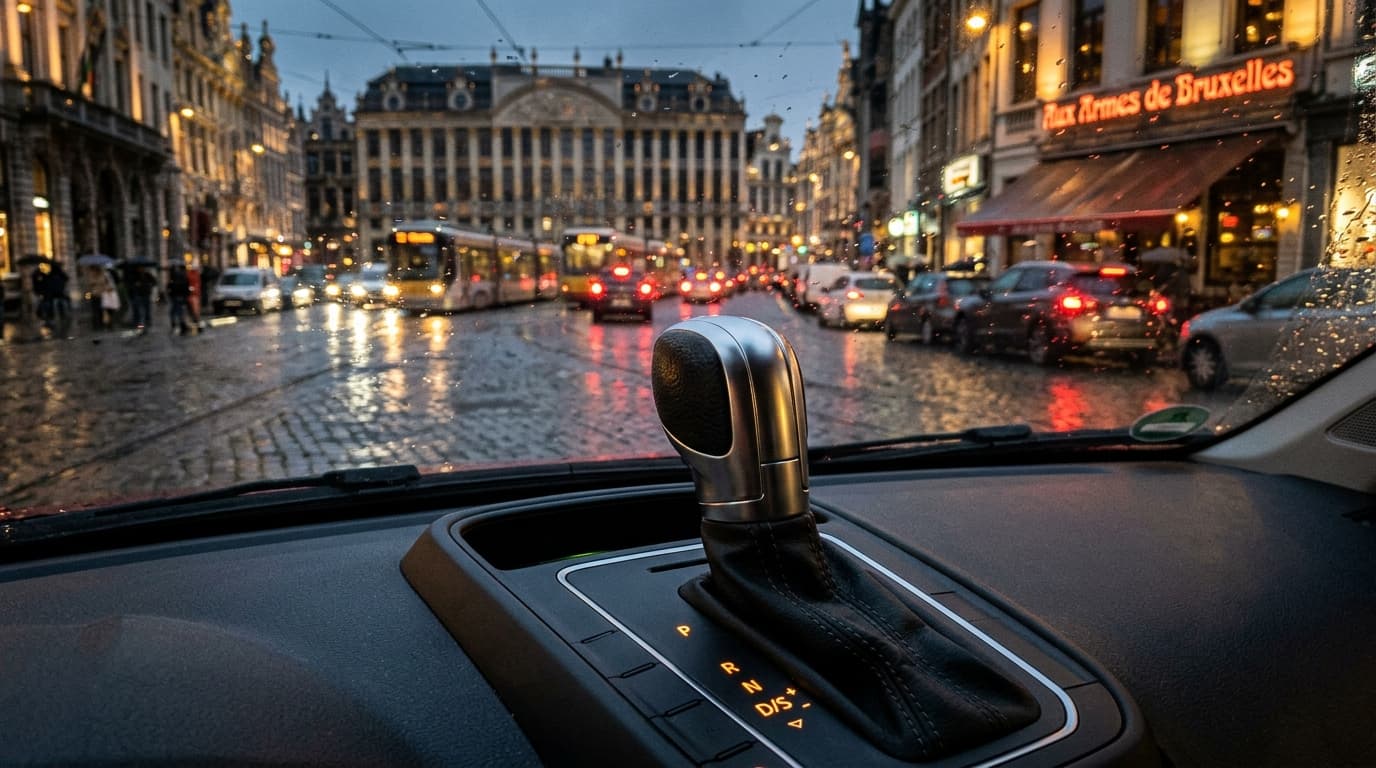
What are the pros and cons in town?
The pros all come down to weight and friction. A shorter, lighter block lightens the front end, which you feel at the wheel when parking. Fewer moving parts means less energy lost at low revs and when cold, and an urban city car makes much of its journeys on a cold engine: over two kilometres, a small petrol car's consumption rises by about a third, as we calculated in our article on the city car with the lowest fuel consumption in town.
The cons are refinement at idle, the sound and, on one-litre turbo versions, less tolerance of neglected oil changes. None of them rules the layout out for city use. On a busy motorway with four on board, a 65 hp 1.0 struggles, but that is a matter of power, not of cylinders.
The three-cylinder diesel, a case apart
It did exist: the three-cylinder Volkswagen Polo 1.4 TDI, sold in the mid-2010s, is the most common used example. In town, it combines the flaws of diesel on short trips, a particulate filter that never regenerates and low emission zones (LEZ) that target it first, as we explain in our guide to the LEZ of Brussels, Antwerp and Ghent. The three cylinders have nothing to do with it. Avoid it anyway.
The right three-cylinder for town comes down to three figures
Three figures on the spec sheet are enough to sort them, and none of them is the number of cylinders. Engine size first, which sets road tax in Wallonia and Brussels: 999 cm³ and 1,199 cm³ do not cost the same. Power next: 65 to 75 hp is enough for town only, 90 to 115 hp makes dual carriageways more relaxed. The engine code last, the only sure way to know whether a used PureTech has a belt or a chain.
The real cost is insurance and maintenance, not just the sticker price, and the engine only weighs on it through those three figures. To compare the city cars on the market on every cost, the ranking of the best city cars sorts them on measured criteria, with Belgian prices.
My view: for town, take a one-litre three-cylinder without a second thought, and for a used car, check the engine code before you sign.
Essence & hybride comparator
Compare all essence & hybride side by side.
Compare now →
Frequently asked questions
Léa suit le marché des petites voitures depuis 2014. Basée à Liège, elle roule au quotidien en citadine et passe ses week-ends à comparer autonomies réelles, coffres et coûts d’entretien. Elle teste surtout ce qu’on utilise vraiment en ville : créneaux serrés, recharge en copropriété, trajets courts et budget assurance jeune conducteur.