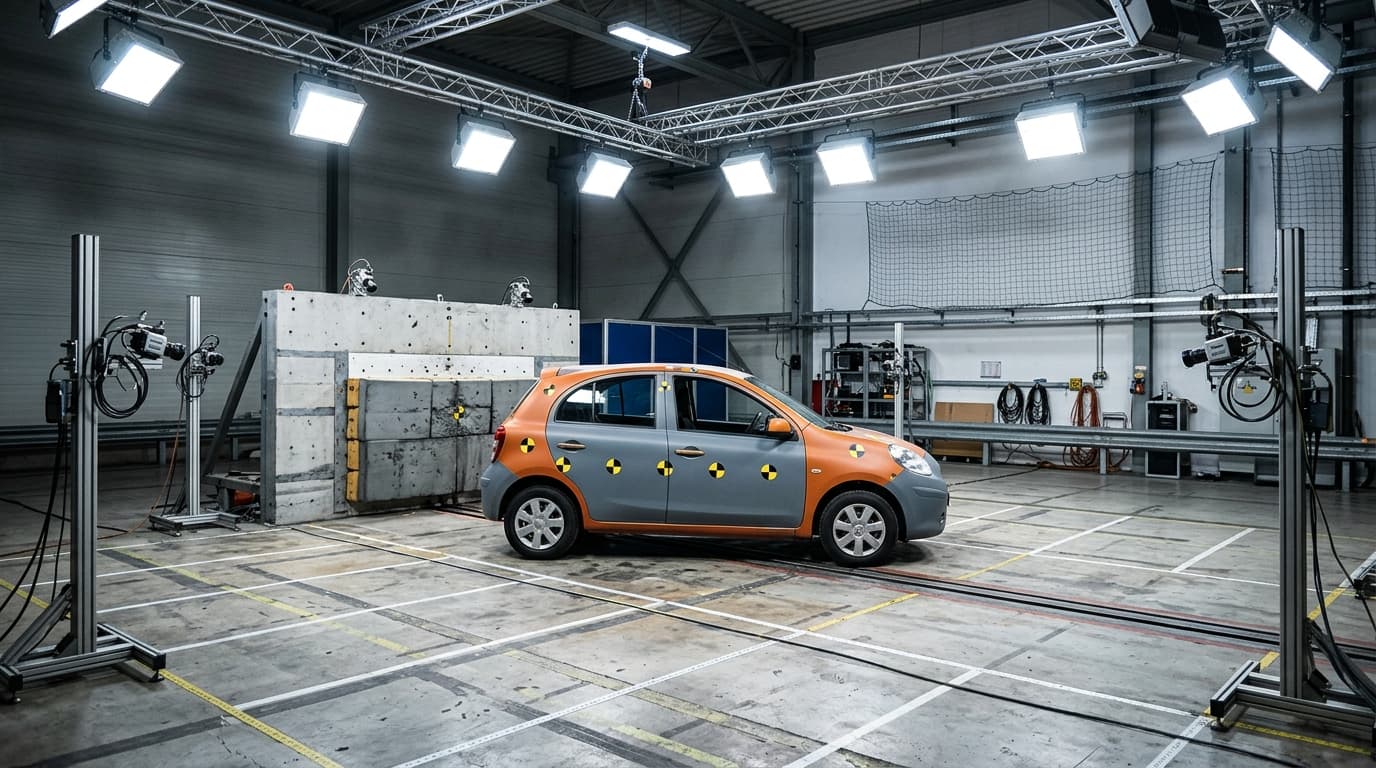
No, the stars do not compare with each other. A city car rated five stars in 2019 and one rated four stars in 2025 did not sit the same exam, and the second is often the better equipped of the two. The useful reading runs through the date of the test and through one column almost nobody looks at.
A 2019 star is not worth a 2025 star
Euro NCAP raises its requirements every three years. A model that takes five stars just before the bar moves up is no safer than one that takes four stars three years later: it was simply judged against a more forgiving scale.
A rating is never updated.
It stays printed as it is on technical sheets, in used car adverts and in dealer brochures, for the whole commercial life of the model.
Eight city cars, their ratings and the year they were tested
The four percentage columns matter as much as the stars, because they are what builds the overall rating. Every value below comes from the result sheets published by Euro NCAP, with the year of the test.
| Model | Year tested | Stars | Adults | Children | Vulnerable road users | Safety assistance |
|---|---|---|---|---|---|---|
| Renault Clio (fifth generation) | 2019 | 5 | 96 % | 89 % | 72 % | 75 % |
| Peugeot 208 | 2019 | 4 | 91 % | 86 % | 56 % | 71 % |
| Toyota Yaris | 2020 | 5 | 86 % | 81 % | 78 % | 85 % |
| Dacia Sandero Stepway | 2021 | 2 | 70 % | 72 % | 41 % | 42 % |
| Škoda Fabia | 2021 | 5 | 85 % | 81 % | 70 % | 71 % |
| Volkswagen Polo | 2022 | 5 | 94 % | 80 % | 70 % | 70 % |
| Renault 5 E-Tech | 2024 | 4 | 80 % | 80 % | 76 % | 68 % |
| Renault Clio hybrid (sixth generation) | 2025 | 4 | 79 % | 82 % | 80 % | 73 % |
Two rows tell the story of the same car six years apart. The 2019 Clio shows five stars and 96 % adult protection, while the Clio hybrid whose results were published on 10 December 2025 shows four stars and 79 %. In between, Renault did not build a weaker car: Euro NCAP added scenarios, tightened how it reads chest loads on the driver and looked far more closely at how emergency braking behaves.
The Sandero Stepway is the other textbook case. Its two stars made a lot of noise in April 2021 and cost it the Car of the Year title awarded by the British magazine What Car?, even though its occupant protection stood comparison with far better rated models.
Why does the vulnerable road user column decide things in town?
Because it measures the urban risk exactly. That column rates how well the car avoids injuring a pedestrian or a cyclist it hits, and how effective its autonomous emergency braking is against them. In town, that is the most likely collision of all.
The detail of the calculation is worth knowing, because it changes how you read a result sheet. Euro NCAP assesses the shape of the bonnet and bumper, the hard points sitting underneath, and above all the automatic braking scenarios facing a pedestrian crossing the road, a child stepping out between two parked cars, a cyclist cutting across. Those runs happen at urban boulevard speeds, not at open road speeds. A city car that excels in a 50 km/h frontal impact against a barrier can therefore score very poorly in that column, and the reverse happens too.
The 2019 Peugeot 208 is the clearest illustration: 91 % for its occupants, 56 % for the people it risks knocking down.
Picture two buyers on the same street. The first chooses on stars and buys a car that protects his own family very well. The second reads the fourth column, takes the model that brakes by itself in front of a child at 30 km/h, and buys a car that also protects everyone else. Both are right on their own criterion, but only one of them bought a car suited to a neighbourhood.
35 points of gap, and a fifth star lost
Subtract the vulnerable road user column from the adult column, model by model. The gap tells you who each car's safety actually benefits, and it rarely flatters the older models.
Across the six city cars in the table tested between 2019 and 2022, that gap averages 22.5 points. The Peugeot 208 climbs to 35 points, the Dacia Sandero Stepway to 29, the Volkswagen Polo and the 2019 Clio to 24 each. Only the 2020 Toyota Yaris stays in single figures, at 8.
Across the two city cars tested in 2024 and 2025, the same calculation gives an average of 1.5 points. The Renault 5 E-Tech sits at 4 points. The 2025 Clio hybrid even goes negative, at minus one point: it protects pedestrians slightly better than its own occupants, which had never happened to any city car in the table before.
The average gap has therefore been divided by fifteen in five years. That figure appears on no result sheet, it comes out of a simple subtraction, and it sums up what European regulation imposed on manufacturers over that period better than the stars do.
Nine of the twenty people killed in Brussels in 2025 were on foot or on a bike
Twenty people lost their lives on Brussels roads in 2025, against ten the previous year. Among them six pedestrians, four motorcyclists, four e-scooter riders and three cyclists, according to the barometer of Vias, the Belgian road safety institute, and of Statbel, the national statistics office, as relayed by the Belgian press.
Nine of the twenty victims were therefore on foot or on a bike. Thirteen out of twenty were outside a passenger compartment at the moment of impact.
The rest of the figures point the same way. The Brussels-Capital Region counted 4,370 accident casualties in 2025 against 4,281 a year earlier, with a clear rise among two-wheelers: 1,089 cyclists injured against 946, and 670 e-scooter casualties, 143 more than in 2024. Across the country, 464 people died on the road in 2025.
A Brussels city car spends most of its life among those road users. The regional statistics are public, updated every year, and they say the same thing as Euro NCAP's fourth column.
From 2019 to 2026, four successive tightenings
| Date | Event | Effect on city cars |
|---|---|---|
| 2019 | The Renault Clio V takes 5 stars and the best in class title | Segment benchmark for six years |
| April 2021 | The Dacia Sandero Stepway scores 2 stars with 70 % adult protection | Safety assistance becomes a knockout criterion |
| December 2024 | The Renault 5 E-Tech tops out at 4 stars | A recent electric city car no longer takes 5 stars by default |
| December 2025 | The Clio hybrid scores 4 stars, six years after the previous generation took 5 | Direct comparison between the two ratings becomes impossible |
| January 2026 | Full overhaul: four domains scored out of 100 replace the four old categories | Physical controls become compulsory to aim for 5 stars |
| September 2026 | The Cupra Raval scores 4 stars as standard, 5 with its optional safety pack | Two ratings for the same car depending on the equipment bought |
The January 2026 overhaul is the deepest since 2009. The four historic chapters give way to four domains: safe driving, crash avoidance, crash protection and post-crash safety, each scored out of 100 and expressed as a percentage. Moniteur Automobile, the Belgian motoring magazine, detailed the first verdict handed down under that scale in July 2026.
One point deserves a small car buyer's attention, because it hits the segment directly. Euro NCAP now publishes a double rating: one for the equipment fitted as standard on every European version, and one obtained with the optional safety pack. The Cupra Raval, an electric city car, demonstrated this in September 2026 with four stars as standard and five with the pack. Its crash protection does not move by a single point between the two ratings, at 91 % and 95 %. Only the assistance systems change: safe driving climbs from 58 to 72 %, crash avoidance from 66 to 77 %. On an entry level city car, the box you tick at the dealer therefore weighs as much as the car itself.
Should you rule out a city car rated under the old protocol?
No, that would be absurd: it would mean ruling out almost the entire used market. An old rating is still information, provided you read it with its date and do not put it in competition with a recent one.
Five things to check before trusting a rating.
- The year of the test, printed on every result sheet, rather than the model year of the car.
- The vulnerable road user percentage, the most discriminating column for urban use and the one rankings pass over in silence.
- The version tested, because Euro NCAP assesses one specific trim and safety equipment varies from one version to another afterwards.
- The presence of a double rating, introduced with the 2026 scale: the standard rating and the optional pack rating are not the same car.
- Any mention of a specific body style, such as the Stepway for the Sandero, whose rating does not automatically transfer to the other variants.
A buyer who keeps those five reflexes reads a Euro NCAP sheet in three minutes and will find no nasty surprise in it after signing.
What do you do when a city car has never been tested?
Nothing replaces a test drive, but there is a reasonable position: treat a missing rating as missing information rather than as a fault.
The Citroën ë-C3 is the most visible example on the Belgian market. It has no safety result published by Euro NCAP, even though it took five Green NCAP stars in 2025, a programme that measures energy use and emissions and runs no impact at all. The two ratings carry the same logo and have nothing to do with each other. The confusion is common, and it suits everyone except the buyer.
In that case, look at the equipment rather than the stars: autonomous emergency braking with pedestrian and cyclist detection, lane keeping, blind spot warning, accessible Isofix anchorage points. All of those can be checked on an order form, straight away, without waiting for a test.
To place a model within its segment, our ranking of the best city cars and the city car comparator put them side by side, and the quiz points you somewhere in four questions. If the car is meant for a recent licence holder, our guide to the best city car for a young driver covers the insurance side, and the one on the low mileage used city car details the checks to run before buying.
Guides d’achat comparator
Compare all guides d’achat side by side.
Compare now →
Frequently asked questions
Léa suit le marché des petites voitures depuis 2014. Basée à Liège, elle roule au quotidien en citadine et passe ses week-ends à comparer autonomies réelles, coffres et coûts d’entretien. Elle teste surtout ce qu’on utilise vraiment en ville : créneaux serrés, recharge en copropriété, trajets courts et budget assurance jeune conducteur.