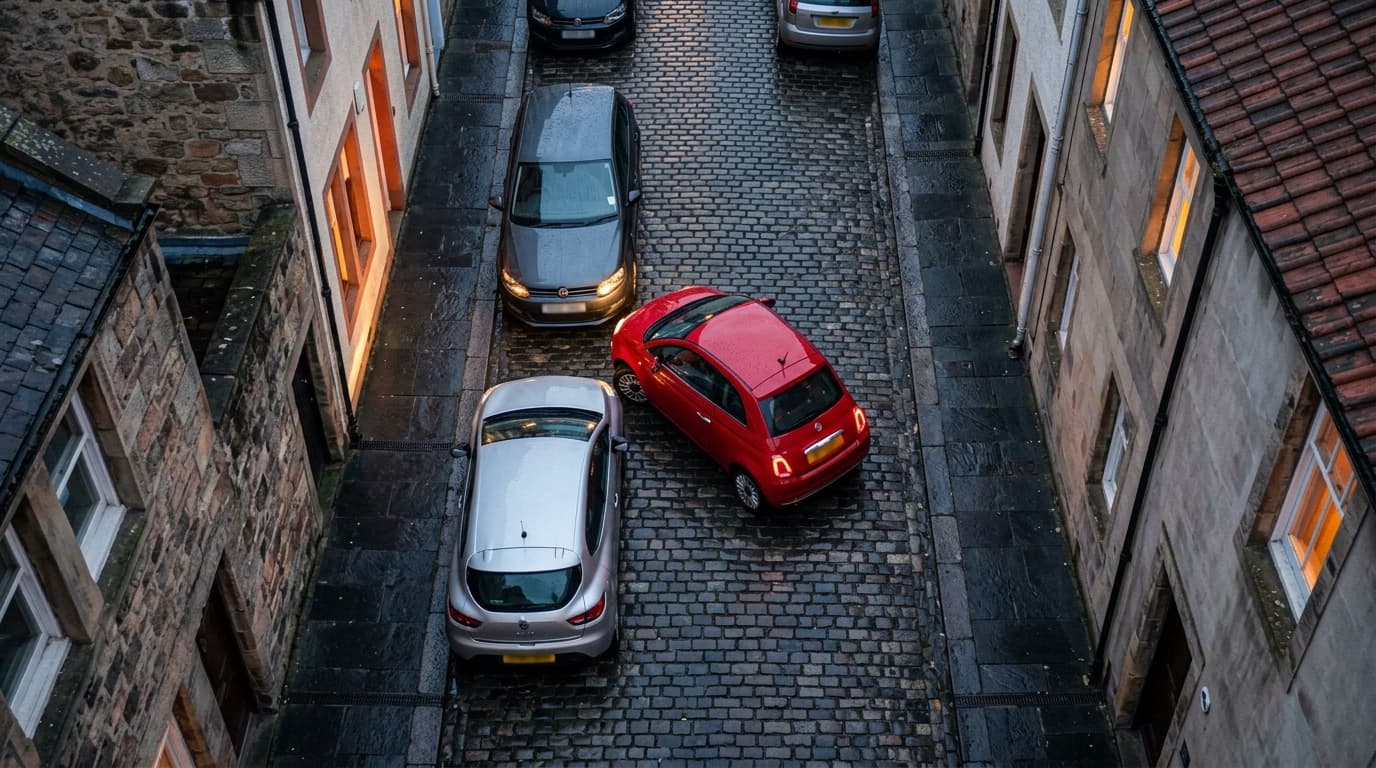
The Fiat Pandina and the Kia Picanto are the easiest city cars to park among the petrol and hybrid models sold new in Belgium: a 9.3 and 9.4 m turning circle, and under 3.70 m long. The Renault Clio VI comes last with 10.4 m and 4.12 m. Steering matters. Length matters more.
Which city car is easiest to park?
The one that combines a small turning circle with a short body, and on both counts the Kia Picanto and the Fiat Pandina come out ahead. On 20 October 2026 I collected the dimensions of seven petrol or hybrid city cars in the Belgian line-up, from manufacturers' spec sheets and press kits, then converted every steering figure into a turning circle so they could be compared.
| Model | Length | Width excluding mirrors | Height | Turning circle | Margin in a 6 m space |
|---|---|---|---|---|---|
| Kia Picanto | 3.60 m | 1.60 m | 1.49 m | 9.4 m | 2.40 m |
| Hyundai i10 | 3.67 m | 1.68 m | 1.48 m | 10.0 m (1) | 2.33 m |
| Fiat Pandina | 3.69 m | 1.66 m | 1.55 m | 9.3 m (2) | 2.31 m |
| Toyota Aygo X Hybrid | 3.78 m | 1.74 m | 1.53 m | 9.4 m | 2.22 m |
| Suzuki Swift | 3.86 m | 1.74 m | 1.52 m | 9.6 m | 2.14 m |
| Toyota Yaris Hybrid | 3.94 m | 1.75 m | 1.50 m | 9.8 m | 2.06 m |
| Renault Clio VI | 4.12 m | 1.77 m | 1.45 m | 10.4 m | 1.88 m |
Sources: Toyota Aygo X press kit (4.7 m radius, June 2025), Suzuki Swift press release (4.8 m radius, March 2024), Renault FAQ, Fiat Pandina spec sheet, Kia Picanto spec sheet, Toyota Yaris spec sheet (4.9 m radius). (1) 5.0 m radius announced by Hyundai at the launch of the current i10, a provisional figure at the time. (2) Fiat does not publish the Pandina's turning circle on its spec sheet: figure taken from the Belgian site Autotijd. Margin: 6 m minus the length.
Two surprises. The Suzuki Swift, 19 cm longer than the Hyundai i10, turns tighter on paper. And the Toyota Aygo X, 3.78 m long, steers like the Picanto. Length does not predict the turning circle, which depends on the wheelbase and on how far the front wheels can turn.
Turning radius or turning circle: what is the difference?
The radius is half the circle, and that is the number one trap on spec sheets. Toyota, Suzuki and Hyundai quote a radius (4.7 m, 4.8 m, 5.0 m). Kia publishes a 9.4 m "minimum turning circle". Renault writes "rayon de braquage", French for turning radius, next to 10.4 m, which is in fact a circle. A figure under 6 m is almost always a radius; over 9 m, a circle.
A second, finer point. The circle is measured kerb to kerb, at the outer front wheel, or wall to wall, including the front overhang, and Caradisiac pointed out that manufacturers usually publish the first without saying so. My ranking is therefore reliable to within a few tens of centimetres, not to the centimetre.
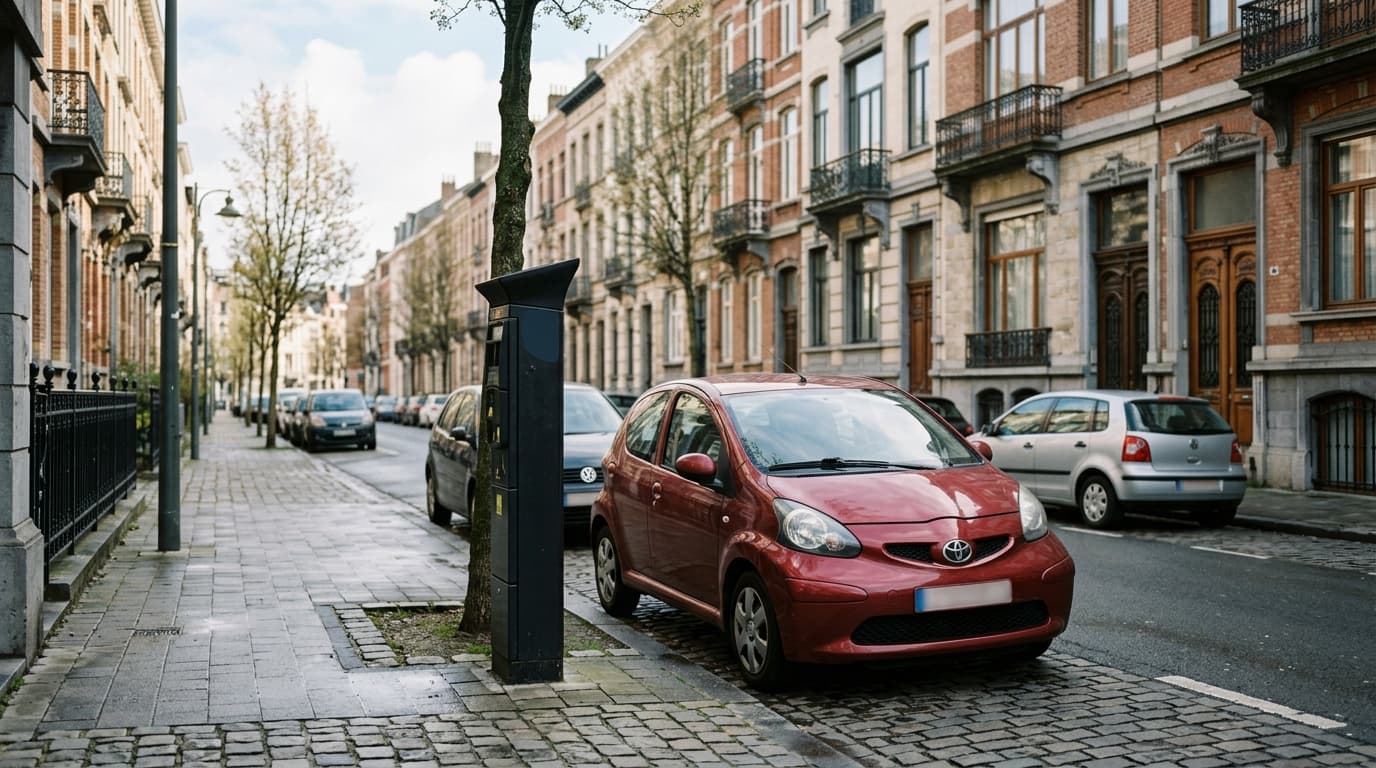
Does length matter more than steering when parallel parking?
Yes, by a long way. Parallel parking happens in reverse, at a shallow angle, and what decides success is the room left in front of and behind the car once it is in. The Walloon Region's road safety handbook (Sécurothèque) recommends spaces of 6 m by 2 m, and records spaces 6 to 6.3 m long in Belgium and neighbouring countries. In 6 m, a Picanto leaves 2.40 m of play, a Clio VI 1.88 m: a 52 cm gap. Steering matters mostly on the way out, when the car in front has crept closer and you have to pull out on full lock early, and that is where the Pandina and its 9.3 m beat the Clio's 10.4 m.
I parallel park almost every day, and the margin counts more than the steering.
How much width do you need in a bay?
Expect bays of 2.30 to 2.80 m for perpendicular parking, 2.50 m in the Walloon recommendation. Between two identical cars parked in the middle of 2.50 m bays, you have 90 cm to open a door next to a Picanto, 73 cm next to a Clio VI.
The real trap is elsewhere: the mirrors. Fiat is the only manufacturer in this comparison to publish the width with mirrors unfolded, and it reaches 1.88 m for a Pandina that is 1.66 m wide without them. Yet parallel parking spaces only 1.80 m wide still exist in Belgium, according to the same Sécurothèque. With the mirrors out, they stick 8 cm into the road. Fold them in narrow streets: it is the best insurance against a mirror torn off by a delivery van.
Will my city car fit in an underground car park?
Yes. The seven city cars compared stand between 1.45 and 1.55 m tall, and the minimum clearance of a typical public car park is 2 m under beams, according to the norms quoted by Onepark. That leaves almost half a metre. Only a roof box or a bike on the roof changes things: the height posted at the car park entrance is then what counts, not the car's spec sheet.
Do you need to add a camera or sensors?
On a new city car, no. EU Regulation 2019/2144 has required a reversing detection system on every new car registered in the Union since 7 July 2024. On an older used car, a sensor kit can be fitted for under €100, and we went through the options in our guide to adding a reversing camera or parking sensors.
Which size suits where you park?
| Situation | Figure that matters | Benchmark | What to do |
|---|---|---|---|
| Daily on-street parallel parking | Length | under 3.80 m | Picanto, i10, Pandina or Aygo X |
| Tight exit from a space, U-turn in a narrow street | Turning circle | 9.5 m or less | Pandina, Picanto, Aygo X |
| Bay or narrow garage | Width excluding mirrors | under 1.70 m | Picanto, Pandina, i10 |
| Narrow street with delivery vans | Width with mirrors unfolded | ask the dealer | Fold the mirrors |
| Underground car park | Height | under 2 m with luggage | No city car is blocked, watch the roof box |
| You need a car over 4 m long | Turning circle | around 10 m | Clio VI, with a parking aid |
The last row matters as much as the others: beyond 4 m, you no longer gain on size, you make up for it with equipment.
Seven figures to check on the spec sheet before you buy
For a Brussels driver who parks on the street, the spec sheet says almost everything, as long as you read it in the right order:
- the overall length, to compare with the 6 m of a parallel parking space;
- the turning circle, doubling a radius if that is all the manufacturer gives;
- the width excluding mirrors, for bays and garages;
- the width with mirrors unfolded, rarely published, so ask for it;
- the height, useful only with a roof box;
- whether a camera or sensors come as standard on a used car built before July 2024;
- the wheel size, as wheels scrape the kerb sooner when the tyre profile is low, as we explain in our piece on kerbed alloy wheels.
Parking rules themselves, residents' permits (carte riverain, the card that lets residents park in their zone) and paid zones, change from one Brussels commune (municipality) to the next: our guide to parking in Brussels covers it all. To choose between the Picanto, the i10 and the Aygo X on price and fuel use, read our head-to-head of the smallest city cars, and to compare every city car on the market on its real costs, see the ranking of the best city cars and the comparison tool. Electric models, led by the Renault 5 and the Citroën ë-C3, are covered in our electric head-to-head.
My advice: if you park on the street every day, stay under 3.80 m, and check the turning circle by doubling it when the spec sheet talks about a radius.
Guides d’achat comparator
Compare all guides d’achat side by side.
Compare now →
Frequently asked questions
Léa suit le marché des petites voitures depuis 2014. Basée à Liège, elle roule au quotidien en citadine et passe ses week-ends à comparer autonomies réelles, coffres et coûts d’entretien. Elle teste surtout ce qu’on utilise vraiment en ville : créneaux serrés, recharge en copropriété, trajets courts et budget assurance jeune conducteur.