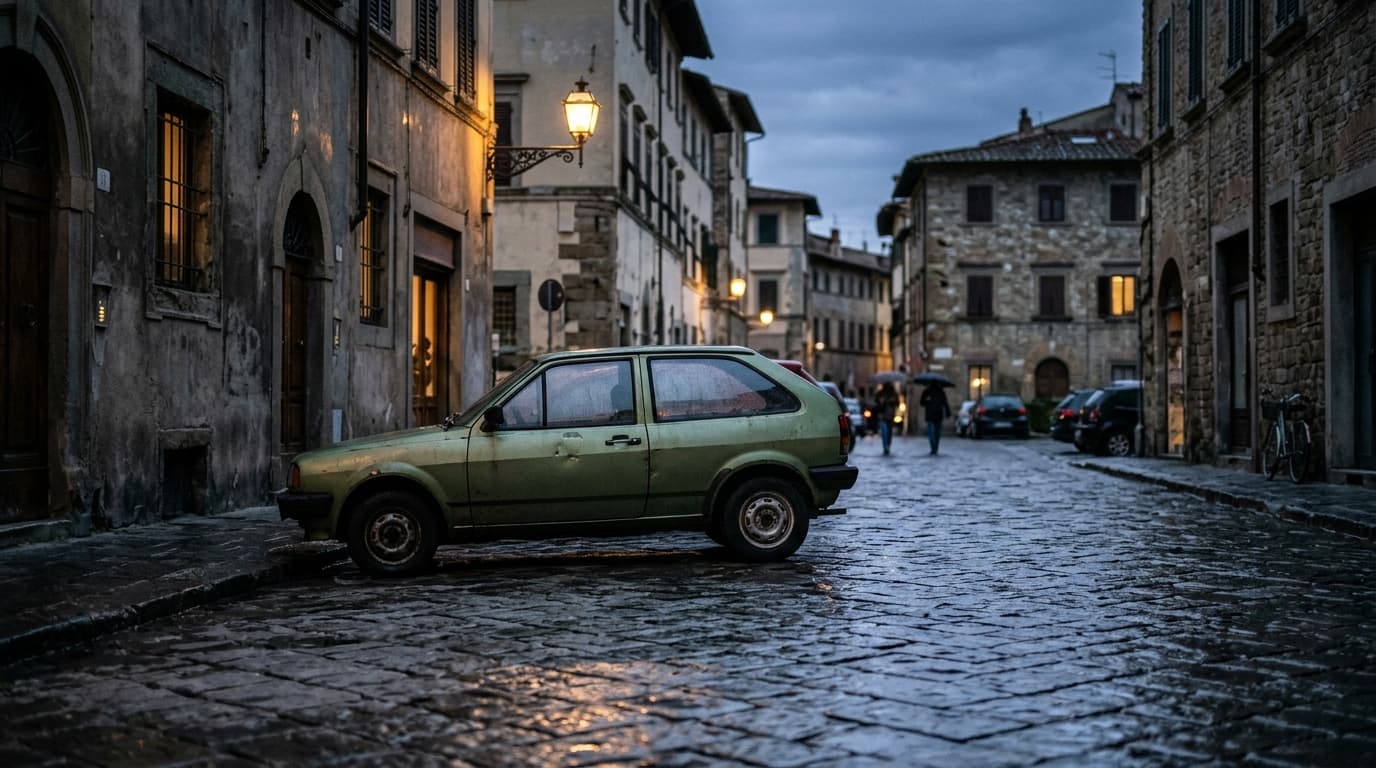
Keep your city car as long as a repair costs less than one year of depreciation on the car that would replace it, and as long as your city's low-emission zone lets it in. For a ten-year-old small petrol car, that is almost always the case. For a Euro 5 diesel that enters Brussels, the decision has already been made elsewhere.
Keep or replace: the head-to-head on eight criteria
A car that still runs has no expiry date. On one side its costs creep up; on the other, a replacement starts losing value the day you sign.
Belgian drivers have picked their side. At the end of 2023 the average car on Belgian roads was 9.2 years old according to the motoring club Touring, and the GIPA study reported by Le Moniteur Automobile counted 13% of cars over fifteen years old, against 7% ten years earlier.
| Criterion | Keep the old city car | Replace it with a newer one |
|---|---|---|
| First year | possible repairs, often a few hundred euros | 15 to 30% depreciation on a new car, then 10 to 15% of the new price per year |
| Registration tax (TMC) | none | about €79 to €126 for a five-year-old city car, depending on the region |
| Insurance | third-party liability alone is enough | comprehensive cover often advised, sometimes required by the loan |
| Brussels low-emission zone (LEZ) | Euro 3 to 6 petrol allowed until 2035; Euro 5 diesel on day passes since 2026 | diesel allowed until 2030, petrol until 2035 |
| Roadworthiness test | every year in Wallonia and Brussels, every two years in Flanders | none before a new car turns four |
| Driver assistance | ABS, airbags, rarely more | automatic emergency braking standard on new cars sold since July 2024 |
| On-street parking | one more scrape changes nothing | every scratch is paid for at resale |
| Winning profile | small petrol car, under 10,000 km a year | Euro 5 diesel entering Brussels, changing needs |
Six criteria out of eight favour the old city car as soon as it covers few kilometres. The two where it loses, the LEZ and active safety, are precisely the two no mechanic can fix.
When to replace your car so you don't lose money?
When keeping your car one more year costs more than the replacement would lose in value over the same year. Everything else is comfort.
Depreciation is the cost nobody sees, because no invoice ever announces it. AutoScout24 puts it at 15 to 30% of the price in the first year, then 10 to 15% of the original purchase price for each following year. Apply that range to the cheapest new city car on the Belgian market, a Dacia Sandero listed at €13,990 on the brand's Belgian website when we checked on 2 October 2026: it loses €2,100 to €4,200 in its first year. That is €175 to €350 a month, before the first tank of fuel and before the first insurance premium.
A recent used car softens the blow without removing it. Above all, it has become much more expensive: according to National Bank of Belgium indices quoted by La Libre in September 2025, used car prices went from 100 in 2013 to 165.19 in 2025, while new car prices stopped at 133.25. Replacing an old city car with a five-year-old one therefore costs noticeably more than it did ten years ago, for the same budget.
The real cost is insurance and maintenance, not just the sticker price. And for a new car, it is depreciation first.
Repair or replace your car after a big quote?
Set the quote against one year of the replacement's depreciation. If it is lower, repair.
Touring puts a timing belt replacement at €500 to €1,000, usually between 100,000 and 150,000 km, and places the clutch and shock absorbers in the same mileage window. A €1,000 quote on a 2012 Volkswagen Polo 1.2 petrol represents three to six months of a new Sandero's depreciation. The maths is quick, and it still holds for two big repairs in the same year.
One detail often skews the decision: the old car's resale value. People hesitate to put €1,000 into a Polo worth €2,500, as if the repair had to be "earned back" at resale. It does not. The question is not what the car is worth, it is what the next kilometre costs with it or without it, and a car that keeps running for the price of a timing belt remains, at that point, the cheapest car you can drive.
Three cases overturn the rule.
Structural corrosion flagged at the roadworthiness test (chassis rails, floor pan, seat anchor points) announces a series of quotes, not a single one. A tired gearbox or engine on a car having its third major breakdown in two years follows the same logic. And a Euro 5 diesel that can no longer enter where you drive does not get repaired: it gets sold.
In Brussels, the LEZ decides before the mechanic
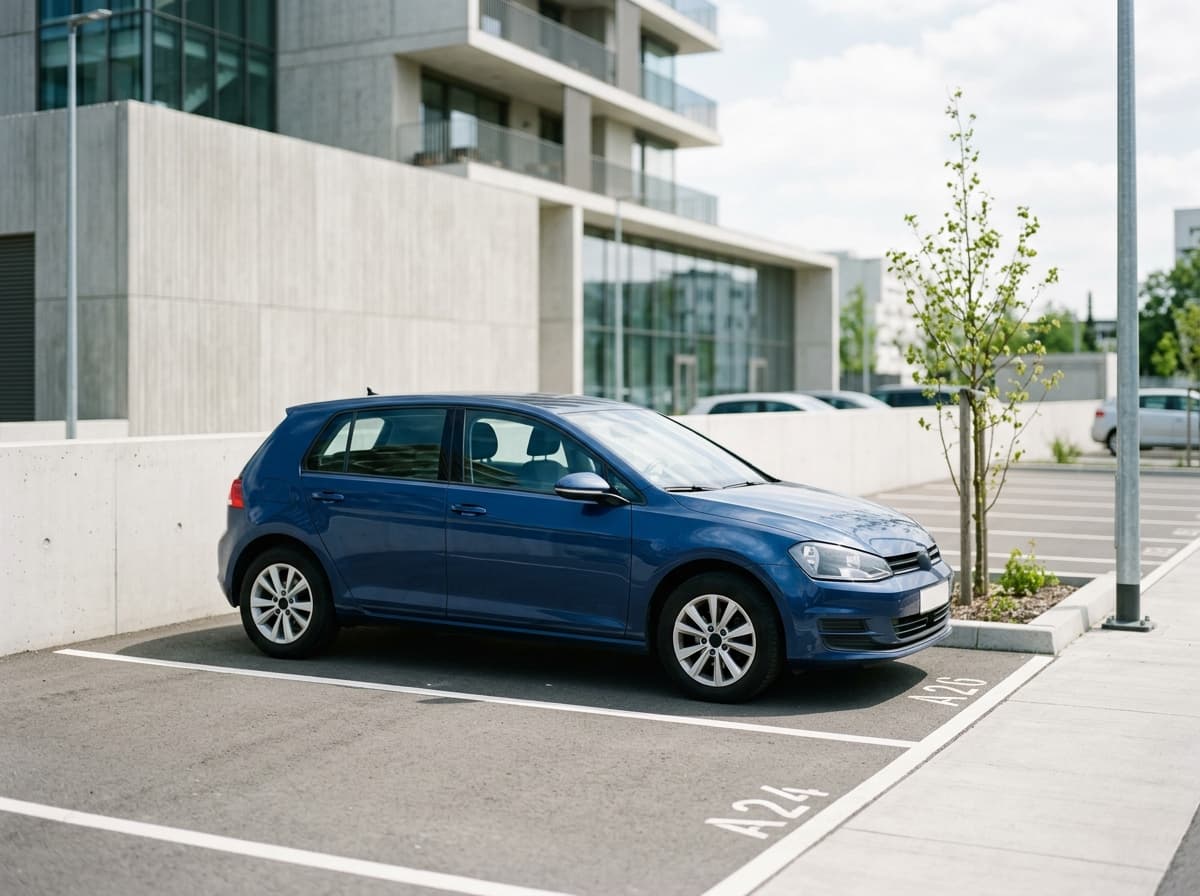
Since 1 January 2026, Euro 5 diesels and Euro 2 petrol cars can only enter the Brussels low-emission zone with a €35 day pass, capped at 24 per year and per number plate, and the €350 fine has applied since 1 July 2026, according to Le Moniteur Automobile. The postponement to 2027 voted by the Brussels Parliament no longer exists: the Constitutional Court annulled it in December 2025. The next stages are set: all diesels in 2030, all petrol cars in 2035, as the official lez.brussels portal confirms.
In Antwerp and Ghent, the same Euro 5 diesel drives freely until 1 September 2027, then switches to day passes (€45 in Antwerp, twelve times a year at most); all diesels are banned there in 2031. In Wallonia, nothing: no zone is in force.
The same repair is therefore not worth the same everywhere. Putting €1,000 into a 2014 Renault Clio IV dCi makes sense in Namur. In Saint-Gilles, it means getting the car ready for its future Walloon buyer. Enter Brussels twice a week and your 24 passes run out by mid-March, after €840 spent: the city-by-city detail is in our article on the Brussels, Antwerp and Ghent LEZs.
A Euro 4 or Euro 5 petrol car has nothing to fear in Brussels before 2035.
How much does changing cost in taxes, region by region?
Almost nothing, as long as you stay in the city car segment. In Belgium, a car changing hands pays a one-off registration tax (taxe de mise en circulation, TMC), set by each region. The table below applies the scales published by Le Moniteur Automobile (Brussels rates from 1 July 2026, the Walloon system in force since 1 July 2025, the 2026 Flemish formula) to two five-year-old used petrol cars.
| Five-year-old used petrol car | Brussels | Wallonia | Flanders (estimate) |
|---|---|---|---|
| 67 kW city car (118 g/km WLTP, 1,600 kg gross weight) | €78.88 (floor) | scale minimum, €50 to €61.50 | about €126 |
| 110 kW compact (140 g/km WLTP, 1,900 kg gross weight) | €556 | about €528 | about €323 |
Calculation assumptions: 50% of the amount in Brussels between five and six years, 55% of the base amount in Wallonia at five years, age coefficient of 0.54 in Flanders. The Walloon result for the city car (about €27) falls below the minimum. The Flemish figure is derived from the published formula and should be checked on the Region's official simulator.
The lesson fits in one line: replacing a city car with another city car costs less than €130 in tax in all three regions, while moving up a class adds €320 to €560. In Brussels and Wallonia, the annual road tax follows the same logic: it depends on fiscal horsepower, so on engine size, not on age. A 2012 1.2 pays no more than it did when new. In Flanders, the calculation takes CO2 and the Euro standard into account. The full running cost, tax included, is broken down region by region in how much a city car costs per year.
An old city car parked on the street costs less than you think
The city works in the old car's favour, and it is the argument buying guides forget.
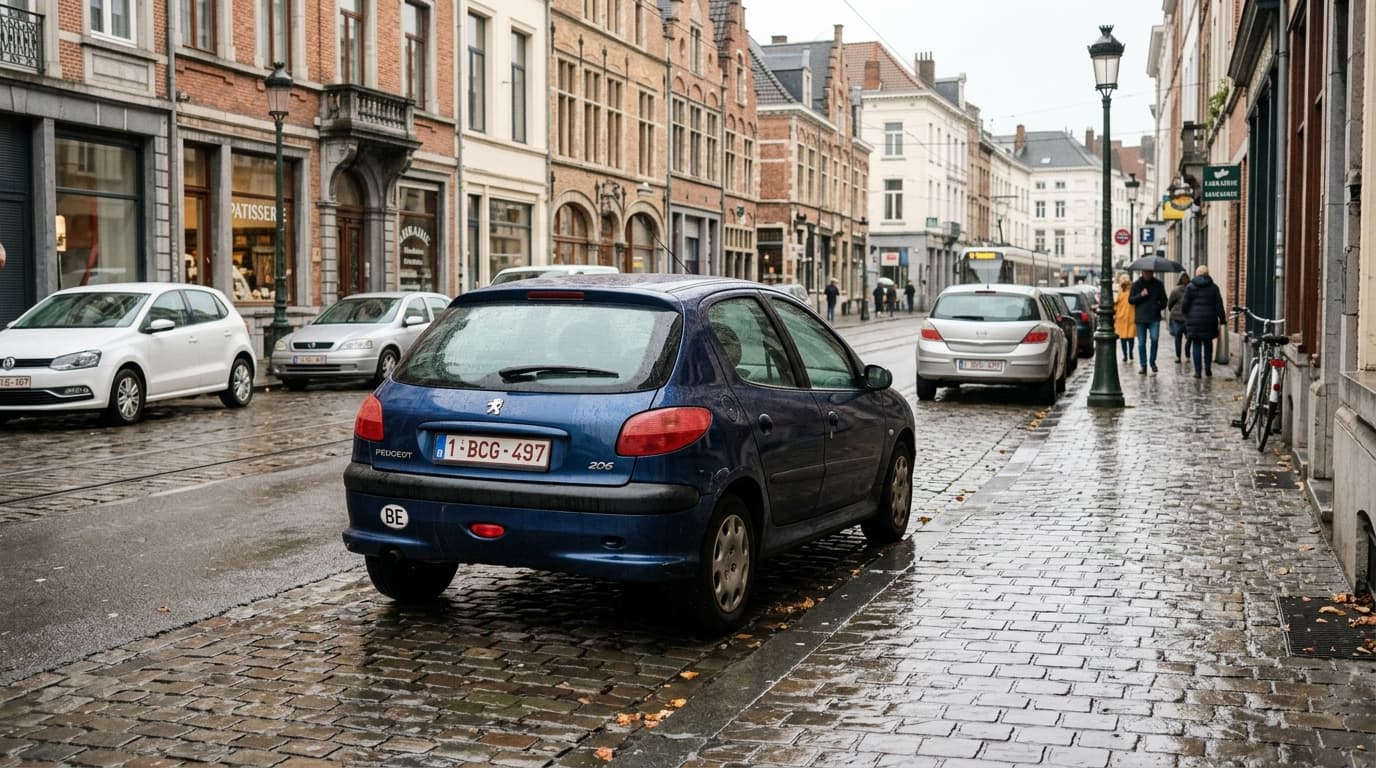
On a 2011 Toyota Yaris, one more scratch changes neither how it is used nor its resale price, already low. On a two-year-old car, every scrape costs an insurance excess or extra depreciation, and comprehensive cover becomes almost compulsory for peace of mind. Keeping the old one also means you can drive on third-party liability alone. For a second car that only goes out on Saturdays, the difference runs to hundreds of euros a year.
Fixed costs do not move. A residents' parking permit (carte riverain) for a second vehicle costs at least €127 a year in Brussels, whether the car is two years old or fifteen, and below 4,000 km a year the real question becomes car sharing versus a second car.
Five signals, on the other hand, tip the balance towards replacing:
- you drive a Euro 5 diesel and regularly enter Brussels, or Antwerp and Ghent after 1 September 2027;
- the quote exceeds one year of depreciation on the car that would replace yours;
- the roadworthiness test flags corrosion on the chassis rails, floor pan or anchor points;
- your needs have changed: a child and no Isofix mounts, a move, a longer daily commute;
- the car ends up stuck at the garage several times a year, and it is your only means of transport.
What is the best time to replace your car?
Just before a big deadline, if you already know you will change within the year. Paying for the timing belt and then selling three months later is a €500 to €1,000 gift to the buyer.
The roadworthiness test sets a second calendar. It costs €40.90 in Brussels and Flanders and €59.60 in Wallonia according to the rates listed by Selectra on 23 October 2026, and it is annual once the car turns four in Wallonia and Brussels. Flanders moved to a test every two years on 1 September 2026, and from 1 January 2027 it will no longer require a test when you sell to a buyer living in Belgium, as KBC explains. The Car-Pass, Belgium's mandatory mileage history certificate, remains compulsory everywhere.
For a Euro 5 diesel, the window has a date: 1 September 2027. After that, Antwerp and Ghent buyers disappear in turn, and only Wallonia will be left to take the car.
My verdict for a ten-year-old city car
A small petrol car covering fewer than 10,000 km a year, I keep it and repair it. A Euro 5 diesel that enters Brussels, I sell it now, to a Walloon buyer.
When you really do have to change, the best city car ranking and the comparison tool list the segment's models with their Belgian prices.
Citadines pas chères comparator
Compare all citadines pas chères side by side.
Compare now →
Frequently asked questions
Léa suit le marché des petites voitures depuis 2014. Basée à Liège, elle roule au quotidien en citadine et passe ses week-ends à comparer autonomies réelles, coffres et coûts d’entretien. Elle teste surtout ce qu’on utilise vraiment en ville : créneaux serrés, recharge en copropriété, trajets courts et budget assurance jeune conducteur.